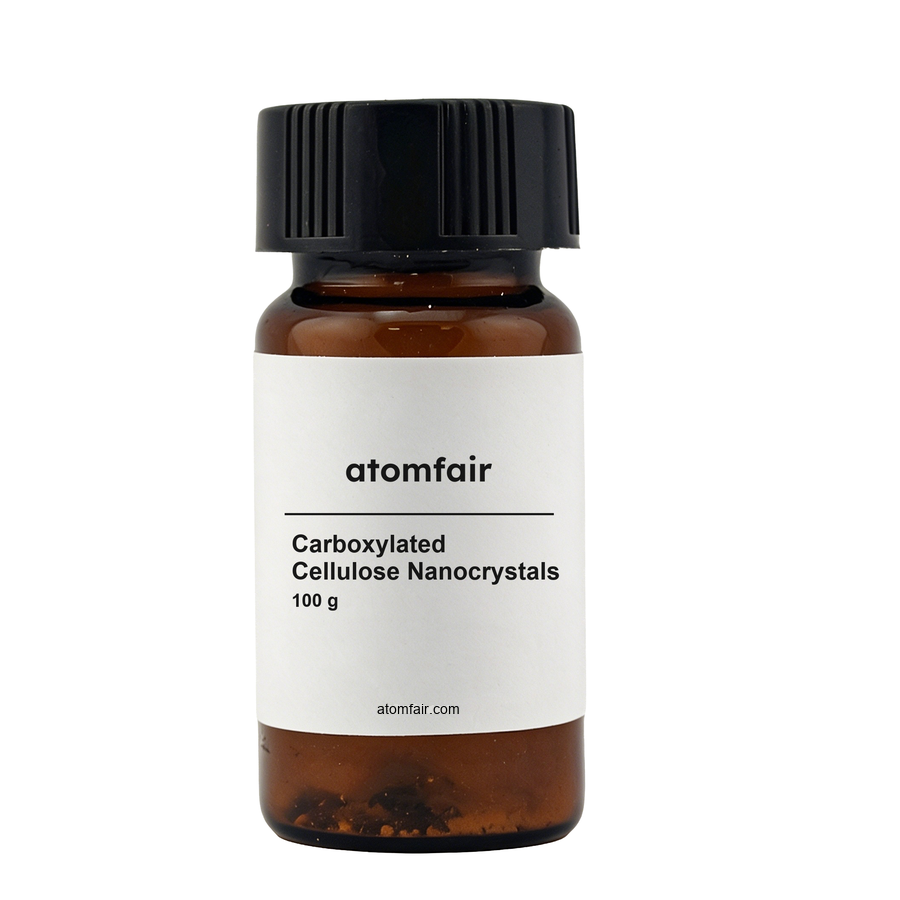
Carboxylated Cellulose Nanocrystals – CNC-MY20NP; Package 100 gProduct Type: Cellulose nanocrystals
Research-grade laboratory product
|
|||||||||||||||
|
|||||||||||||||
|
LABORATORY PROCUREMENT SUPPORT
For material selection, specification review, package confirmation, and quotation support, contact our technical sales team.
E-MAIL: inquiry@atomfair.com
|
|||||||||||||||
|
Manufacturer: Atomfair LLC
Brand: ATOMFAIR®
|
How does the carboxylation degree in CNC-MY20NP influence its surface charge and potential for electrostatic self-assembly compared to unmodified CNCs?
Carboxylated Cellulose Nanocrystals (CNC-MY20NP) contain anionic surface groups that enhance electrostatic stabilization and enable self-assembly with cationic species in aqueous media. However, the product description does not specify the exact carboxyl content (e.g., meq/g) or zeta potential. For quantitative ion-exchange capacity and surface charge data, researchers should request the certificate of analysis from Atomfair technical support.
Is CNC-MY20NP compatible with organic solvents such as dimethylformamide (DMF) for nanocomposite film casting?
Carboxylated cellulose nanocrystals are predominantly hydrophilic and exhibit optimal dispersion in water. Dispersion in polar organic solvents like DMF is not specified in the product listing; it may require additional sonication or solvent-exchange protocols. Users should experimentally verify dispersibility under their specific preparation conditions before scale-up.
What personal protective equipment (PPE) is recommended when handling dry Carboxylated Cellulose Nanocrystals CNC-MY20NP powder?
As a research-grade nanomaterial, standard laboratory PPE—including nitrile gloves, safety goggles, and a lab coat—is recommended to minimize inhalation and dermal exposure. The product description does not include a safety data sheet; therefore, researchers should follow institutional nanomaterial handling guidelines and contact Atomfair for specific safety documentation.
This carboxylated cellulose nanocrystal product in a 100 g research-grade package offers surface functional groups for covalent modification, but lacks detailed morphological and purity specifications, requiring independent verification before use in advanced applications.
Positive
- Carboxylated surface for functionalization: The carboxyl groups on the cellulose nanocrystals enable covalent attachment of biomolecules, drugs, or polymers for tailored surface chemistry in composite or biomedical research.
- 100 g package for extended studies: The 100 g package provides sufficient mass for screening multiple reaction conditions or preparing larger batches of modified nanocellulose materials.
Trade-offs
- Research-grade only: Labeled as research-grade laboratory product, not validated for clinical, diagnostic, or commercial manufacturing use without additional certification.
- Missing physical specifications: Diameter, length, concentration, and purity are not listed; buyers must request these parameters from the supplier to confirm material suitability for their specific application.
Every advanced material, component, equipment, and instrument in our catalog is backed by rigorous testing. We maintain strict internal quality management frameworks and align with CE conformity metrics to deliver transparent, reproducible performance data via our public open-science repository.
To request raw batch performance data, submit formal vendor registration paperwork, or execute a fast-turnaround R&D manufacturing loop, contact us at inquiry@atomfair.com.
Item is dispatched under the Atomfair Shipping & Delivery Framework (Free worldwide shipping on orders over $59 USD excl. heavy equipment). Return is governed by the Atomfair Return & Refund Policy (7-day technical return window).