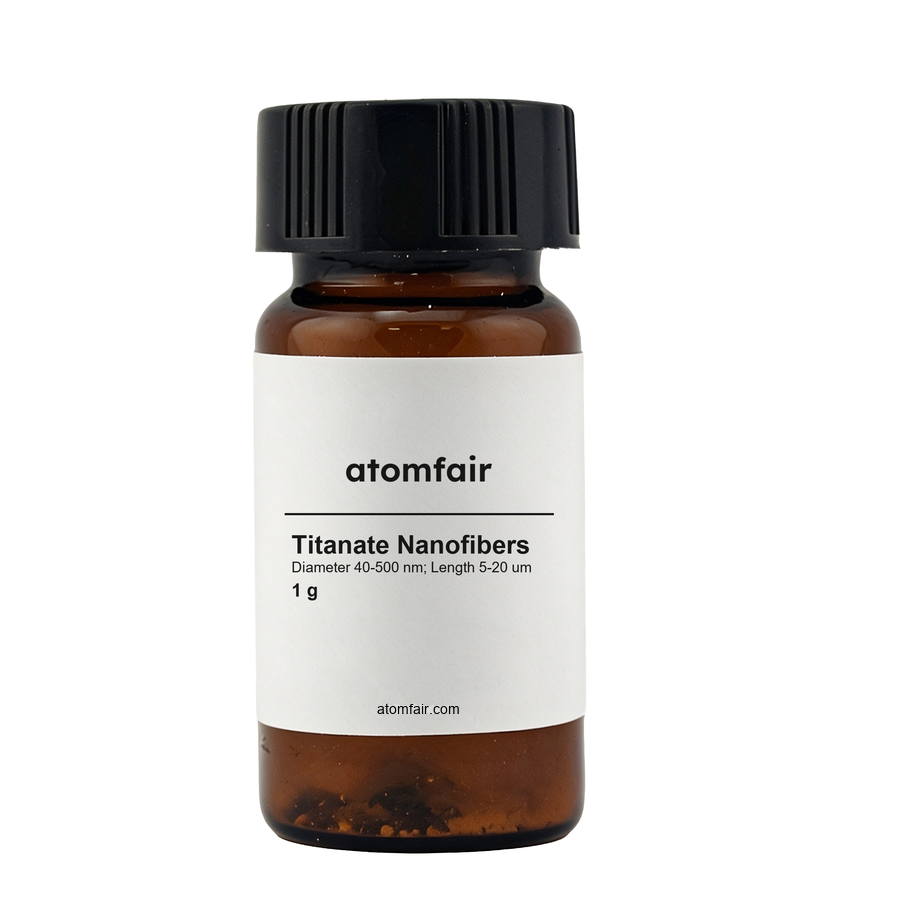
Titanate Nanofibers – Diameter 40-500 nm; Length 5-20 um; Package 1 gProduct Type: One-dimensional nanofiber material
Research-grade laboratory product
|
|||||||||||||||||
|
|||||||||||||||||
|
LABORATORY PROCUREMENT SUPPORT
For material selection, specification review, package confirmation, and quotation support, contact our technical sales team.
E-MAIL: inquiry@atomfair.com
|
|||||||||||||||||
|
Manufacturer: Atomfair LLC
Brand: ATOMFAIR®
|
How does the broad diameter range of 40–500 nm affect the specific surface area and catalytic performance of these titanate nanofibers?
The specific surface area varies inversely with fiber diameter; nanofibers near 40 nm offer significantly higher surface area than those near 500 nm. However, the product does not provide a surface area measurement or specify performance metrics, so the effective catalytic activity depends on the actual diameter distribution within the batch.
What are the typical solvent systems compatible with these titanate nanofibers for dispersion or functionalization?
The product description does not specify compatible solvents. As a research-grade one-dimensional nanomaterial, users should perform dispersion tests in target solvents (e.g., water, ethanol) and may require sonication or surface modification to achieve uniform dispersion. The diameters (40–500 nm) and lengths (5–20 µm) suggest fibers may be prone to entanglement, influencing processability.
What storage conditions are recommended to preserve the integrity of titanate nanofibers with diameters as small as 40 nm?
The product description does not state specific storage conditions. However, as a nanomaterial with diameters down to 40 nm and high aspect ratios, storage in a sealed, dry container away from moisture and static charge is advisable to prevent agglomeration and contamination. Standard nanoparticle handling with PPE and fume hood is recommended.
Titanate nanofibers with 40-500 nm diameter and 5-20 μm length offer high aspect ratio for enhanced surface interactions in catalysis and energy storage, but require careful handling due to nanoscale dimensions and limited batch size of 1 g for scale-up studies.
Positive
- High aspect ratio nanofiber morphology: The 40-500 nm diameter and 5-20 μm length provide a high surface-to-volume ratio, beneficial for applications requiring enhanced interfacial contact, such as catalysis, adsorption, or electrode materials.
- One-dimensional titanate structure: The one-dimensional nanofiber form offers anisotropic properties that can improve charge transport and mechanical reinforcement in composite materials compared to bulk or particulate titanates.
Trade-offs
- Broad diameter distribution range: The specified diameter range of 40-500 nm introduces significant polydispersity, which may affect reproducibility in applications requiring uniform fiber dimensions, such as templating or size-dependent optical properties.
- Limited package size for scale-up: The 1 g package size restricts immediate use in large-scale synthesis or pilot studies, necessitating multiple orders or bulk procurement for extended experimental campaigns.
Every advanced material, component, equipment, and instrument in our catalog is backed by rigorous testing. We maintain strict internal quality management frameworks and align with CE conformity metrics to deliver transparent, reproducible performance data via our public open-science repository.
To request raw batch performance data, submit formal vendor registration paperwork, or execute a fast-turnaround R&D manufacturing loop, contact us at inquiry@atomfair.com.
Item is dispatched under the Atomfair Shipping & Delivery Framework (Free worldwide shipping on orders over $59 USD excl. heavy equipment). Return is governed by the Atomfair Return & Refund Policy (7-day technical return window).