|
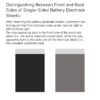
Hard Carbon Single-Sided Anode, 6.6 mg/cm² per side
Single-Sided Anode Sheet
|
||||||||||||||||||||||||||||||||||||||||
|
The electrode sheet is moisture-sensitive and requires controlled vacuum drying before thermal validation testing. The mandatory protocol is 12 hours under vacuum at 100°C to prevent moisture contamination or structural degradation.
- Vacuum baking requirement: Process and maintain the electrode sheets for 12 hours under vacuum at 100°C before thermal validation testing workflows.
- Moisture contamination prevention: Maintain strictly vacuum conditions throughout the baking protocol to completely prevent moisture contamination.
- Structural degradation prevention: Complete the full vacuum drying cycle before thermal validation testing to avoid structural degradation of the electrode sheet.
This protocol describes the required vacuum drying treatment for Atomfair HC-S04 hard carbon electrode sheets before thermal validation testing. The sheets must be processed and maintained under vacuum at 100°C for 12 hours.
Required Equipment: Vacuum oven capable of maintaining 100°C
- Set vacuum oven conditions
Set the vacuum oven to maintain 100°C under vacuum for the drying cycle. - Load electrode sheets
Load the electrode sheets into the vacuum oven for the baking protocol. - Maintain drying cycle
Maintain the electrode sheets under vacuum at 100°C for 12 hours to prevent moisture contamination or structural degradation.
How does the active material ratio of 94.5% in the HC-S04 hard carbon electrode sheet affect its electrochemical performance for sodium-ion battery applications?
The high active material ratio of 94.5% ensures a capacity of 300 mAh/g and minimizes binder/additive interference, providing reliable electrochemical performance. The uniform coating density of 6.6 mg/cm² further supports consistent cell-to-cell results in sodium-ion battery research.
What substrate and current collector configuration does the HC-S04 electrode sheet use, and what are the implications for cell assembly?
The HC-S04 electrode uses a carbon-coated aluminum foil substrate with a current collector density of 3.3 mg/cm² and a substrate thickness of 12+0.5+0.5 μm. This configuration ensures low contact resistance and excellent adhesion, but the single-sided coating requires careful handling to avoid damage during cell assembly.
What is the recommended drying protocol for the HC-S04 hard carbon electrode sheet to ensure optimal performance?
The recommended protocol is to bake the electrode sheets under vacuum at 100°C for 12 hours to eliminate moisture and prevent structural degradation. This step is critical before any thermal validation testing workflows to maintain material integrity.
The Atomfair HC-S04 hard carbon electrode sheet offers a 94.5% active material loading on a carbon-coated aluminum foil substrate, providing consistent 6.6 mg/cm² coating for sodium-ion battery research. However, it requires a 12-hour vacuum baking at 100°C to prevent moisture contamination and is single-sided coated, which may limit cell assembly options.
Positive
- High active material purity: The 94.50% hard carbon active material ratio ensures targeted electronic pathways and reliable half-cell testing control.
- Stable carbon-coated aluminum substrate: Carbon-coated aluminum foil provides excellent active layer adhesion, secure electrical contact, and reduced contact resistance.
Trade-offs
- Mandatory vacuum baking protocol: The electrode sheets must be baked under vacuum at 100°C for 12 hours to prevent moisture contamination or structural degradation before use.
- Single-sided coating limitation: The single-sided coating on a 110 × 80 mm active area may restrict configurations requiring double-sided electrodes for full-cell assembly.
Every advanced material, component, equipment, and instrument in our catalog is backed by rigorous testing. We maintain strict internal quality management frameworks and align with CE conformity metrics to deliver transparent, reproducible performance data via our public open-science repository.
To request raw batch performance data, submit formal vendor registration paperwork, or execute a fast-turnaround R&D manufacturing loop, contact us at inquiry@atomfair.com.
Item is dispatched under the Atomfair Shipping & Delivery Framework (Free worldwide shipping on orders over $59 USD excl. heavy equipment). Return is governed by the Atomfair Return & Refund Policy (7-day technical return window).