|
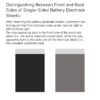
Hard Carbon Electrode S01, 5 mg/cm² per side
Battery Electrode Sheet
|
||||||||||||||||||||||||||||||||||||||||||||
|
The electrode sheets require strict moisture control to prevent structural degradation. A mandatory vacuum baking protocol at 100°C for 12 hours is required before thermal validation testing.
- Moisture Sensitivity: Exposure to moisture can cause structural degradation of the electrode sheets.
- Pre-Testing Baking Requirement: The sheets must be baked under vacuum at 100°C for 12 hours to mitigate moisture contamination.
- Infrastructure Requirement: A vacuum oven capable of maintaining 100°C is required for the baking protocol.
The electrode sheets must be processed under vacuum at 100°C for 12 hours to remove moisture. This protocol prevents structural degradation before testing.
Required Equipment: Vacuum oven
- Place sheets in oven
Place the electrode sheets inside the vacuum oven. - Set temperature
Set the oven temperature to 100°C. - Evacuate oven
Evacuate the oven to achieve the required vacuum. - Maintain conditions
Maintain the vacuum and temperature for 12 hours. - Cool and store
After completion, cool the sheets and store them in a dry environment.
What is the compaction density of the Atomfair HC-S01 hard carbon electrode sheet and how does it influence capacity retention in sodium-ion half-cell testing?
The compaction density is 0.91 g/cm³. This parameter, combined with the 94.5% active material ratio and single-sided coating at 5 mg/cm², is designed to balance porosity and electronic conductivity for consistent electrochemical performance in SIB R&D, as specified in the product's technical data.
What substrate material is used for the HC-S01 electrode sheet and why is it selected for sodium-ion battery research?
The substrate is a carbon-coated aluminum foil matrix crystals with a current collector density of 3.53 mg/cm² and total thickness of 12 + 0.5 + 0.5 μm. The carbon coating improves contact resistance and layer adhesion, ensuring structural durability for SIB characterization, as stated in the product's key features.
What is the required baking protocol for the HC-S01 hard carbon electrode sheet before use in electrochemical testing?
The recommended protocol is to bake the electrode sheets under vacuum at 100°C for 12 hours to mitigate moisture contamination and structural degradation before thermal validation testing workflows, as specified in the product's logistics and operational notice.
The HC-S01 hard carbon electrode sheet delivers a 94.50% active material ratio with single-side wet-process coating at 5 mg/cm² on carbon-coated aluminum foil, providing a consistent anode platform for sodium-ion battery half-cell testing. Its 300 mAh/g rated capacity and 0.91 g/cm³ compaction density support reproducible electrochemical characterization, provided the mandatory 12-hour vacuum drying at 100°C is performed before use.
Positive
- High active material uniformity: The 94.50% active material ratio with wet-process single-side coating ensures a uniform hard carbon distribution across the 152 × 110 mm active area, supporting consistent half-cell baseline data.
- Carbon-coated foil improves interface: The carbon-coated aluminum foil substrate enhances contact resistance and layer adhesion, contributing to structural durability during sodium-ion battery characterization.
Trade-offs
- Mandatory vacuum drying protocol: The electrode sheets require processing for 12 hours under vacuum at 100°C before use to mitigate moisture contamination and prevent structural degradation during thermal validation workflows.
- Laboratory research scope only: This product is sold exclusively for laboratory research use, limiting deployment to R&D benchmarking and electrochemical analysis rather than production-scale or clinical applications.
Every advanced material, component, equipment, and instrument in our catalog is backed by rigorous testing. We maintain strict internal quality management frameworks and align with CE conformity metrics to deliver transparent, reproducible performance data via our public open-science repository.
To request raw batch performance data, submit formal vendor registration paperwork, or execute a fast-turnaround R&D manufacturing loop, contact us at inquiry@atomfair.com.
Item is dispatched under the Atomfair Shipping & Delivery Framework (Free worldwide shipping on orders over $59 USD excl. heavy equipment). Return is governed by the Atomfair Return & Refund Policy (7-day technical return window).