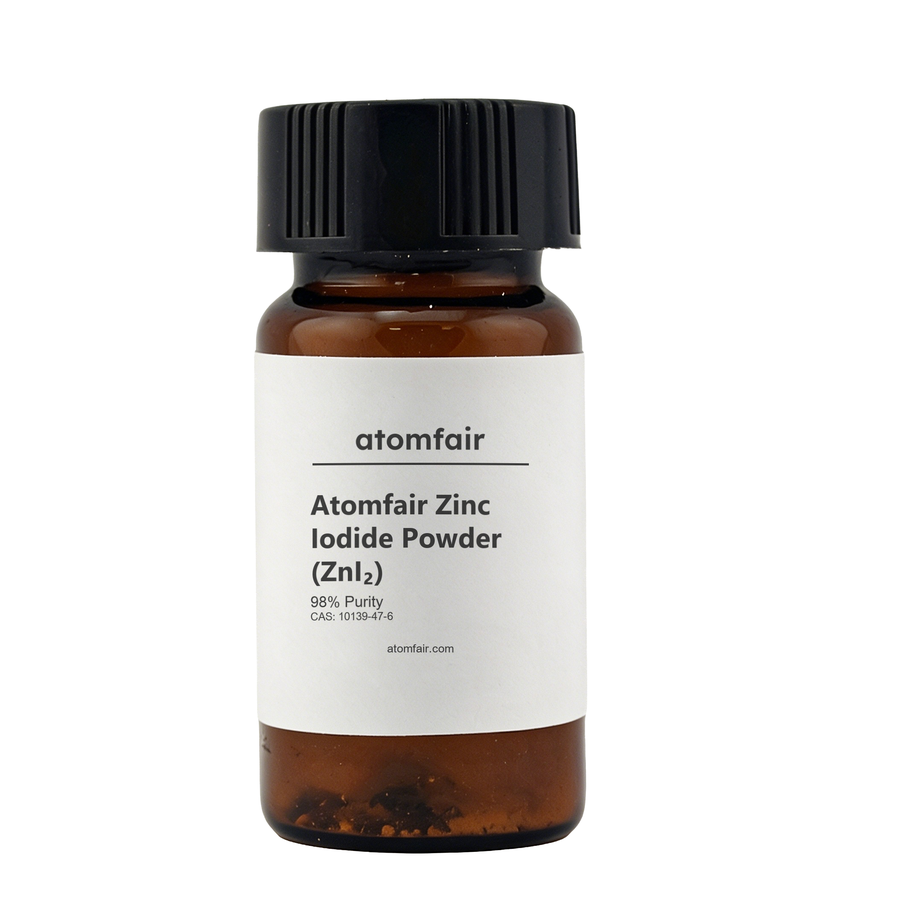
Atomfair Zinc Iodide Powder (ZnI₂), 98% Purity
Product Description
Atomfair zinc iodide (ZnI₂) is supplied as a white solid with 98% purity. It is intended for research on X-ray opaque penetrants, zinc-halogen battery electrolytes, and electron-microscopy staining.
Technical Specifications
| PARAMETER DETAILS | |
|---|---|
| Product | Zinc Iodide Powder (ZnI2) |
| Material | Zinc Iodide |
| Chemical Formula | ZnI2 |
| CAS Number | 10139-47-6 |
| Purity | 98% |
| Physical State | Powder |
| Appearance | White solid |
| EC / EINECS Number | 233-396-0 |
| Molar Mass | 319.22 g/mol |
| Density | 4.74 g/cm³ |
| Melting Point | 446 °C |
| Boiling Point | 1150 °C (decomposes) |
| Water Solubility | 450 g/100 mL at 20 °C |
| Crystal Structure | Tetragonal, tI96 |
| Moisture Sensitivity | Readily absorbs moisture from air |
Key Features and Advantages
- 98% purity.
- White solid.
APPLICATION SCOPE: X-ray opaque penetrants, zinc-halogen battery electrolytes, and electron-microscopy staining
DOCUMENTATION: COA and SDS can be provided upon request for batch-specific confirmation.
TAILORED SOLUTIONS FOR RESEARCH
For product specifications and quotation support, contact the Atomfair team.
Zinc iodide powder readily absorbs moisture from air, requiring storage under dry conditions to prevent degradation. For research applications, handling under inert atmosphere is recommended to preserve material integrity and performance.
- Moisture Sensitivity: The material must be kept in a sealed container with desiccant to prevent moisture absorption and caking.
- Battery Electrolyte Use: For zinc-halogen battery electrolyte preparation, use anhydrous solvents and glovebox conditions to avoid water contamination.
- Electron Microscopy Staining: Electron-microscopy staining requires the powder to be dissolved in high-purity water immediately before use to avoid hydrolysis.
- Thermal Decomposition: Avoid exposure to temperatures above 1150°C as the material decomposes.
- Handling Procedure: When opening the container, minimize exposure to ambient humidity by working quickly and resealing promptly.
What is the water solubility of Atomfair Zinc Iodide powder and how does this facilitate electrolyte or staining solution preparation?
Zinc Iodide has a water solubility of 450 g/100 mL at 20 °C, making it highly soluble in water. This allows straightforward preparation of concentrated aqueous solutions for zinc-halogen battery electrolytes and electron-microscopy staining formulations. The high solubility also supports the development of X-ray opaque penetrants without requiring organic solvents.
How should Atomfair Zinc Iodide powder be stored to prevent moisture absorption and maintain experimental consistency?
The product readily absorbs moisture from air, which can alter its chemical behavior. It should be stored in a tightly sealed container in a dry environment, ideally under inert gas or within a desiccator. The manufacturer provides COA and SDS upon request for batch-specific handling and stability guidance.
What is the melting and decomposition behavior of Zinc Iodide, and why is this relevant for thermal processing or high-temperature electrolyte studies?
Zinc Iodide has a melting point of 446 °C and decomposes at 1150 °C. This thermal stability window is relevant for evaluating its use in high-temperature battery electrolyte systems or for processes requiring thermal activation. Researchers should note that decomposition occurs at the boiling point, limiting operation above 1150 °C without chemical breakdown.
Atomfair Zinc Iodide Powder (ZnI₂) at 98% purity is evaluated for research applications in X-ray opaque penetrants, zinc-halogen battery electrolytes, and electron-microscopy staining, with high water solubility (450 g/100 mL at 20 °C) enabling concentrated electrolyte preparation, but requiring strict moisture control due to its hygroscopic nature.
Positive
- High water solubility for electrolytes: With a solubility of 450 g/100 mL at 20 °C, ZnI₂ enables preparation of highly concentrated aqueous solutions, beneficial for zinc-halogen battery electrolyte formulations where high ionic conductivity is desired.
- Multipurpose research applicability: The material supports three distinct research domains—X-ray opaque penetrants, zinc-halogen battery electrolytes, and electron-microscopy staining—offering versatility for labs exploring imaging or energy storage.
Trade-offs
- Moisture sensitivity requires dry handling: ZnI₂ readily absorbs moisture from air, necessitating storage in a desiccated environment and handling under inert atmosphere to prevent hydration or degradation, adding to laboratory infrastructure requirements.
- 98% purity limits high-precision applications: The 98% purity level may introduce trace impurities that could affect reproducibility in sensitive electrochemical or staining protocols, requiring batch-specific COA verification for critical research.
Every advanced material, component, equipment, and instrument in our catalog is backed by rigorous testing. We maintain strict internal quality management frameworks and align with CE conformity metrics to deliver transparent, reproducible performance data via our public open-science repository.
To request raw batch performance data, submit formal vendor registration paperwork, or execute a fast-turnaround R&D manufacturing loop, contact us at inquiry@atomfair.com.
Item is dispatched under the Atomfair Shipping & Delivery Framework (Free worldwide shipping on orders over $59 USD excl. heavy equipment). Return is governed by the Atomfair Return & Refund Policy (7-day technical return window).