|
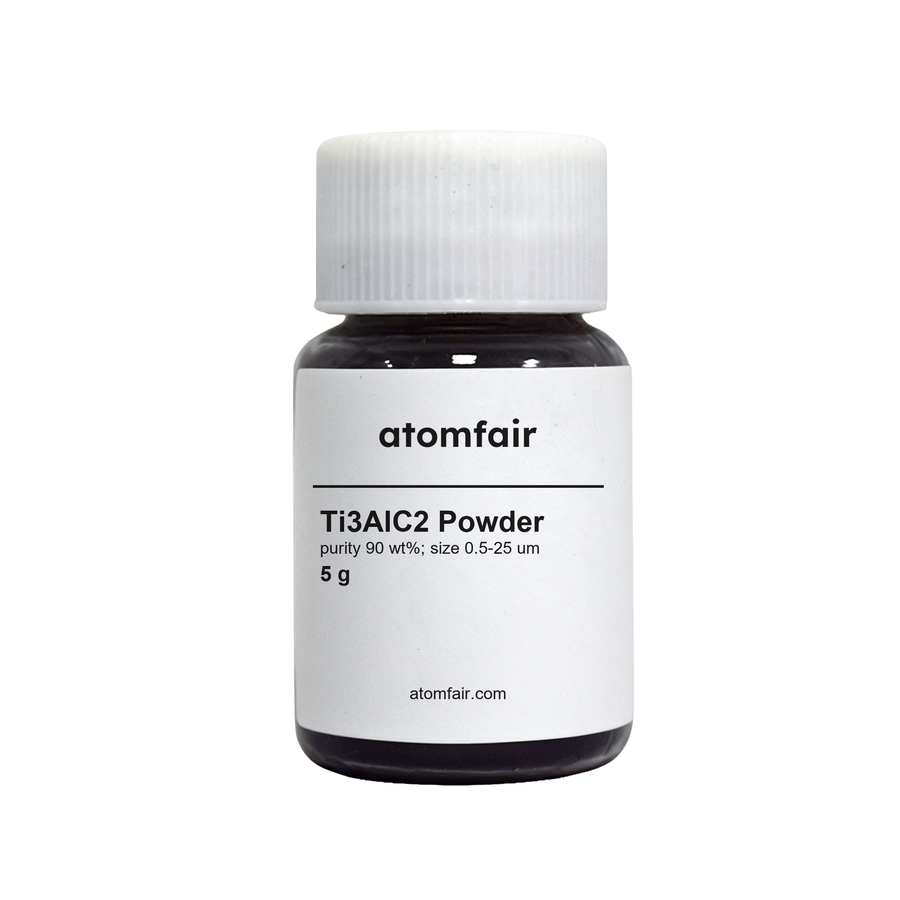
Ti3AlC2 Powder, 5 g
Product Type: MAX phase ceramic powder
Research-grade laboratory product
|
|||||||||||||||||
|
|||||||||||||||||
|
LABORATORY PROCUREMENT SUPPORT
For material selection, specification confirmation and package-size quotation support, contact our technical sales team.
E-MAIL: inquiry@atomfair.com
|
|||||||||||||||||
|
Manufacturer: Atomfair LLC
Brand: ATOMFAIR®
|
What is the phase purity and particle size distribution of Ti3AlC2 MAX phase powder, and how do these parameters affect its use in high-temperature ceramic matrix composites?
The Ti3AlC2 powder is supplied at 90 wt% purity with a particle size range of 0.5–25 µm. This broad distribution can influence packing density and sintering behavior in composite fabrication; finer fractions may enhance reactivity while larger particles can improve fracture toughness, requiring careful sieving or classification for specific composite processing routes.
Can this Ti3AlC2 powder be directly integrated into a molten salt synthesis or spark plasma sintering workflow without additional purification?
The 90 wt% purity level indicates the presence of secondary phases such as TiC or Al2O3, which may act as nucleation sites or contaminants in sensitive sintering or synthesis processes. For applications requiring phase-pure MAX phase, additional purification steps like acid leaching or thermal treatment may be necessary before integration into spark plasma sintering or molten salt synthesis.
What storage and handling precautions are required for Ti3AlC2 powder to prevent oxidation or moisture uptake before use?
As a MAX phase ceramic powder with a 0.5–25 µm particle size, Ti3AlC2 has a high surface area that can promote slow oxidation in ambient air and moisture absorption. It should be stored in an airtight, desiccated container under inert gas (e.g., argon) and handled in a glovebox or dry room to preserve phase integrity and avoid surface degradation prior to high-temperature processing.
Ti3AlC2 MAX phase ceramic powder (90 wt% purity, 0.5–25 µm particle size, 5 g package) is evaluated for research-scale synthesis of MXene precursors, where phase purity and particle size distribution directly affect etching yield and delamination efficiency.
Positive
- Broad particle size range: The 0.5–25 µm size distribution provides flexibility for optimizing selective etching kinetics, as finer fractions enhance surface area while larger particles may reduce over-etching in HF-based protocols.
- Research-scale packaging: The 5 g package is appropriate for exploratory synthesis batches, minimizing material waste and cost during method development or small-scale MXene production.
Trade-offs
- Moderate purity constraint: At 90 wt% purity, residual secondary phases (e.g., TiC or Al2O3) may interfere with etching uniformity and require post-synthesis purification steps for high-quality MXene monolayers.
- Polydisperse particle distribution: The wide 0.5–25 µm range without specified D10/D50/D90 values introduces batch-to-batch variability in etching behavior, necessitating pre-characterization for reproducible MXene synthesis.
Every advanced material, component, equipment, and instrument in our catalog is backed by rigorous testing. We maintain strict internal quality management frameworks and align with CE conformity metrics to deliver transparent, reproducible performance data via our public open-science repository.
To request raw batch performance data, submit formal vendor registration paperwork, or execute a fast-turnaround R&D manufacturing loop, contact us at inquiry@atomfair.com.
Item is dispatched under the Atomfair Shipping & Delivery Framework (Free worldwide shipping on orders over $59 USD excl. heavy equipment). Return is governed by the Atomfair Return & Refund Policy (7-day technical return window).