|
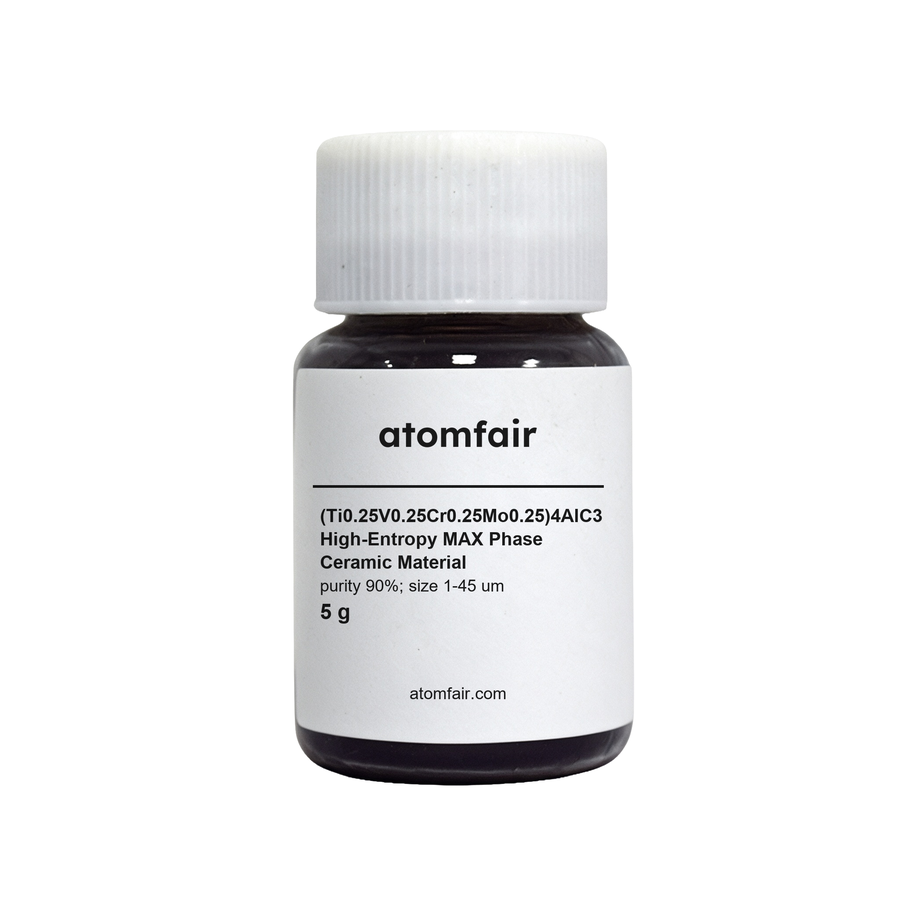
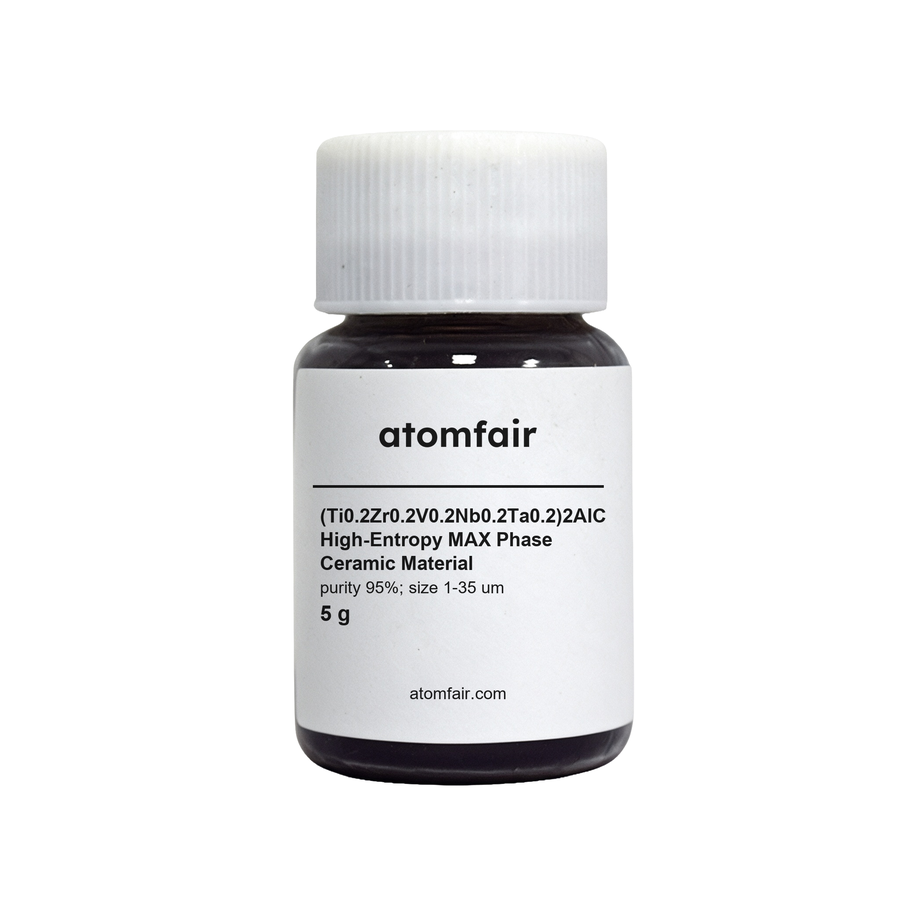
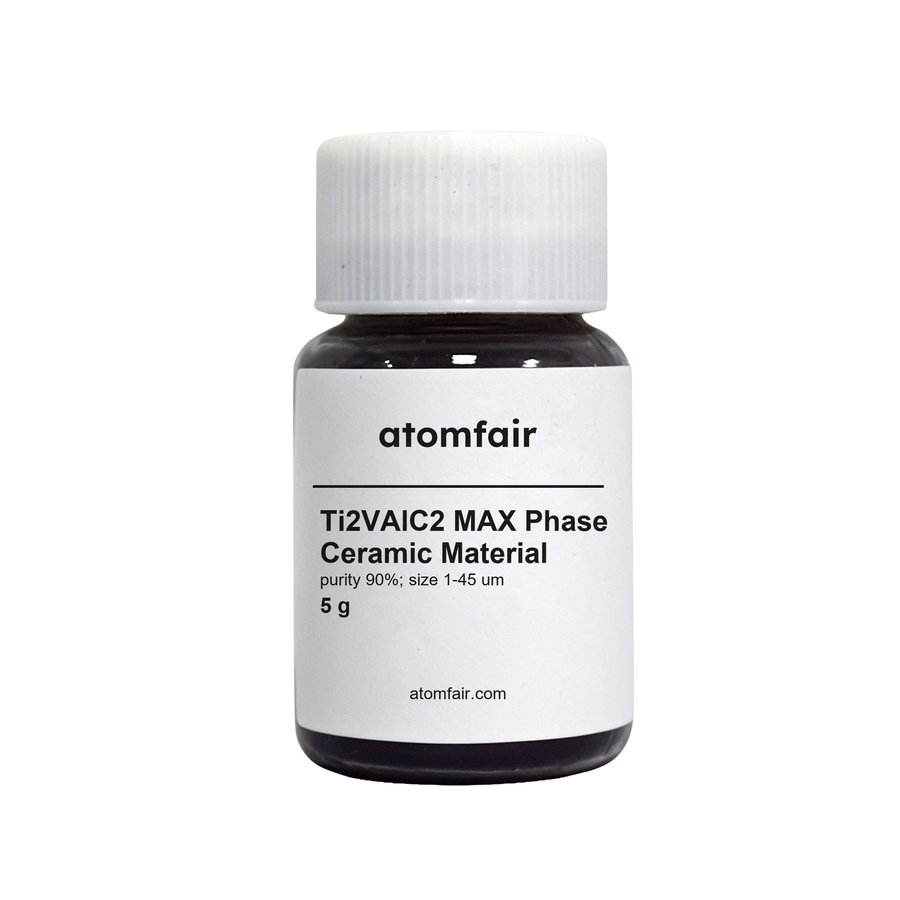
Ti2VAlC2 MAX Phase Ceramic Material, 5 g
Product Type: MAX phase ceramic powder
Research-grade laboratory product
|
|||||||||||||||||||
|
|||||||||||||||||||
|
LABORATORY PROCUREMENT SUPPORT
For material selection, specification confirmation and package-size quotation support, contact our technical sales team.
E-MAIL: inquiry@atomfair.com
|
|||||||||||||||||||
|
Manufacturer: Atomfair LLC
Brand: ATOMFAIR®
|
What does the 90% purity specification mean for Ti2VAlC2 MAX phase ceramic powder in research applications?
The 90% purity indicates that the powder contains at least 90% by weight of the Ti2VAlC2 MAX phase, with the remainder consisting of secondary phases or amorphous content. This purity level is explicitly stated in the product description for the 1–45 µm particle size fraction, making it suitable for research where phase purity is a known variable. Researchers should verify that this purity meets the requirements of their specific experiment, especially for studies sensitive to phase composition, such as mechanical or electronic property measurements.
How does the 1–45 µm particle size range of Ti2VAlC2 MAX phase powder affect its suitability for ceramic processing?
The particle size range of 1–45 µm includes both fine and coarse particles, which can influence powder packing density, sintering behavior, and mixing uniformity with other powders. The product description specifies this size range, and no narrower cut is offered. For applications requiring a specific size distribution—such as tape casting, additive manufacturing, or controlled rheology—additional sieving or milling may be necessary to achieve the desired fraction.
Ti2VAlC2 MAX phase ceramic powder (90% purity, 1–45 µm, 5 g) offers a layered ternary carbide structure suitable for high-temperature and radiation-tolerant applications, but the 90% purity level and broad particle size distribution impose constraints on phase-purity-sensitive experiments and downstream processing uniformity.
Positive
- MAX phase layered structure: Ti2VAlC2 belongs to the MAX phase family, combining metallic conductivity with ceramic thermal stability and machinability, enabling use in high-temperature coatings, nuclear cladding, and oxidation-resistant composites.
- Broad particle size range: The 1–45 µm size distribution provides flexibility for both powder compaction (sintering) and dispersion-based processing, accommodating diverse lab-scale forming methods.
Trade-offs
- 90% purity limitation: At 90% purity, residual secondary phases (e.g., unreacted carbides or intermetallics) may interfere with property measurements or phase-purity-dependent applications, requiring post-synthesis characterization.
- Broad particle size distribution: The 1–45 µm range without specified D10/D50/D90 values introduces variability in packing density and sintering behavior, necessitating sieving or classification for uniform results in thin-film or additive manufacturing processes.
Every advanced material, component, equipment, and instrument in our catalog is backed by rigorous testing. We maintain strict internal quality management frameworks and align with CE conformity metrics to deliver transparent, reproducible performance data via our public open-science repository.
To request raw batch performance data, submit formal vendor registration paperwork, or execute a fast-turnaround R&D manufacturing loop, contact us at inquiry@atomfair.com.
Item is dispatched under the Atomfair Shipping & Delivery Framework (Free worldwide shipping on orders over $59 USD excl. heavy equipment). Return is governed by the Atomfair Return & Refund Policy (7-day technical return window).