|
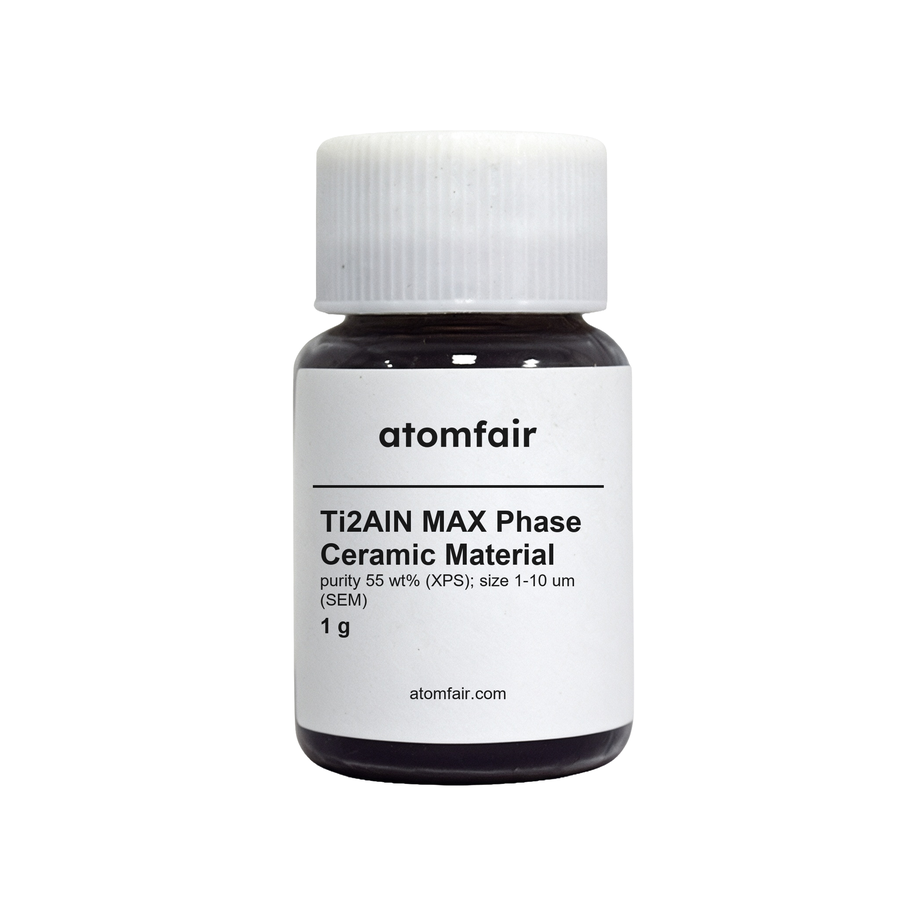
Ti2AlN MAX Phase Ceramic Material, 1 g
Product Type: MAX phase ceramic powder
Research-grade laboratory product
|
|||||||||||||||||
|
|||||||||||||||||
|
LABORATORY PROCUREMENT SUPPORT
For material selection, specification confirmation and package-size quotation support, contact our technical sales team.
E-MAIL: inquiry@atomfair.com
|
|||||||||||||||||
|
Manufacturer: Atomfair LLC
Brand: ATOMFAIR®
|
How is the purity of Ti2AlN MAX phase ceramic powder measured at 55 wt% by XPS, and what limitations does this technique have compared to XRD for phase quantification?
The purity of 55 wt% is determined by X-ray photoelectron spectroscopy (XPS), which is a surface-sensitive technique. XPS quantifies the elemental composition and chemical states on the surface (typically 1-10 nm depth), so the reported 55 wt% reflects the Ti2AlN phase content within the surface region. For bulk phase quantification, X-ray diffraction (XRD) is often used complementarily, but the source data only provides XPS results. Researchers should consider the surface sensitivity when interpreting purity for applications requiring bulk material properties.
What is the particle size range of 1-10 µm (SEM) for Ti2AlN MAX phase powder, and how does it affect downstream processing such as sintering or composite fabrication?
The particle size is specified as 1-10 µm as measured by scanning electron microscopy (SEM). This submicron-to-micron range is typical for MAX phase ceramics and is suitable for processes like spark plasma sintering, hot pressing, or as a filler in composite materials. The broad size distribution can influence packing density and sintering kinetics; finer particles (<5 µm) may enhance reactivity but also increase agglomeration. The 1 g package size is intended for research-scale evaluation of these effects.
Ti2AlN MAX phase ceramic powder at 55 wt% purity (XPS) and 1–10 µm particle size (SEM) offers a layered ternary carbide/nitride structure suitable for high-temperature structural or electrical contact applications, though the moderate phase purity and sub-10 µm distribution impose constraints on homogeneity and sintering behavior.
Positive
- Layered ternary carbide structure: Ti2AlN MAX phase combines metallic conductivity with ceramic thermal stability, enabling use in high-temperature coatings, electrical contacts, and radiation-resistant components.
- Fine particle size range: The 1–10 µm (SEM) distribution supports uniform dispersion in composite formulations and facilitates densification during spark plasma sintering or hot pressing.
Trade-offs
- Moderate phase purity: At 55 wt% (XPS), the material contains significant secondary phases, which may affect reproducibility in property-critical applications and require additional purification or characterization.
- Small research-scale package: The 1 g package limits use to proof-of-concept or small-batch trials; scale-up requires multiple units and careful batch-to-batch consistency verification.
Every advanced material, component, equipment, and instrument in our catalog is backed by rigorous testing. We maintain strict internal quality management frameworks and align with CE conformity metrics to deliver transparent, reproducible performance data via our public open-science repository.
To request raw batch performance data, submit formal vendor registration paperwork, or execute a fast-turnaround R&D manufacturing loop, contact us at inquiry@atomfair.com.
Item is dispatched under the Atomfair Shipping & Delivery Framework (Free worldwide shipping on orders over $59 USD excl. heavy equipment). Return is governed by the Atomfair Return & Refund Policy (7-day technical return window).