|
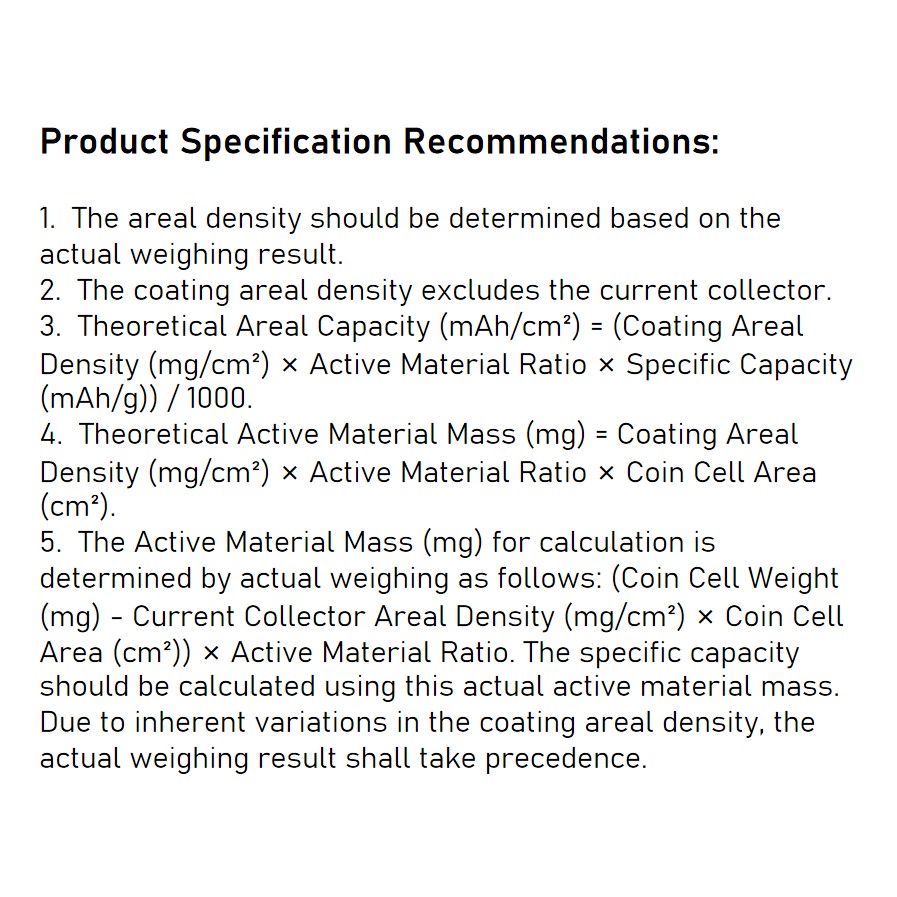
NVP Sodium Vanadium Phosphate Single-Sided Cathode, 5 mg/cm² per side
Single-Sided Cathode Sheet
|
||||||||||||||||||||||||||||||||||||||||||
|
This electrode sheet is sensitive to ambient exposure, which can cause phase contamination and structural degradation. It must be baked under vacuum at 100°C for 12 hours prior to thermal validation to ensure material integrity.
- Ambient Exposure Risk: Ambient exposure can introduce phase contamination and structural degradation, compromising electrochemical performance.
- Baking Requirement: Vacuum baking at 100°C for 12 hours is mandatory to prevent ambient phase contamination and structural degradation.
- Research Use Only: This product is sold exclusively for laboratory research and not for clinical or commercial applications.
This procedure outlines the required vacuum baking step to prevent ambient contamination and structural degradation. Follow these steps to ensure proper conditioning of the electrode sheet before thermal validation.
Required Equipment: Vacuum oven capable of maintaining 100°C
- Transfer sheets to vacuum oven
Transfer the electrode sheets into a vacuum oven capable of reaching 100°C. - Set temperature
Set the oven temperature to 100°C. - Evacuate chamber
Evacuate the oven chamber to achieve vacuum conditions. - Maintain conditions
Maintain the vacuum and temperature for 12 hours without interruption. - Cool and remove
Allow the sheets to cool within the vacuum oven before removal for use.
How does the 93.5% active material ratio in the NVP-S01 electrode sheet influence electrochemical performance?
The 93.5% active material ratio ensures a robust, highly uniform NVP distribution across the electrode coating. This high ratio minimizes binder and conductive additive content, which can enhance the accessible capacity per unit mass and reduce internal resistance, thereby improving charge-discharge rate capability and overall cell-to-cell consistency in sodium-ion battery R&D testing.
Is the NVP-S01 electrode sheet optimized for half-cell or full-cell sodium-ion battery configurations?
The NVP-S01 electrode sheet is designed primarily for half-cell testing and baseline evaluation in sodium-ion battery R&D. Its single-sided coating on a carbon-coated aluminum foil substrate allows direct integration into standard coin-cell half cells with a sodium metal counter electrode. The sheet can also be used in full-cell configurations, but the single-sided nature and 5 mg/cm² loading are tailored for eliminating variables and validating electrolyte performance in controlled laboratory studies.
What is the required pre-drying protocol for the NVP-S01 electrode sheet before use?
The recommended baking protocol is to maintain the electrode sheet under vacuum at 100°C for 12 hours. This step is critical to prevent ambient phase contamination or structural degradation of the sodium vanadium phosphate coating, ensuring reliable electrochemical performance during thermal validation and subsequent testing.
The Atomfair NVP-S01 Sodium Vanadium Phosphate Electrode Sheet is a single-side coated cathode designed for sodium-ion battery R&D, featuring a 93.5% active material ratio, 5 mg/cm² coating density by wet process, and a carbon-coated aluminum foil substrate, delivering consistent electrochemical performance for baseline testing and electrolyte validation. The product requires a 12-hour vacuum bake at 100°C before use to prevent phase contamination.
Positive
- High active material purity: The 93.50% active material ratio ensures a homogeneous NVP distribution, reducing variability in half-cell evaluations.
- Precision wet coating uniformity: The wet process delivers a consistent 5 mg/cm² loading across the 152 × 100 mm active area, supporting reliable electrochemical data.
Trade-offs
- Mandatory vacuum baking protocol: A 12-hour vacuum bake at 100°C is required before use to avoid ambient phase contamination or structural degradation, adding preparation time.
- Single-sided coating limitation: The electrode is coated on only one side, which may restrict certain cell configurations or require additional handling for double-sided use.
Every advanced material, component, equipment, and instrument in our catalog is backed by rigorous testing. We maintain strict internal quality management frameworks and align with CE conformity metrics to deliver transparent, reproducible performance data via our public open-science repository.
To request raw batch performance data, submit formal vendor registration paperwork, or execute a fast-turnaround R&D manufacturing loop, contact us at inquiry@atomfair.com.
Item is dispatched under the Atomfair Shipping & Delivery Framework (Free worldwide shipping on orders over $59 USD excl. heavy equipment). Return is governed by the Atomfair Return & Refund Policy (7-day technical return window).