|
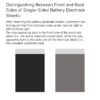
Sodium Vanadium Phosphate Electrode, 26mg/cm² per side
Battery Electrode Sheet
|
||||||||||||||||||||||||||||||||||||||||||||
|
This electrode sheet requires vacuum baking at 100°C for 12 hours before cell assembly to remove adsorbed volatiles. Storage must be vacuum-sealed to preserve material integrity and minimize environmental contamination.
- Vacuum baking: Bake the electrode sheet at 100°C under vacuum for 12 hours prior to cell assembly.
- Storage: Keep sheets vacuum-sealed until use to prevent moisture and volatile pickup.
What is the specific capacity and active material loading of the Atomfair NVP-D04 electrode sheet?
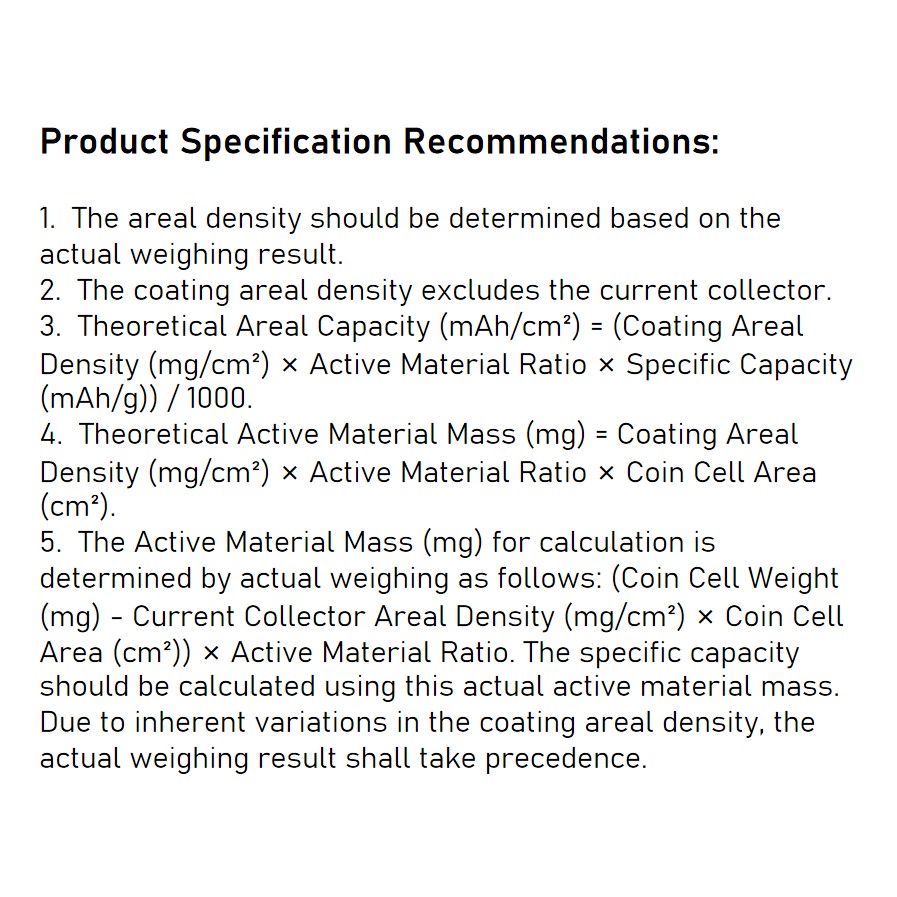
The NVP-D04 electrode sheet has a specific capacity of 110 mAh/g with an active material ratio of 92.00% and a coating density of 26 mg/cm². This ensures high electrochemical efficacy for sodium-ion intercalation pathways.
What substrate material is used in the NVP-D04 electrode sheet and why?
The NVP-D04 uses a carbon-coated aluminum foil substrate with a current collector areal density of 3.63 mg/cm² and a substrate thickness of 12 + 0.5 + 0.5 μm. The carbon coating minimizes internal contact resistance and improves long-term cycling stability limits.
What is the recommended storage and pre-treatment procedure for the NVP-D04 electrode sheet?
The electrode sheets are vacuum-sealed and shipped 5 per pack to maintain material consistency. Before cell assembly, a baking protocol of 12 hours under vacuum at 100°C is recommended to remove environmental volatile layers.
The Atomfair NVP-D04 sodium vanadium phosphate electrode sheet, double-side coated at 26 mg/cm² with 92% active material on carbon-coated aluminum foil, offers high active material loading and reduced contact resistance for sodium-ion battery research, but requires strict vacuum baking pretreatment and storage in vacuum-sealed conditions.
Positive
- High Active Material Loading: 92.00% active material ratio maximizes electrochemical efficacy for robust sodium-ion intercalation pathways.
- Enhanced Conductivity Matrix: Carbon-coated aluminum substrate minimizes internal contact resistance and improves long-term cycling stability.
Trade-offs
- Vacuum Baking Preconditioning Required: Electrode sheet must be baked under vacuum at 100°C for 12 hours before cell assembly to remove environmental volatile layers.
- Storage Sensitivity: Requires vacuum-sealed packaging and dedicated storage care to maintain material consistency and performance.
Every advanced material, component, equipment, and instrument in our catalog is backed by rigorous testing. We maintain strict internal quality management frameworks and align with CE conformity metrics to deliver transparent, reproducible performance data via our public open-science repository.
To request raw batch performance data, submit formal vendor registration paperwork, or execute a fast-turnaround R&D manufacturing loop, contact us at inquiry@atomfair.com.
Item is dispatched under the Atomfair Shipping & Delivery Framework (Free worldwide shipping on orders over $59 USD excl. heavy equipment). Return is governed by the Atomfair Return & Refund Policy (7-day technical return window).