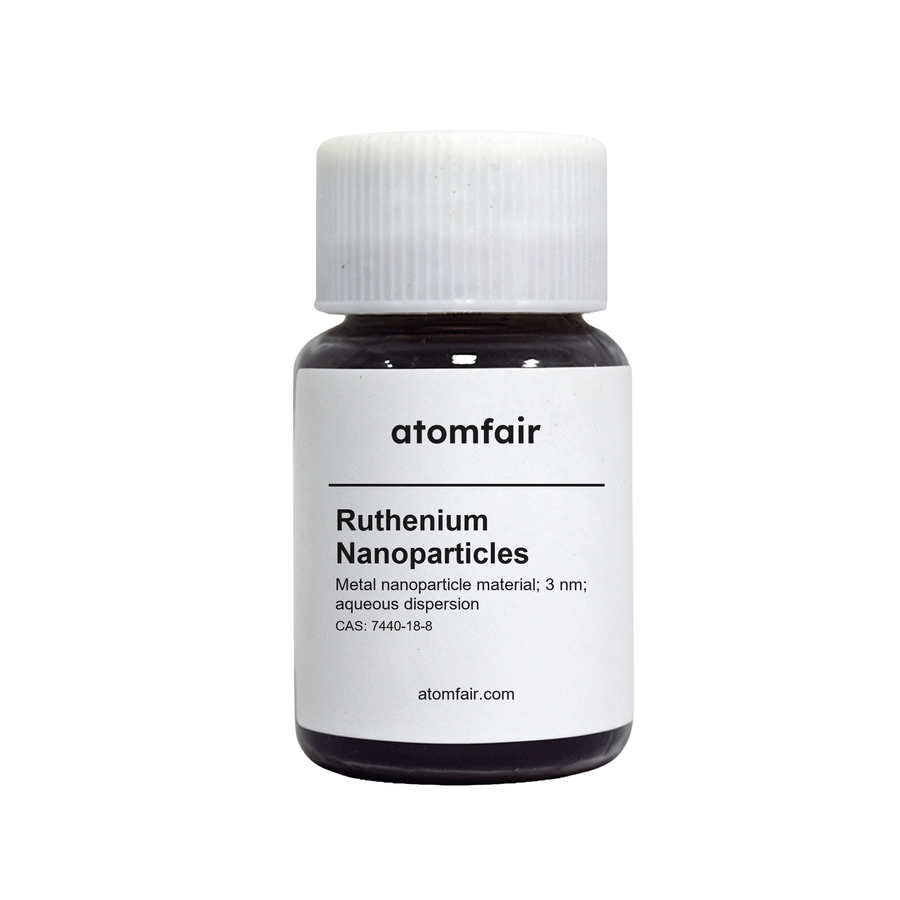
RUTHENIUM NANOPARTICLES 3 NM 3NM RESEARCH GRADE NANOMATERIALRESEARCH GRADE MATERIAL
|
|||||||||||||||||||||||||||||||||||||
|
Brand: ATOMFAIR®
This material requires storage under inert atmosphere at 2–8 °C in a light-protected, sealed, refrigerated environment. Appropriate personal protective equipment must be used when handling the product.
- Inert Atmosphere Requirement: Store the nanoparticles under an inert atmosphere to prevent oxidation or degradation.
- Temperature Range: Maintain storage temperature between 2 and 8 degrees Celsius to preserve particle stability.
- Light Protection: Protect the material from light exposure to avoid photochemical or physical changes.
- Sealed Container: Keep the container tightly sealed to prevent contamination or loss of dispersion medium.
- Personal Protective Equipment: Wear appropriate personal protective equipment such as gloves and safety glasses when handling the product.
How does the 3 nm particle size of this ruthenium nanoparticle dispersion affect its catalytic performance?
The 3 nm nominal particle size provides a high surface-area-to-volume ratio, which is critical for catalysis and electrocatalysis research by maximizing active sites. The source specifies a 3 nm size with a citrate-stabilized aqueous dispersion at 0.05 mg/mL (50 ppm) in ultrapure water, without polymeric surfactant residue, ensuring clean surfaces for catalytic studies.
What is the dispersion medium and stabilizer, and how does it affect compatibility with downstream applications like SERS or bioconjugation?
The nanoparticles are dispersed in ultrapure water at 0.05 mg/mL (50 ppm) and stabilized by citrate modification, with no polymeric surfactant residue. This water-based, surfactant-free formulation is suitable for SERS/Raman sensing, biosensing, and biomedical nanomaterial studies, but researchers should verify compatibility with specific buffers, solvents, or functionalization protocols before use.
What storage and handling conditions are required for this research-grade ruthenium nanoparticle dispersion?
Store under an inert atmosphere at 2–8°C, sealed and protected from light, and handle with appropriate personal protective equipment. The product is research grade and intended for laboratory-scale R&D; consult the SDS for detailed safety information before use.
3 nm ruthenium nanoparticles in aqueous citrate dispersion at 0.05 mg/mL (50 ppm) for catalysis, SERS, and sensing research, requiring inert atmosphere and refrigerated storage.
Positive
- Surfactant-free citrate stabilization: Citrate-modified without polymeric surfactant residue minimizes surface contamination, preserving active sites for catalytic and sensing applications.
- 3 nm uniform particle size: Monodisperse 3 nm nanoparticles enable size-dependent catalytic activity and reproducible SERS enhancement in nanomaterial research.
Trade-offs
- Low metal loading concentration: Supplied at 0.05 mg/mL (50 ppm) in ultrapure water requires preconcentration or large volumes for bulk catalytic or coating trials.
- Strict refrigerated inert storage: Storage at 2–8°C under inert atmosphere in light-protected sealed conditions is mandatory to maintain colloidal stability and prevent oxidation.
Every advanced material, component, equipment, and instrument in our catalog is backed by rigorous testing. We maintain strict internal quality management frameworks and align with CE conformity metrics to deliver transparent, reproducible performance data via our public open-science repository.
To request raw batch performance data, submit formal vendor registration paperwork, or execute a fast-turnaround R&D manufacturing loop, contact us at inquiry@atomfair.com.
Item is dispatched under the Atomfair Shipping & Delivery Framework (Free worldwide shipping on orders over $59 USD excl. heavy equipment). Return is governed by the Atomfair Return & Refund Policy (7-day technical return window).