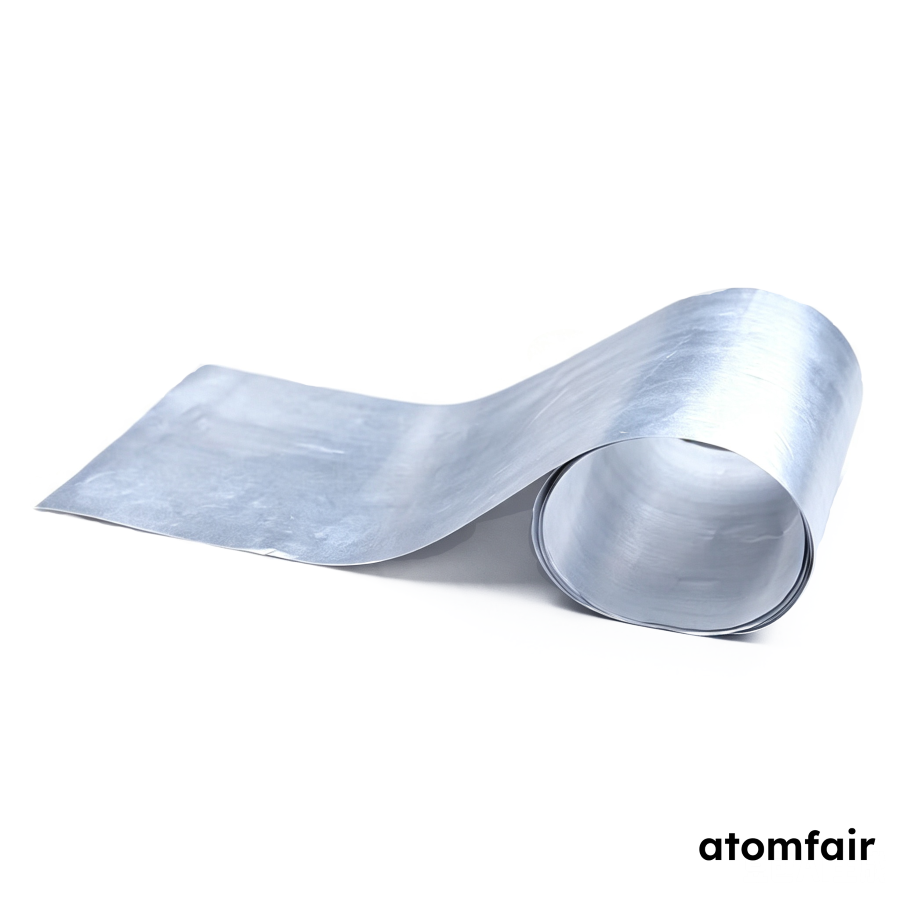
Battery-Grade Porous Aluminum FoilProduct Type: Porous aluminum foil current collector
Research-grade laboratory product
|
|||||||||||||||||||||||||||||||||||||||
|
|||||||||||||||||||||||||||||||||||||||
|
LABORATORY PROCUREMENT SUPPORT
For model selection, accessory matching, platform compatibility or configuration confirmation, contact our technical sales team.
E-MAIL: inquiry@atomfair.com
|
|||||||||||||||||||||||||||||||||||||||
|
Manufacturer: Atomfair LLC
Brand: ATOMFAIR®
|
This porous aluminum foil current collector requires specific surface energy and pore structure to ensure adequate adhesion and wetting with electrode slurries and electrolytes. The foil's mechanical properties and dimensional tolerances impose constraints on handling, coating, and assembly processes.
- Surface Energy Requirement: The foil must maintain a dyne value of at least 40 to guarantee sufficient wetting with slurry and electrolyte.
- Pore Structure Uniformity: Pore uniformity must exceed 90% and pore count must be at least 1000 pores/cm² to support uniform current distribution and prevent localized failure.
- Tensile Strength Change: The tensile strength decreases by approximately 3% after processing, requiring careful handling to avoid mechanical damage.
- Base Foil Thickness Range: The base foil thickness range of 9 to 20 μm limits the maximum coating thickness and influences the electrode's mechanical integrity.
- Aluminum Purity Requirement: Aluminum purity of at least 99.5% is required to minimize electrochemical side reactions in battery cells.
What is the significance of the ≥1000 pores/cm² pore count and ≥90% pore uniformity specification for battery performance?
The specified pore count of ≥1000 pores/cm² with ≥90% uniformity ensures consistent slurry infiltration and electrolyte wetting across the entire electrode surface, which is critical for achieving uniform charge distribution and high-rate capability. The high uniformity minimizes localized current density variations that could lead to premature degradation.
How does the porous aluminum foil's dyne value of ≥40 correlate with electrolyte wetting behavior?
A dyne value of ≥40 indicates a high surface energy that promotes spontaneous wetting of the electrolyte onto the current collector surface. This directly supports the improved wetting claimed in the product description, enabling faster electrolyte absorption and more complete active material utilization, especially in thick electrodes.
What is the trade-off between base foil thickness (9–20 μm) and mechanical strength for the porous current collector?
The product maintains a tensile strength decrease of only 3% compared to non-porous foil, with elongation ≥2%, across the 9–20 μm thickness range. Thinner foils (9 μm) reduce inactive mass and improve energy density, while thicker foils (20 μm) provide greater mechanical robustness for handling during electrode coating and cell assembly, with minimal strength penalty due to the porous design.
This battery-grade porous aluminum foil current collector features >99.5% purity aluminum with a 9–20 μm base thickness and ≥1000 pores/cm², improving electrode adhesion and wetting while providing high pore uniformity and a dyne value ≥40 for electrolyte compatibility. The 3% reduction in tensile strength and required confirmation of pore diameter specifications are key engineering considerations for lab deployment.
Positive
- Improved electrode adhesion and wetting: The porous structure promotes better mechanical interlocking with positive electrode materials and improves slurry and electrolyte wetting, supporting more uniform coating and ion transport.
- High-purity aluminum with uniform porosity: Measured aluminum purity ≥99.5% (grades 1060, 1100, 1235-H18) combined with ≥1000 pores/cm² and ≥90% pore uniformity delivers consistent electrochemical performance and high-rate charge-discharge capability.
Trade-offs
- Reduced tensile strength: The porous architecture decreases tensile strength by 3% relative to non-porous foil, which can reduce mechanical durability during electrode calendering or cell assembly handling.
- Application-specific pore specification confirmation: Pore diameter (10–20 μm), pore count, uniformity, and dyne value must be confirmed per application, adding a technical procurement step to match electrochemical and wetting requirements.
Every advanced material, component, equipment, and instrument in our catalog is backed by rigorous testing. We maintain strict internal quality management frameworks and align with CE conformity metrics to deliver transparent, reproducible performance data via our public open-science repository.
To request raw batch performance data, submit formal vendor registration paperwork, or execute a fast-turnaround R&D manufacturing loop, contact us at inquiry@atomfair.com.
Item is dispatched under the Atomfair Shipping & Delivery Framework (Free worldwide shipping on orders over $59 USD excl. heavy equipment). Return is governed by the Atomfair Return & Refund Policy (7-day technical return window).