|
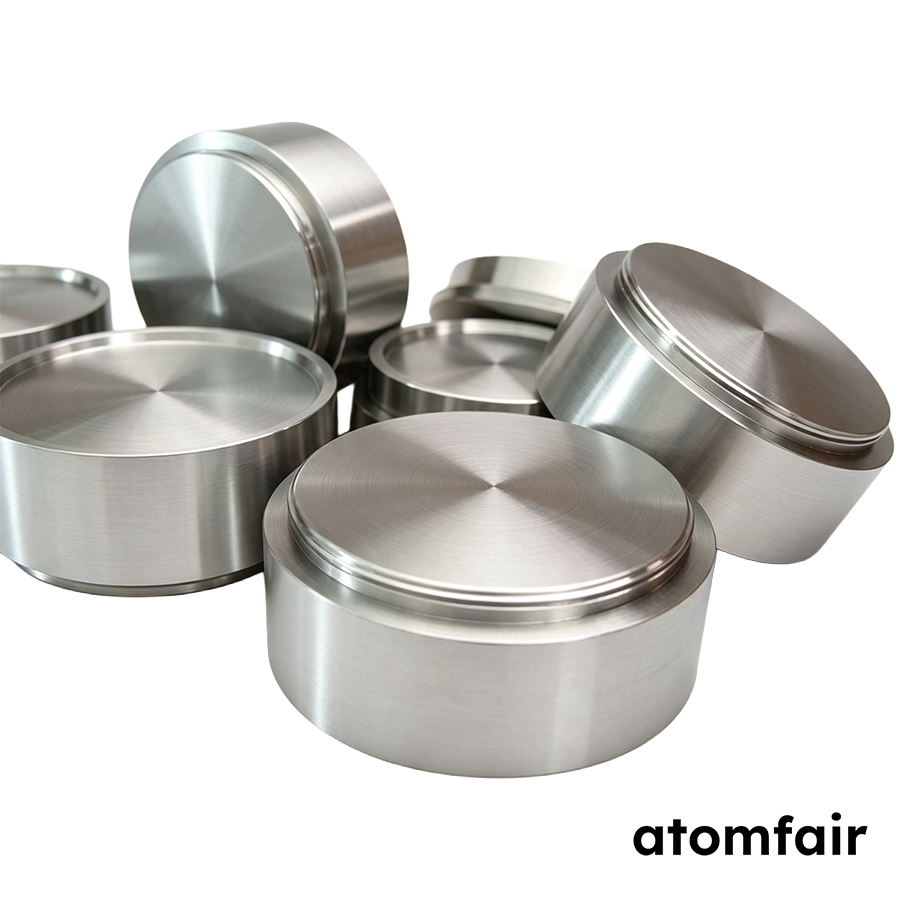
Molybdenum-Copper Alloy Sputtering Target (MoCu (95:5 at%))
Product Type: Metal alloy sputtering target
Research-grade laboratory product
|
|||||||||||||||||||||||||||||||||||||
|
|||||||||||||||||||||||||||||||||||||
|
LABORATORY PROCUREMENT SUPPORT
INQUIRY: inquiry@atomfair.com
|
|||||||||||||||||||||||||||||||||||||
|
Manufacturer: Atomfair LLC
Brand: ATOMFAIR®
|
Store the target in a dry, inert atmosphere to prevent surface oxidation and moisture adsorption. Avoid mechanical shock or abrasion to maintain the machined surface finish of Ra ≤ 0.8 µm.
- Environmental Sensitivity: Exposure to ambient humidity or oxygen can degrade the target surface and introduce contaminants that compromise deposited film purity.
- Mechanical Integrity: The fine-grained microstructure (≤ 50 µm) and relative density ≥97% require careful handling to avoid edge chipping or surface damage.
- Bonding Compatibility: Indium or elastomer bonding options must be selected based on the sputtering system's cooling capacity and thermal cycling profile to prevent bond failure.
Mount the target in a compatible DC or RF magnetron sputtering cathode with appropriate backing plate and bonding. Condition the target surface by pre-sputtering to remove any native oxide layer before deposition.
Required Equipment: DC/RF magnetron sputtering system with argon gas supply, Oxygen-free copper or CuCrZr backing plate
- Inspect target surface
Inspect the target surface for visible defects, scratches, or contamination before mounting. - Mount target onto backing plate
Mount the target onto the selected backing plate using the specified bonding method (indium or elastomer) to ensure thermal contact. - Install assembly in sputtering chamber
Install the bonded target assembly into the sputtering cathode and secure all fasteners per system manufacturer instructions. - Evacuate chamber and introduce argon
Evacuate the deposition chamber to base pressure below 1×10⁻⁴ Pa, then backfill with high-purity argon to 0.5–2.0 Pa. - Pre-sputter to clean target surface
Pre-sputter the target for 5–10 minutes at low power density (3–5 W/cm² DC or 1–2 W/cm² RF) with shutter closed to remove surface oxides. - Set deposition parameters
Set the desired power density within 3–15 W/cm² (DC) or 1–5 W/cm² (RF) and confirm stable plasma before opening the shutter. - Monitor deposition rate and uniformity
Monitor deposition rate (10–80 nm/min) and thickness uniformity (±5% across 100 mm substrate) using in-situ quartz crystal microbalance or post-deposition measurement.
What deposition rate and thickness uniformity can be achieved with the MoCu (95:5 at%) sputtering target under optimized conditions?
Under DC/RF magnetron sputtering at 3-15 W/cm² (DC) or 1-5 W/cm² (RF) in 0.5-2.0 Pa Ar atmosphere, deposition rates of 10-80 nm/min are achievable with ±5% thickness uniformity across a 100 mm substrate. The target enables stoichiometric transfer within ±2 at% of the 95:5 composition.
What are the available bonding and backing plate options for this MoCu sputtering target?
The target can be supplied with either indium bonding or elastomer bonding, and the backing plate may be made of oxygen-free copper or CuCrZr alloy.
What purity level and impurity limits are specified for this MoCu target, and how do they impact thin film quality?
The target has a purity of 99.95% (3N5) with total metallic impurities below 500 ppm and O+N below 100 ppm. These low impurity levels minimize contamination in deposited films, improving resistivity and adhesion performance.
The MoCu (95:5 at%) sputtering target delivers 99.95% purity with a fine-grained microstructure (≤50 µm) and ≥97% relative density, enabling stoichiometric film transfer and adhesion >15 MPa under optimized DC/RF magnetron sputtering conditions.
Positive
- High purity with low impurity levels: 99.95% (3N5) purity with total metallic impurities <500 ppm and O+N <100 ppm minimizes contamination, improving deposited film resistivity and adhesion.
- Fine-grained microstructure for uniform sputtering: Grain size ≤50 µm and relative density ≥97% of theoretical enable consistent erosion and deposition rate uniformity of ±5% across 100 mm substrates.
Trade-offs
- Requires proper substrate preparation for adhesion: Adhesion strength >15 MPa (ASTM D4541) is achieved only on properly prepared substrates; surface cleanliness and roughness must be controlled to avoid delamination.
- Deposition performance depends on optimized conditions: Specified deposition rates of 10-80 nm/min and thickness uniformity of ±5% require careful tuning of power density (3-15 W/cm² DC, 1-5 W/cm² RF) and Ar pressure (0.5-2.0 Pa); real-world results may vary.
Every advanced material, component, equipment, and instrument in our catalog is backed by rigorous testing. We maintain strict internal quality management frameworks and align with CE conformity metrics to deliver transparent, reproducible performance data via our public open-science repository.
To request raw batch performance data, submit formal vendor registration paperwork, or execute a fast-turnaround R&D manufacturing loop, contact us at inquiry@atomfair.com.
Item is dispatched under the Atomfair Shipping & Delivery Framework (Free worldwide shipping on orders over $59 USD excl. heavy equipment). Return is governed by the Atomfair Return & Refund Policy (7-day technical return window).