Atomfair MI-627 Michelson Interferometer
1. Product Overview
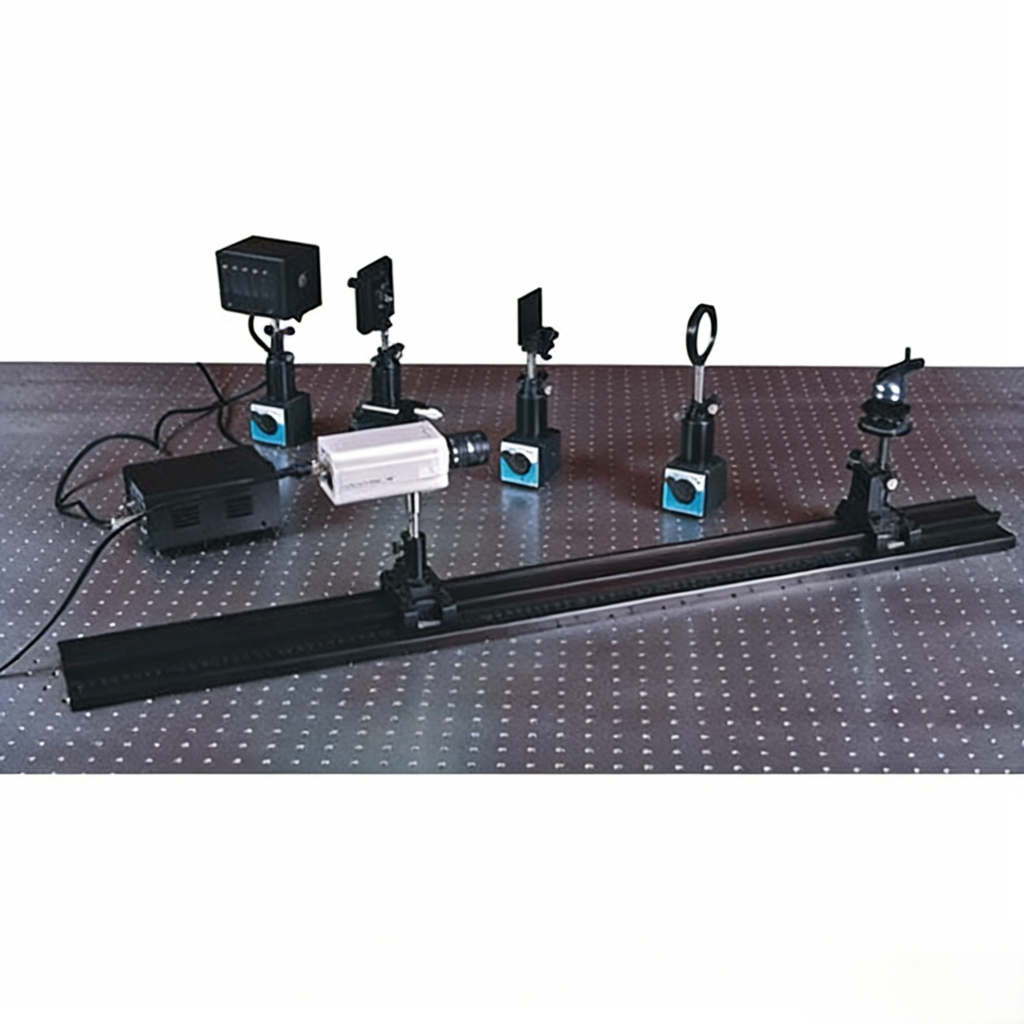
Atomfair MI-627 Michelson Interferometer is an independently developed experimental instrument, built by drawing on the classic design of traditional interferometers and combining a new platform structure. It can be used to observe various optical interference phenomena and verify relevant basic theories. With the optional Fabry-Prot interference device, it can also observe sharp rings of beam interference and measure the wavelength difference between adjacent spectral lines, making it an essential equipment for Michelson interferometry experiments, and comes with a Matlab simulation experiment program.
2. Core Features
-
- Light source: Equipped with a He-Ne laser with a wavelength of 632.8nm, power
-
- Structure: Adopts a new platform structure with a cast iron base as the experimental platform, which is convenient for adding measured substances into the optical path and ensures the stability of the experimental process;
-
- Measurement: The open space design makes the adjustment of equal-thickness interference, equal-inclination interference and various fringe changes extremely convenient, and various precision measurements can be easily carried out.
3. Main Experimental Content
-
- Observe non-localized interference of point light source (He-Ne laser as standard configuration);
-
- Observe equal-inclination interference fringes (low-voltage sodium lamp required separately);
-
- Observe equal-thickness interference fringes (low-voltage sodium lamp required separately);
-
- Observe white light interference phenomenon (white light source required separately);
-
- Determine the wavelength of the light source or filter (He-Ne laser as standard configuration or low-voltage sodium lamp required separately);
-
- Determine the wavelength difference of sodium yellow doublet (low-voltage sodium lamp required separately);
-
- Measure the refractive index of transparent medium thin slices (transparent medium thin slices need to be prepared by oneself);
-
- Optional experiment: Measure the refractive index of transparent gas (glass air chamber required separately);
-
- Optional experiment: Observe Fabry-Prot interference phenomenon (Fabry-Prot etalon required separately).
4. Specification Parameters (International Standard)
-
- Laser wavelength: 632.8nm;
-
- Laser power:
-
- Laser mode: Single-mode TEM€€;
-
- Laser cavity length: 250mm;
-
- Laser plug type: Fully protected safety high-voltage plug;
-
- Base material: Cast iron;
-
- Specifications of accessories related to supporting experiments: In line with industry standard configurations.
5. Main Configuration
Atomfair MI-627 Michelson Interferometer main unit (main unit, ground glass screen, beam expander, one-dimensional base), GY-11 He-Ne laser (including power supply);
Optional accessories: GY-5 low-voltage sodium lamp, GY-14 white light source, Fabry-Prot etalon, air chamber assembly, etc.;
Configuration parameters can be customized according to different customer requirements.
If youe interested, have any questions, or have specific customization requirements, please feel free to contact us at inquiry@atomfair.com.
Which optional accessories are required to perform Fabry-Perot interference or gas refractive index measurements on the Atomfair MI-627 Michelson interferometer?
To observe Fabry-Perot interference, a Fabry-Perot etalon (sold separately) is required. For measuring the refractive index of transparent gas, a separate glass air chamber assembly is needed. Both are listed as optional accessories in the main configuration of the MI-627.
How does the Atomfair MI-627's cast iron base and open-space platform design balance stability with adjustment convenience for interference fringe experiments?
The open-space design allows easy adjustment of equal-thickness and equal-inclination interference fringes, while the cast iron base ensures stability during the experimental process. This combination provides a rigid platform that minimizes vibration while offering accessibility for placing measured substances into the optical path.
What safety features are incorporated into the He-Ne laser power supply of the Atomfair MI-627 interferometer?
The laser uses a fully protected safety high-voltage plug, which is designed to reduce the risk of electric shock. The laser operates at 632.8 nm in single-mode TEM00 with a cavity length of 250 mm, and the power supply is included as part of the main configuration.
The Atomfair MI-627 Michelson Interferometer is a cast-iron base instrument with an open optical path design, enabling precise adjustment of equal-thickness and equal-inclination fringes. It includes a 632.8 nm He-Ne laser and supports optional Fabry-Pérot interferometry for measuring wavelength differences between adjacent spectral lines, making it suitable for advanced optics education and research.
Positive
- Stable cast iron base: The cast iron base provides a rigid and stable platform, minimizing vibrations that could distort interference patterns during measurements.
- Open space design for easy adjustment: The open optical path allows convenient access for adjusting fringes and inserting samples, facilitating a wide range of experiments including refractive index measurements.
Trade-offs
- Requires additional light sources: Several experiments (e.g., equal-thickness fringes, sodium doublet) require a low-voltage sodium lamp or white light source, which are not included and must be purchased separately.
- Manual sample preparation needed: Measuring refractive index of transparent thin slices requires the user to prepare the samples themselves, adding a preparatory step before the experiment.
Every advanced material, component, equipment, and instrument in our catalog is backed by rigorous testing. We maintain strict internal quality management frameworks and align with CE conformity metrics to deliver transparent, reproducible performance data via our public open-science repository.
To request raw batch performance data, submit formal vendor registration paperwork, or execute a fast-turnaround R&D manufacturing loop, contact us at inquiry@atomfair.com.
Item is dispatched under the Atomfair Shipping & Delivery Framework (Free worldwide shipping on orders over $59 USD excl. heavy equipment). Return is governed by the Atomfair Return & Refund Policy (7-day technical return window).