|
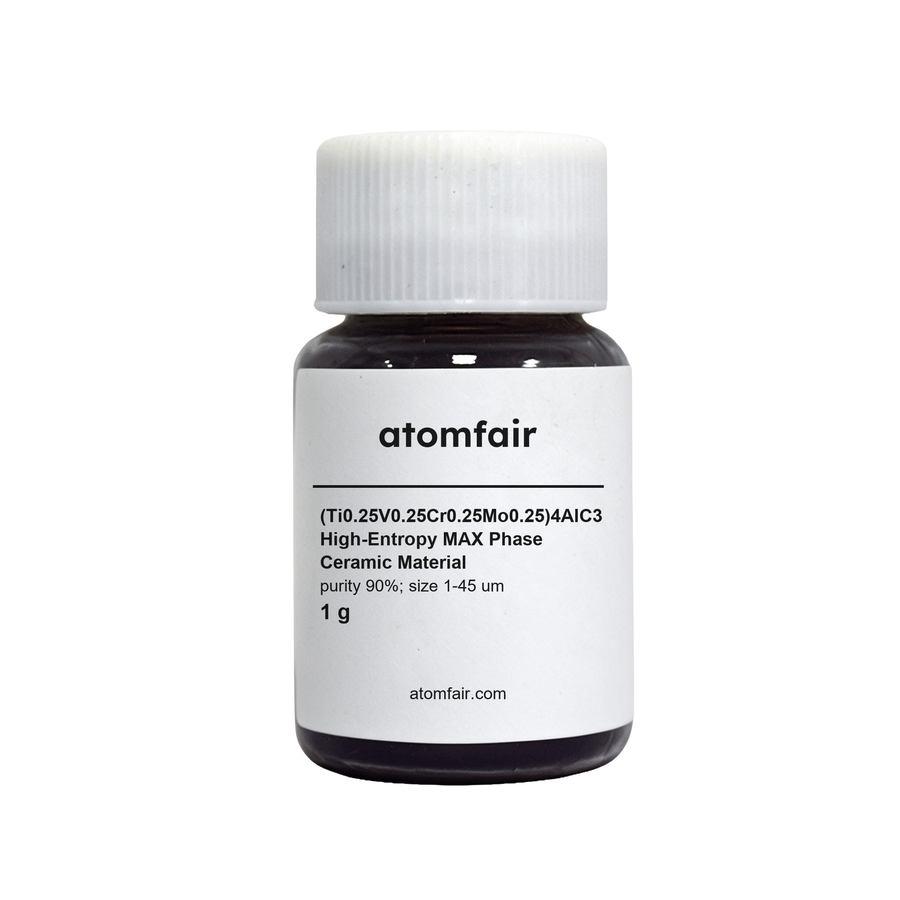
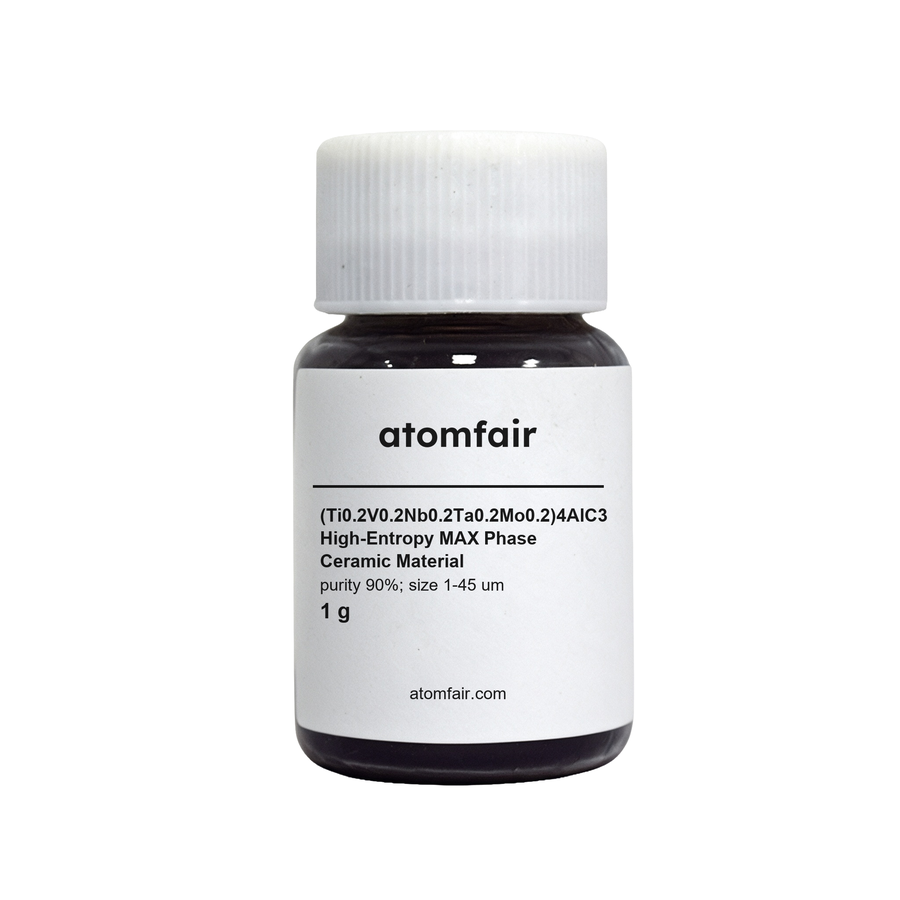
(Ti0.2V0.2Nb0.2Ta0.2Mo0.2)4AlC3 High-Entropy MAX Phase Ceramic Material, 1 g
Product Type: MAX phase ceramic powder
Research-grade laboratory product
|
|||||||||||||||||||
|
|||||||||||||||||||
|
LABORATORY PROCUREMENT SUPPORT
For material selection, specification confirmation and package-size quotation support, contact our technical sales team.
E-MAIL: inquiry@atomfair.com
|
|||||||||||||||||||
|
Manufacturer: Atomfair LLC
Brand: ATOMFAIR®
|
What is the purity of (Ti0.2V0.2Nb0.2Ta0.2Mo0.2)4AlC3 high-entropy MAX phase ceramic powder and how does it affect experimental use?
The product is supplied at 90% purity, meaning 10% of the material consists of secondary phases not specified in the source. For applications demanding phase-pure samples, such as precise structure–property correlation studies, this impurity level may require additional characterization or purification steps.
What is the particle size range of this MAX phase powder and what processing implications does it have?
The particle size is specified as 1–45 µm. This broad range is suitable for general powder processing (e.g., sintering, spray coating) but may require sieving or classification to achieve a narrower distribution for applications like thin-film deposition or additive manufacturing where consistent particle size is critical.
This high-entropy MAX phase ceramic powder (Ti0.2V0.2Nb0.2Ta0.2Mo0.2)4AlC3 offers a unique quinary composition for exploring phase stability and property tuning in extreme environments, but the 90% purity and broad 1-45 µm particle size distribution impose constraints on applications requiring high phase purity or narrow size control.
Positive
- High-entropy composition for property tuning: The equimolar incorporation of Ti, V, Nb, Ta, and Mo into the MAX phase lattice enables exploration of composition-structure-property relationships, potentially yielding enhanced mechanical or thermal stability compared to ternary MAX phases.
- Broad particle size range for varied processing: The 1-45 µm size distribution accommodates multiple downstream processing routes, including powder metallurgy, tape casting, and additive manufacturing, without requiring additional milling or sieving for initial trials.
Trade-offs
- 90% purity limits phase-sensitive applications: The 90% purity indicates the presence of secondary phases or unreacted precursors, which may compromise property measurements or performance in applications requiring single-phase MAX phase behavior, such as oxidation-resistant coatings or nuclear cladding.
- Broad size distribution complicates uniformity: The 1-45 µm range spans over an order of magnitude in particle diameter, leading to non-uniform sintering behavior, packing density, and surface area, which must be accounted for in process optimization for dense ceramic or composite fabrication.
Every advanced material, component, equipment, and instrument in our catalog is backed by rigorous testing. We maintain strict internal quality management frameworks and align with CE conformity metrics to deliver transparent, reproducible performance data via our public open-science repository.
To request raw batch performance data, submit formal vendor registration paperwork, or execute a fast-turnaround R&D manufacturing loop, contact us at inquiry@atomfair.com.
Item is dispatched under the Atomfair Shipping & Delivery Framework (Free worldwide shipping on orders over $59 USD excl. heavy equipment). Return is governed by the Atomfair Return & Refund Policy (7-day technical return window).