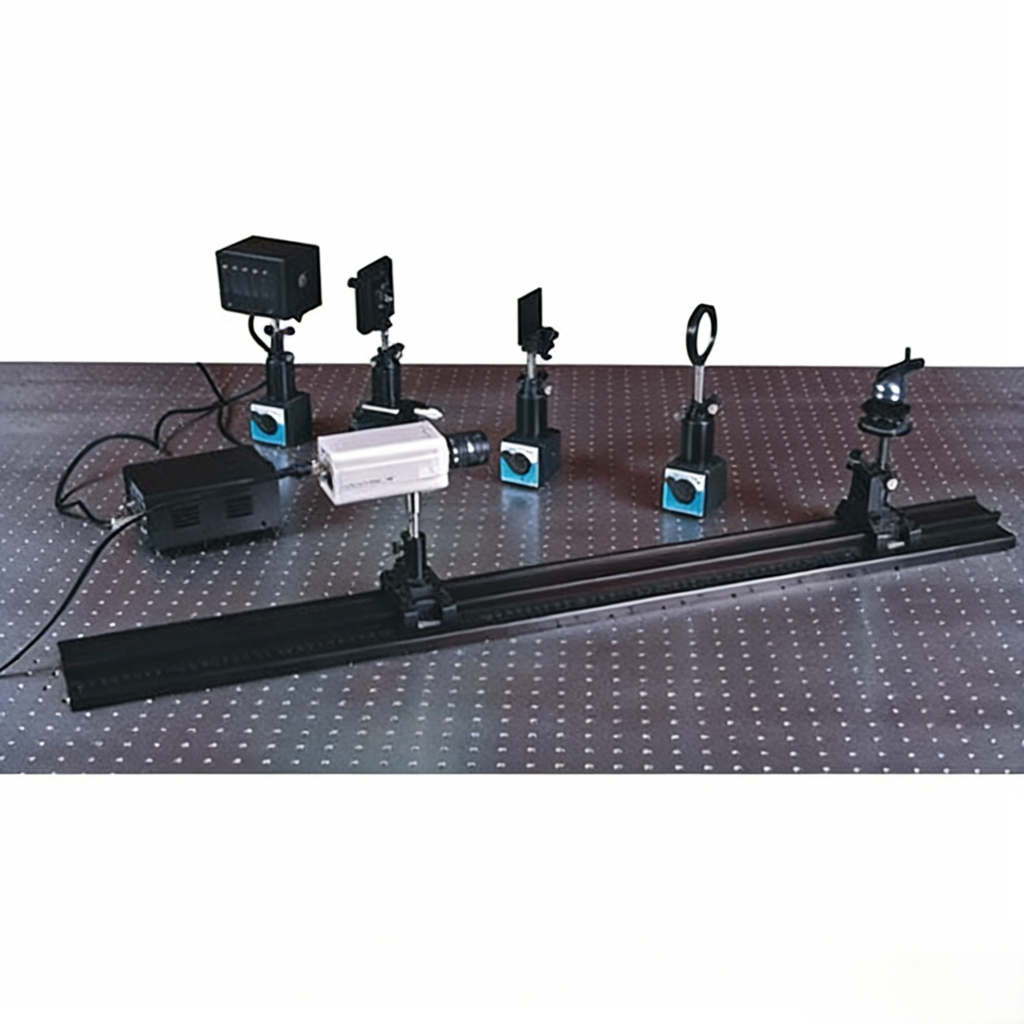
Atomfair-OTF-MS837 Continuous Optical Transfer Function Measurement System
Product Overview
Research on the imaging process and image quality evaluation of optical systems is a core part of optical information processing. The Atomfair-OTF-MS837 is based on spectral analysis methods and the Optical Transfer Function (OTF) of linear systems. By characterizing the transmission performance of optical systems for targets with different spatial frequencies, it can objectively and effectively analyze the information transmission capability of the entire optical system. It is widely applicable to optical design and optical inspection scenarios.
Product Type
Fourier Information Optics Category
Key Features
Enables accurate measurement of the transfer function for continuous spatial frequencies
Experimental Contents
- Understand the basic theories of diffraction-limited systems and optical transfer functions
- Learn about the line spread function and its role in optical transfer function measurement
- Master the basic methods of transfer function measurement and image quality evaluation
- Explore the influence of lens parameters of diffraction-limited systems on the optical transfer function
Standard Configuration & Specifications
| No. | Name | Specifications |
|---|---|---|
| 1 | Light Source | Tungsten Bromide Lamp |
| 2 | CCD Camera | 1/3 inch, 420 TV Lines (TVL), 0.2 Lux, Power Supply: 12V DC |
| 3 | Image Acquisition Card | Minimum Resolution: 640×480×16 |
| 4 | Ground Glass | 80mm × 80mm |
| 5 | Slit | Slit Width: 0±2mm Continuously Adjustable, 5-Degree Rotatable |
| 6 | Other Accessories | Guide Rails, Sliding Seats, Plate Holders, etc. |
Note: The above configuration and parameters are for reference only. The final configuration shall be subject to the packing list. No separate notice will be given for minor changes.
Optional Configuration
| No. | Name | Specifications |
|---|---|---|
| 1 | Computer | 2.5GHz Dual-Core Processor, 200GB Hard Disk, 3GB Memory, Independent Graphics Card |
| 2 | Monitor | LCD Monitor |
| 3 | Printer | – |
Applications
Ideal for professionals and institutions engaged in optical system research, optical design, and optical inspection. It serves as a reliable tool for academic research, laboratory experiments, and industrial quality control in the field of optics, helping to optimize optical system performance and ensure product quality.
If you’re interested, have any questions, or have specific customization requirements, please feel free to contact us at inquiry@atomfair.com.
What is the purpose of the continuously adjustable slit in the Atomfair-OTF-MS837 optical transfer function measurement system?
The slit generates a line spread function (LSF) critical for optical transfer function (OTF) measurement. Its width is continuously adjustable from 0 to 2 mm and can be rotated 5 degrees, allowing precise control over the spatial frequency content of the target used to characterize the system's information transmission capability.
Can the Atomfair-OTF-MS837 be integrated with an external computer for data acquisition and analysis?
Yes, an optional computer configuration is available as an accessory. The recommended specifications include a 2.5 GHz dual-core processor, 200 GB hard disk, 3 GB memory, and an independent graphics card to support the image acquisition card's minimum resolution of 640×480×16 bits, enabling capture and processing of the camera output for OTF analysis.
What are the illumination and detection characteristics of the standard configuration in the Atomfair-OTF-MS837?
The system uses a tungsten bromide lamp for broadband visible illumination and a 1/3-inch CCD camera rated at 420 TV lines, 0.2 lux sensitivity, and 12V DC power supply. The camera captures images of the slit pattern after passing through the test optical system, with the image acquisition card digitizing the signal for OTF computation.
The Atomfair-OTF-MS837 provides a spectral-analysis-based approach to measuring the optical transfer function across continuous spatial frequencies, enabling objective evaluation of image information transmission in optical systems. Its design supports both educational exploration of diffraction-limited system theory and practical optical inspection, with a configuration centered on a tungsten bromide lamp, adjustable slit, and CCD camera.
Positive
- Continuous spatial frequency measurement: The system measures the optical transfer function across continuous spatial frequencies, enabling detailed characterization of image information transmission capability for optical systems.
- Adjustable slit for versatile testing: The slit width is continuously adjustable from 0 to 2 mm and rotatable by 5 degrees, allowing flexible control over the spatial frequency input for varied measurement conditions.
Trade-offs
- Requires external computer system: The standard configuration does not include a computer, monitor, or printer; these are optional and must be sourced separately to operate the system and process data.
- Low-resolution CCD sensor: The included CCD camera has a resolution of 420 TV lines and a minimum image acquisition resolution of 640×480×16, which may limit the precision of high-frequency transfer function measurements.
Every advanced material, component, equipment, and instrument in our catalog is backed by rigorous testing. We maintain strict internal quality management frameworks and align with CE conformity metrics to deliver transparent, reproducible performance data via our public open-science repository.
To request raw batch performance data, submit formal vendor registration paperwork, or execute a fast-turnaround R&D manufacturing loop, contact us at inquiry@atomfair.com.
Item is dispatched under the Atomfair Shipping & Delivery Framework (Free worldwide shipping on orders over $59 USD excl. heavy equipment). Return is governed by the Atomfair Return & Refund Policy (7-day technical return window).