
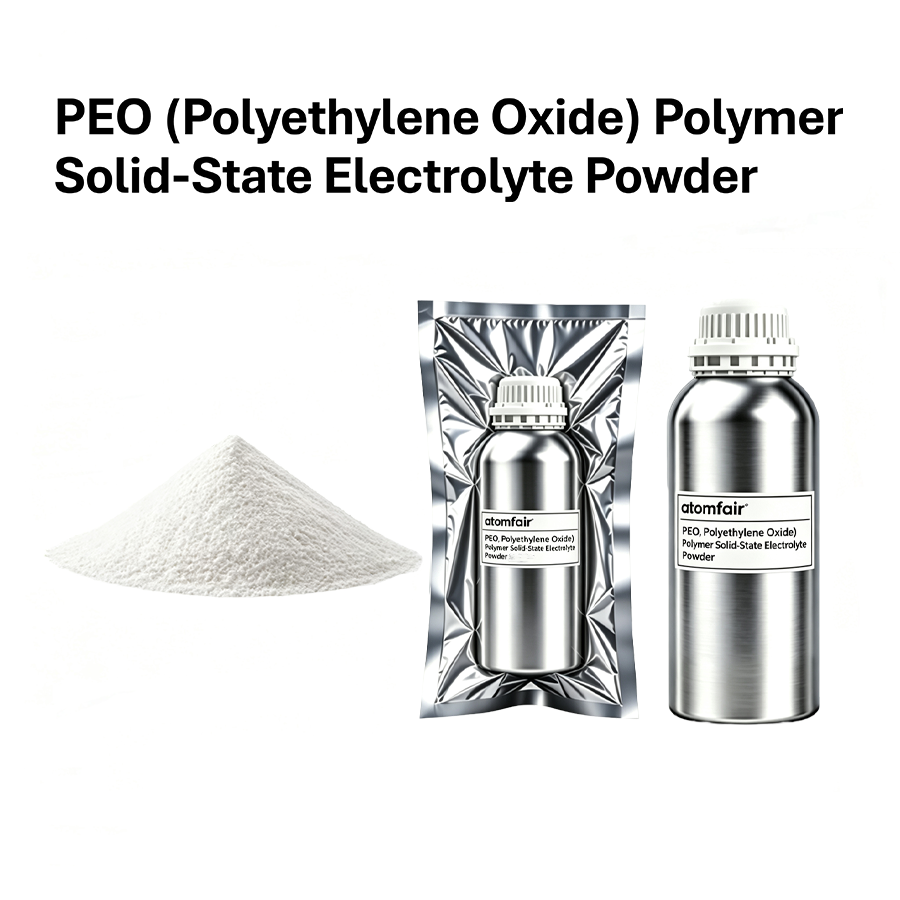
PEO (Polyethylene Oxide) Polymer Solid-State Electrolyte PowderPolymer Solid-State Electrolytes
|
||||||||||||||||||||||||||||||||||
|
||||||||||||||||||||||||||||||||||
|
PEO polymer solid-state electrolyte powder requires strict moisture control during storage and handling to prevent hygroscopic degradation. Optimal ionic conductivity is achieved only at elevated temperatures (60–80 °C) due to high crystallinity at room temperature.
- Moisture Sensitivity: Store and handle PEO powder exclusively in a dry environment with dew point below –40 °C, using vacuum-sealed moisture-barrier packaging and resealing promptly after opening.
- Temperature Constraints: The powder softens at 65–67 °C and decomposes above 423 °C; processing must remain within this range to avoid material degradation.
- Electrochemical Stability: PEO exhibits electrochemical stability up to 3.8–4.0 V vs. Li/Li⁺, limiting compatibility to cathodes such as LFP and low-Ni NCM.
- Infrastructure Requirement: Formulation and handling should be performed in an argon or nitrogen glovebox to maintain anhydrous conditions.
At what operating temperature does PEO polymer solid-state electrolyte achieve optimal ionic conductivity?
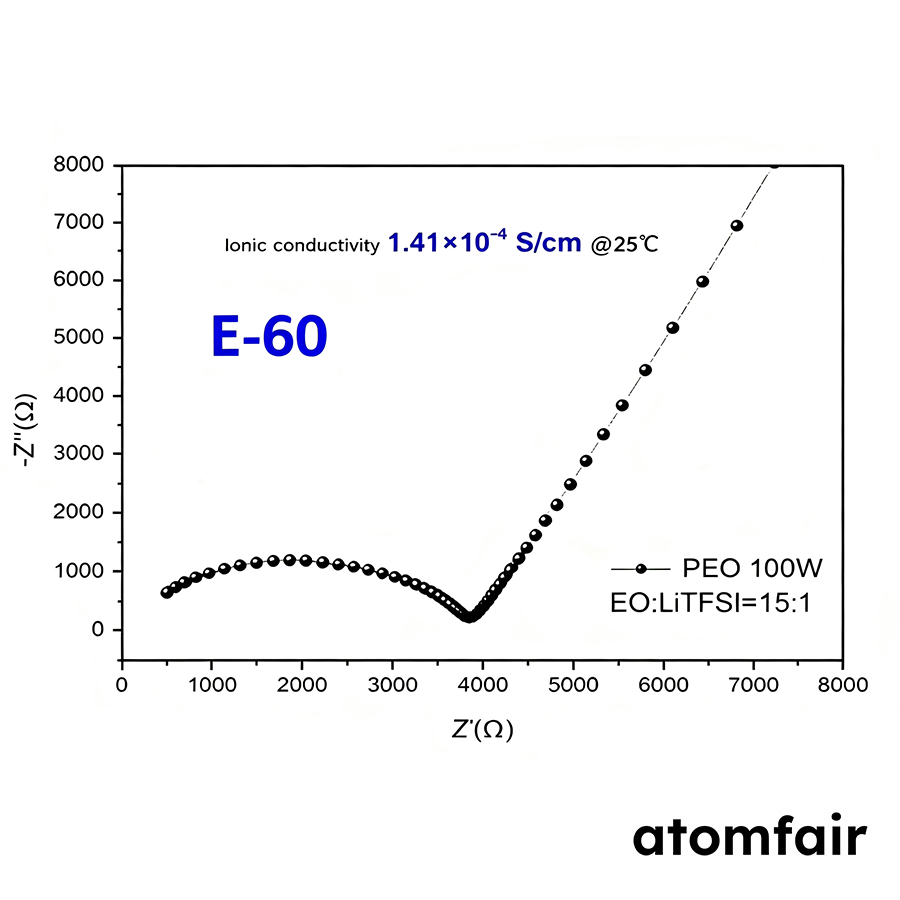
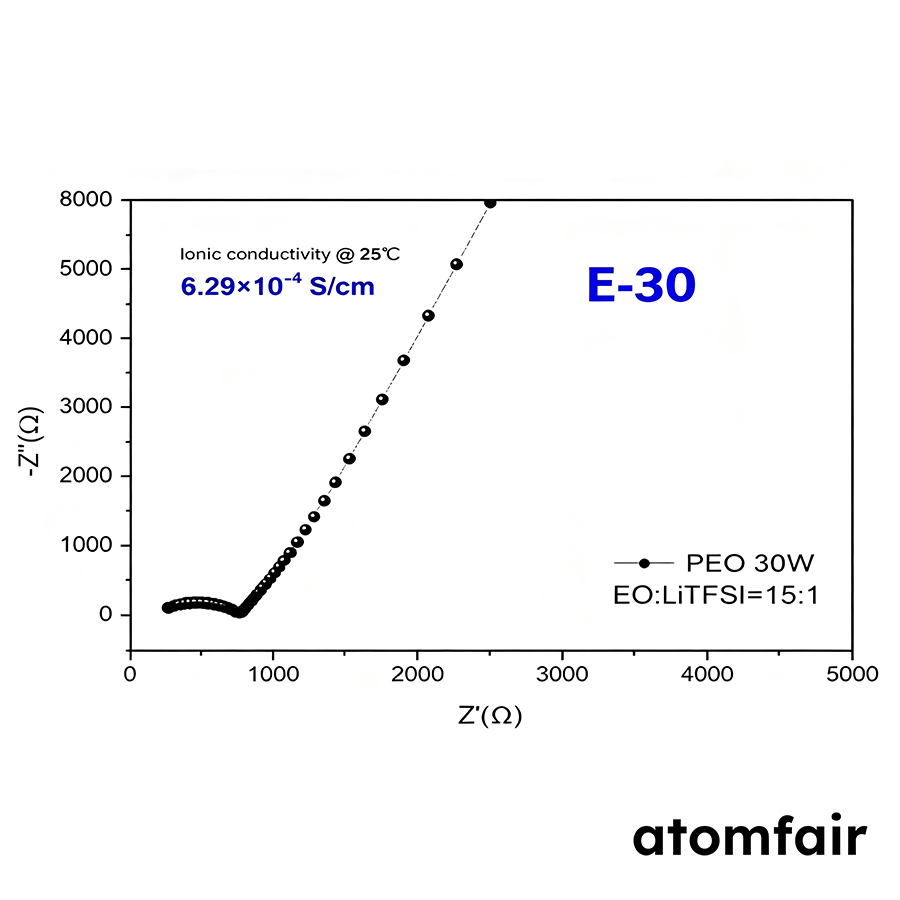
PEO-based electrolytes perform best at 60–80 °C because high crystallinity limits room-temperature conductivity. The product description lists an ionic conductivity of 1.41×10⁻⁶ S/cm and a softening point of 65–67 °C, consistent with use in this elevated-temperature window for polymer all-solid-state lithium batteries.
Which cathode materials can be paired with this PEO solid-state electrolyte without exceeding its electrochemical stability window?
This PEO electrolyte has electrochemical stability up to 3.8–4.0 V vs Li/Li⁺, so it is compatible with LFP and low-Ni NCM cathodes. Higher-voltage cathode systems would exceed the stated stability window and are not supported by the product information.
What storage and handling conditions are required for PEO solid-state electrolyte powder?
PEO powder is hygroscopic and should be handled in a dry environment with dew point below –40 °C. It ships vacuum-sealed in moisture-barrier aluminum-laminated bags; store it sealed in a dry cabinet or Ar/N₂ glovebox, protected from moisture, and keep it away from heat sources and oxidizing agents.
PEO Polymer Solid-State Electrolyte Powder (viscosity-average molecular weight 100,000–7,500,000) is a semi-crystalline matrix optimized for polymer-based all-solid-state lithium batteries. Its ether-oxygen groups dissociate lithium salts and enable Li⁺ conduction via segmental motion, with good interfacial compatibility against Li-metal anodes, but room-temperature conductivity is limited to ~1.41×10⁻⁶ S/cm due to high crystallinity, necessitating operation at 60–80 °C for practical performance.
Positive
- Li-metal anode compatibility: Good interfacial compatibility with Li-metal anode mitigates lithium-dendrite growth, enabling stable cycling in polymer-type all-solid-state batteries.
- Excellent film-forming ability: PEO dissolves in organic solvents for solution-casting free-standing flexible electrolyte membranes, simplifying fabrication of thin-film solid electrolytes.
Trade-offs
- Low room-temperature conductivity: High crystallinity limits ambient ionic conductivity (~1.41×10⁻⁶ S/cm); optimal Li⁺ conduction requires elevated temperature (60–80 °C), adding thermal management constraints.
- Hygroscopic powder handling: PEO is hygroscopic; must be stored hermetically under dry atmosphere and handled in a glovebox or dry environment (dew point < –40 °C) to prevent moisture uptake that degrades performance.
Every advanced material, component, equipment, and instrument in our catalog is backed by rigorous testing. We maintain strict internal quality management frameworks and align with CE conformity metrics to deliver transparent, reproducible performance data via our public open-science repository.
To request raw batch performance data, submit formal vendor registration paperwork, or execute a fast-turnaround R&D manufacturing loop, contact us at inquiry@atomfair.com.
Item is dispatched under the Atomfair Shipping & Delivery Framework (Free worldwide shipping on orders over $59 USD excl. heavy equipment). Return is governed by the Atomfair Return & Refund Policy (7-day technical return window).