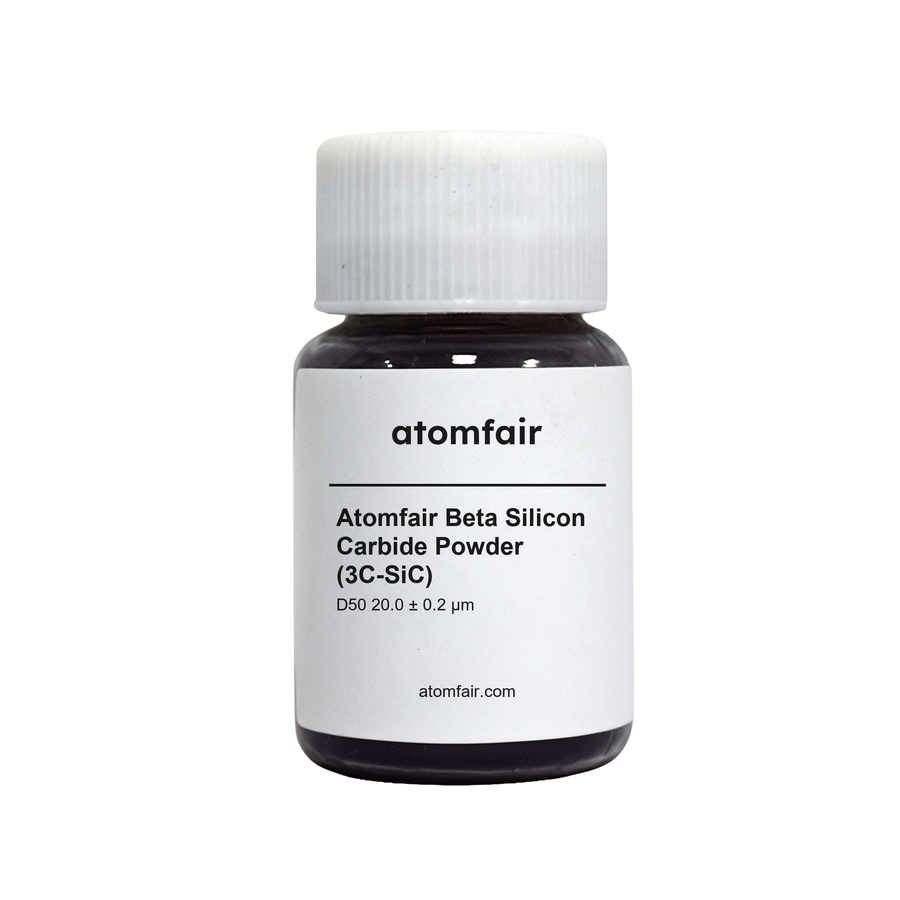
Atomfair Beta Silicon Carbide Powder (3C-SiC), D50 20.0 ± 0.2 μm
Product Description
Atomfair beta Silicon Carbide Powder (3C-SiC) is supplied with D50 20.0±0.2 μm particle size, a cubic beta-SiC (3C-SiC) crystal structure, and controlled powder consistency. It is intended for advanced ceramics, composite materials, thermal-spray coatings, and semiconductor-related materials research.
|
Technical Specifications
|
||||||||||||||||||||||
|
Customization & Ordering
Custom particle-size and purity requirements may be evaluated for selected
grades upon request. Alternative package sizes may also be available.
Minimum order quantities, pricing, and lead times vary by specification and
will be confirmed during technical review and quotation.
Key Features and Advantages
- Defined D50 20.0±0.2 μm particle-size grade.
- Cubic beta-SiC (3C-SiC) structure.
- Good thermal conductivity with low thermal-expansion behavior in the product family.
- Suitable for advanced ceramics, coatings, composites, and semiconductor-related materials evaluation.
APPLICATION SCOPE: advanced ceramics, composite materials, thermal-spray coatings, and semiconductor-related materials research
DOCUMENTATION: COA and SDS can be provided upon request for batch-specific confirmation. Additional documentation requirements may be discussed before order confirmation.
LABORATORY PROCUREMENT SUPPORT
For grade selection, particle-size confirmation, documentation support or custom specification review, contact our technical sales team.
This powder requires controlled atmosphere storage to prevent moisture adsorption and oxidation. Particle size distribution must be verified before use in sensitive applications.
- Moisture Sensitivity: Store in a sealed container under dry inert gas to avoid agglomeration from ambient humidity.
- Oxidation Risk: Avoid prolonged exposure to air above 800°C to prevent surface oxidation of the beta-SiC particles.
- Contamination Control: Use dedicated clean tools and containers to prevent cross-contamination with other ceramic powders.
This procedure describes safe handling and preparation of beta-SiC powder for ceramic or coating applications. Proper dispersion and deagglomeration steps are critical to achieve uniform particle distribution.
Required Equipment: Glovebox or fume hood, Analytical balance, Milling jar with grinding media
- Weigh powder
Weigh the required amount of beta-SiC powder inside a glovebox under dry inert atmosphere to prevent moisture pickup. - Disperse in solvent
Transfer the powder to a milling jar and add a compatible solvent such as ethanol or isopropanol at a 1:2 powder-to-solvent ratio. - Mill to deagglomerate
Mill the slurry for 30 minutes at 200 rpm using yttria-stabilized zirconia media to break up soft agglomerates. - Dry the slurry
Dry the milled slurry in a rotary evaporator at 60°C under reduced pressure to recover the dispersed powder. - Store dried powder
Store the dried powder in a vacuum-sealed container with desiccant until ready for sintering or coating application.
What do the D10, D50, D90, and D97 values mean for Atomfair beta SiC powder with a D50 of 20 µm?
Atomfair specifies a median particle size D50 of 20.0 ± 0.2 μm, with D10 at 11.5 ± 0.2 μm and D90 at 30.5 ± 0.22 μm; D97 is stated as ≤35 μm. These distribution boundaries characterize the equiaxed powder's breadth and are directly relevant for assessing packing, flow, and consolidation behavior in ceramics, composites, and coating applications.
Is Atomfair 3C-SiC powder intended for semiconductor fabrication or only for materials research?
The product is described as suitable for advanced ceramics, composite materials, thermal-spray coatings, and semiconductor-related materials research, not as a device-grade semiconductor feedstock. Its cubic beta-SiC (3C-SiC) crystal phase and equiaxed grain morphology are the basis for these application evaluations.
What batch documentation, packaging options, and handling specifications are available for this beta-SiC powder grade?
Batch-specific COA and SDS can be provided upon request, and the product is offered in 500 g, 1 kg, and 5 kg packages. Tap density is specified as 1.75 ± 0.05 g/cm³, which is useful for estimating fill volume and handling behavior. Custom particle-size and purity requirements may be evaluated for selected grades upon request.
Atomfair Beta Silicon Carbide Powder (3C-SiC) with D50 20.0 ± 0.2 μm offers a tightly controlled median particle size and cubic beta-SiC crystal structure, suitable for advanced ceramics, thermal-spray coatings, and semiconductor materials research, though its tap density and fine particle size impose handling and processing constraints.
Positive
- Tight particle size distribution: D50 20.0 ± 0.2 μm with D10 11.5 ± 0.2 μm and D90 30.5 ± 0.22 μm ensures consistent powder behavior in sintering, coating, and composite fabrication, reducing batch-to-batch variability.
- Cubic beta-SiC crystal structure: The 3C-SiC phase provides good thermal conductivity and low thermal expansion, advantageous for thermal management in semiconductor and advanced ceramic applications.
Trade-offs
- Moderate tap density: Tap density of 1.75 ± 0.05 g/cm³ may require careful powder compaction or slurry formulation to achieve desired green density in ceramic processing.
- Fine particle handling requirements: With D50 at 20 μm and D97 ≤ 35 μm, the powder is prone to airborne dust generation, necessitating proper ventilation, dust control, and personal protective equipment during handling.
Every advanced material, component, equipment, and instrument in our catalog is backed by rigorous testing. We maintain strict internal quality management frameworks and align with CE conformity metrics to deliver transparent, reproducible performance data via our public open-science repository.
To request raw batch performance data, submit formal vendor registration paperwork, or execute a fast-turnaround R&D manufacturing loop, contact us at inquiry@atomfair.com.
Item is dispatched under the Atomfair Shipping & Delivery Framework (Free worldwide shipping on orders over $59 USD excl. heavy equipment). Return is governed by the Atomfair Return & Refund Policy (7-day technical return window).