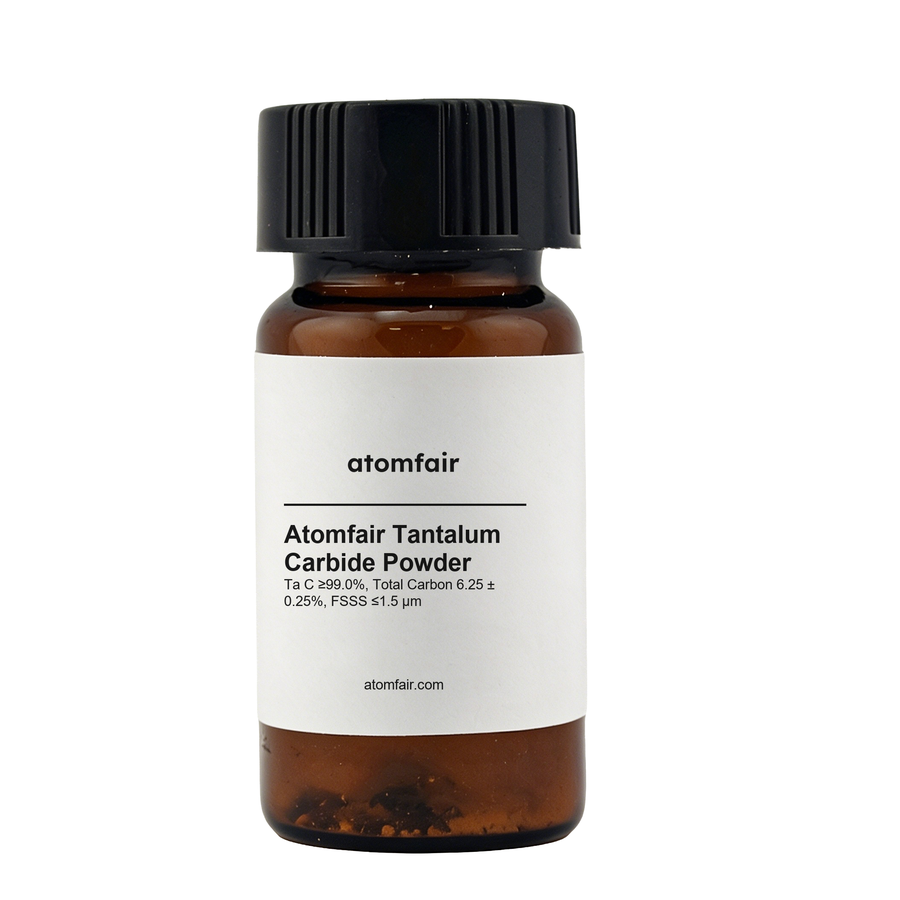
Atomfair Tantalum Carbide (TaC) Powder, Ta(Nb)C ≥99.0%, Total Carbon 6.25 ± 0.25%, FSSS ≤1.5 μm
Product Description
Atomfair tantalum carbide (TaC) powder is supplied as yellow-brown powder with Ta(Nb)C ≥99.0%, total carbon 6.25 ± 0.25%, free carbon ≤0.15%, oxygen ≤0.20%, and FSSS ≤1.5 μm. It is intended for hard alloy additive research.
|
Technical Specifications
|
||||||||||||||||||||||||||||
|
Customization & Ordering
Custom composition and particle-size requirements may be evaluated for selected grades upon request. Alternative package sizes may also be available. Minimum order quantities, pricing, and lead times vary by specification and will be confirmed during technical review and quotation.
Key Features and Advantages
- Defined composition and particle-size specification for hard alloy materials research.
- Source-defined chemical composition and impurity limits are listed for technical review.
- Powder format suitable for cermet or hard alloy additive research.
APPLICATION SCOPE: hard alloy additive research
DOCUMENTATION: COA and SDS can be provided upon request for batch-specific confirmation.
LABORATORY PROCUREMENT SUPPORT
For grade selection, particle-size confirmation, documentation support or custom specification review, contact our technical sales team.
What is the role of the total carbon content specification (6.25 ± 0.25%) and free carbon limit (≤0.15%) in TaC powder for hard alloy applications?
The total carbon content of 6.25 ± 0.25% ensures stoichiometric TaC formation, while the free carbon limit of ≤0.15% minimizes excess carbon that could form undesirable carbide phases or affect the final properties of hard alloys. These specifications are critical for achieving consistent performance in cermet or hard alloy additive research.
How does the FSSS particle size of ≤1.5 μm influence the processing of this TaC powder in hard alloy composites?
The FSSS particle size of ≤1.5 μm indicates a fine powder suitable for producing uniform dispersions in hard alloy matrices. Fine particle size promotes better sintering kinetics and densification, though the specific effects depend on the composite formulation. The source specifies this powder for hard alloy additive research.
What is the significance of the oxygen content limit (≤0.20%) and niobium impurity (≤1.0%) listed in the specifications?
The oxygen limit of ≤0.20% is critical because oxygen can form oxides that degrade the mechanical properties of hard alloys. The niobium content (≤1.0%) is naturally present in tantalum ores; the specification ensures that the total Ta(Nb)C content is ≥99.0%, with Nb within acceptable limits for research-grade material.
Every advanced material, component, equipment, and instrument in our catalog is backed by rigorous testing. We maintain strict internal quality management frameworks and align with CE conformity metrics to deliver transparent, reproducible performance data via our public open-science repository.
To request raw batch performance data, submit formal vendor registration paperwork, or execute a fast-turnaround R&D manufacturing loop, contact us at inquiry@atomfair.com.
Item is dispatched under the Atomfair Shipping & Delivery Framework (Free worldwide shipping on orders over $59 USD excl. heavy equipment). Return is governed by the Atomfair Return & Refund Policy (7-day technical return window).