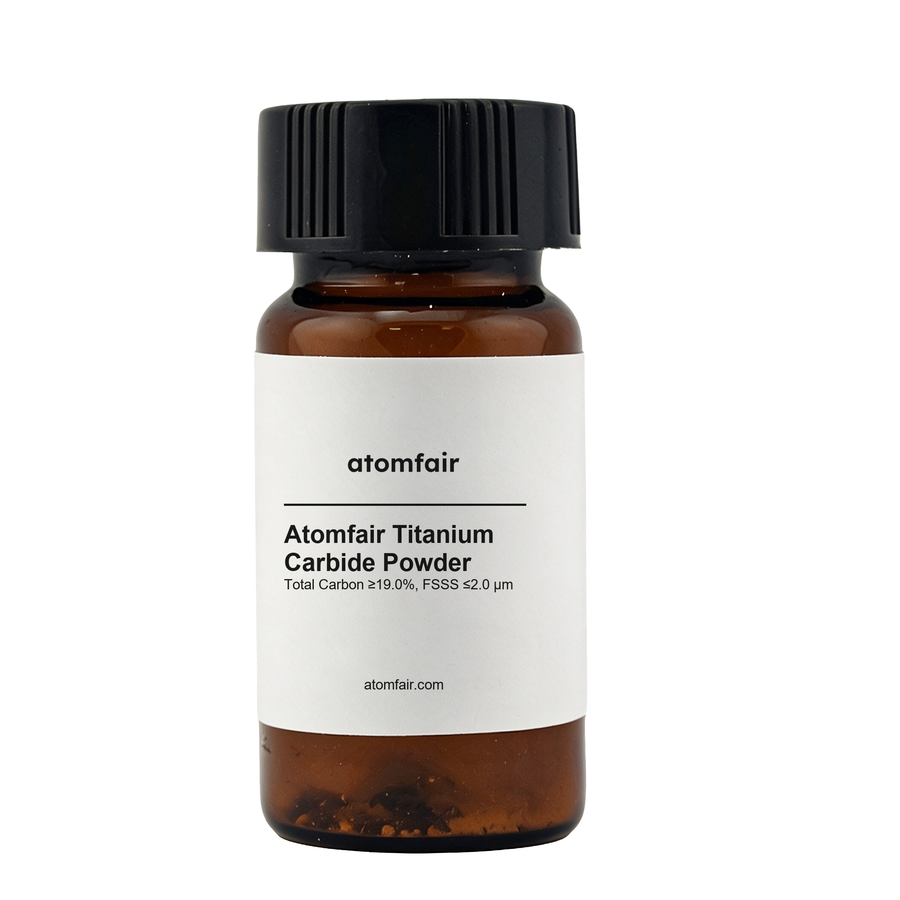
Atomfair Titanium Carbide (TiC) Powder, Total Carbon ≥19.0%, FSSS ≤2.0 μm
Product Description
Atomfair titanium carbide (TiC) powder is supplied as grey powder with a total carbon specification of ≥19.0%, free carbon ≤0.30%, oxygen ≤0.80%, nitrogen ≤0.40%, and FSSS ≤2.0 μm. It is intended for hard alloy additive research.
|
Technical Specifications
|
||||||||||||||||||||||||
|
Customization & Ordering
Custom composition and particle-size requirements may be evaluated for selected grades upon request. Alternative package sizes may also be available. Minimum order quantities, pricing, and lead times vary by specification and will be confirmed during technical review and quotation.
Key Features and Advantages
- Defined composition and particle-size specification for hard alloy materials research.
- Source-defined chemical composition and impurity limits are listed for technical review.
- Powder format suitable for cermet or hard alloy additive research.
APPLICATION SCOPE: hard alloy additive research
DOCUMENTATION: COA and SDS can be provided upon request for batch-specific confirmation.
LABORATORY PROCUREMENT SUPPORT
For grade selection, particle-size confirmation, documentation support or custom specification review, contact our technical sales team.
Titanium carbide powder requires controlled atmosphere storage to prevent oxidation and moisture uptake. The fine particle size (FSSS ≤2.0 μm) increases dust explosion risk and necessitates proper grounding and ventilation during handling.
- Oxidation Sensitivity: Oxygen content is specified at ≤0.80%, indicating the powder is susceptible to oxidation if exposed to air for extended periods.
- Dust Explosion Hazard: The sub-2-micrometer particle size classifies this powder as a combustible dust, requiring antistatic equipment and local exhaust ventilation.
- Moisture Sensitivity: Free carbon ≤0.30% and oxygen ≤0.80% limits imply the powder should be stored in sealed containers under dry inert gas to maintain specification.
This procedure covers the safe receipt, storage, and transfer of titanium carbide powder for hard alloy additive research. Proper controls mitigate dust explosion risk and maintain powder purity.
Required Equipment: Inert-gas glovebox or sealed transfer vessel, Antistatic spatula and grounding strap, Local exhaust ventilation (LEV) or fume hood
- Inspect container integrity
Verify the sealed container shows no damage or moisture ingress before opening. - Ground and ventilate work area
Connect all equipment to a common ground point and activate local exhaust ventilation to control airborne dust. - Transfer powder under inert atmosphere
Open the container inside an inert-gas glovebox or use a sealed transfer vessel to minimize oxygen and moisture exposure. - Weigh using antistatic tools
Use an antistatic spatula and grounded balance to dispense the required mass, avoiding rapid pouring that generates dust clouds. - Reseal and store remaining powder
Immediately reseal the container under inert gas and store in a cool, dry, ventilated area away from ignition sources.
What are the total carbon and free carbon specifications for Atomfair TiC powder, and how do they affect its suitability for hard alloy additive research?
Total carbon is ≥19.0% and free carbon is ≤0.30%. The high total carbon ensures a stoichiometric TiC composition, while the low free carbon limit minimizes undesirable carbide phases that could compromise the mechanical properties of hard alloy composites, aligning with the product's intended use in hard alloy additive research.
What is the maximum FSSS particle size of Atomfair TiC powder, and why is this parameter important for additive manufacturing of hard alloys?
The FSSS particle size is ≤2.0 μm. This fine particle size is critical for achieving uniform dispersion in cermet matrices and for promoting densification during sintering, making it suitable for hard alloy additive research as specified in the product description.
What impurity limits are specified for Atomfair TiC powder, and how do they impact the performance of the final hard alloy?
Impurity limits include oxygen ≤0.80%, nitrogen ≤0.40%, iron ≤0.10%, silicon ≤0.02%, and calcium ≤0.02%. These low impurity levels are essential to prevent oxidation, nitridation, and contamination that could degrade the hardness, toughness, and corrosion resistance of the hard alloy, supporting the product's application in hard alloy additive research.
Atomfair Titanium Carbide powder with total carbon ≥19.0% and FSSS ≤2.0 μm is evaluated for hard alloy additive research, offering defined composition and fine particle size for cermet formulations.
Positive
- High total carbon with low impurities: Total carbon ≥19.0% with free carbon ≤0.30%, oxygen ≤0.80%, and nitrogen ≤0.40% ensures consistent stoichiometry and minimal contamination for hard alloy additive research.
- Fine particle size for uniform dispersion: FSSS ≤2.0 μm particle size enables homogeneous distribution in cermet and hard alloy matrices, supporting reproducible additive performance.
Trade-offs
- Documentation not automatically included: COA and SDS are provided upon request, requiring proactive procurement steps to confirm batch-specific quality and safety data.
- Customization requires technical review: Custom compositions and particle sizes are evaluated on a case-by-case basis, with lead times and pricing confirmed only during quotation, limiting immediate off-the-shelf availability.
Every advanced material, component, equipment, and instrument in our catalog is backed by rigorous testing. We maintain strict internal quality management frameworks and align with CE conformity metrics to deliver transparent, reproducible performance data via our public open-science repository.
To request raw batch performance data, submit formal vendor registration paperwork, or execute a fast-turnaround R&D manufacturing loop, contact us at inquiry@atomfair.com.
Item is dispatched under the Atomfair Shipping & Delivery Framework (Free worldwide shipping on orders over $59 USD excl. heavy equipment). Return is governed by the Atomfair Return & Refund Policy (7-day technical return window).