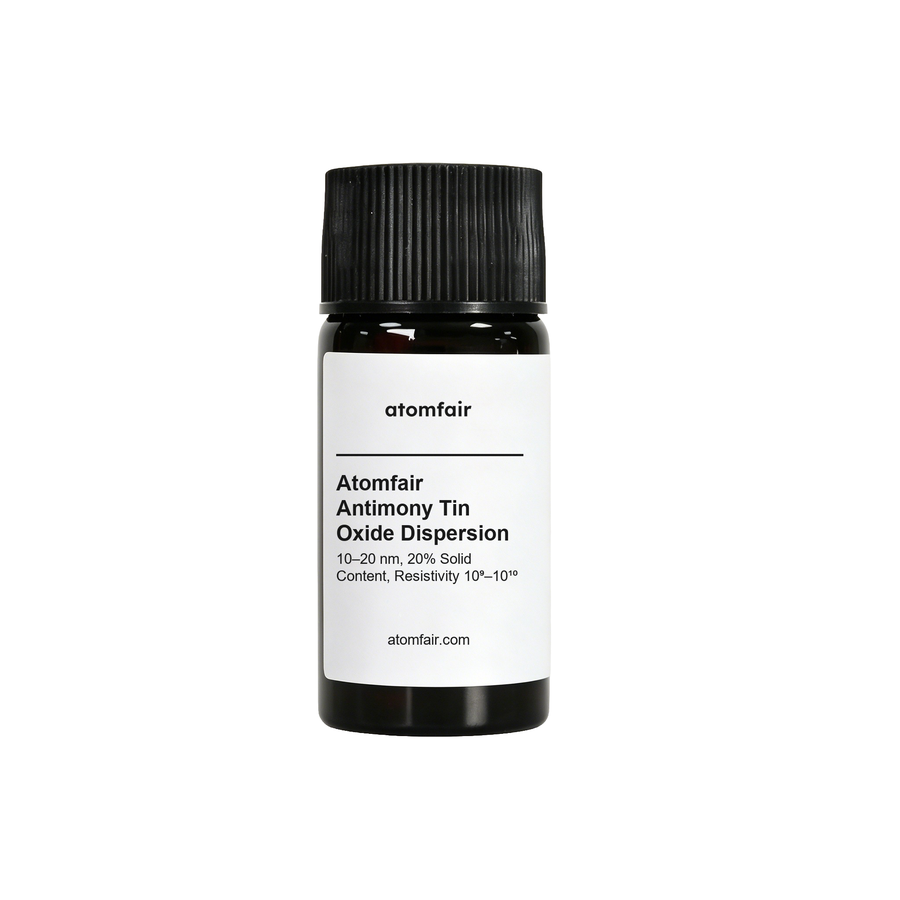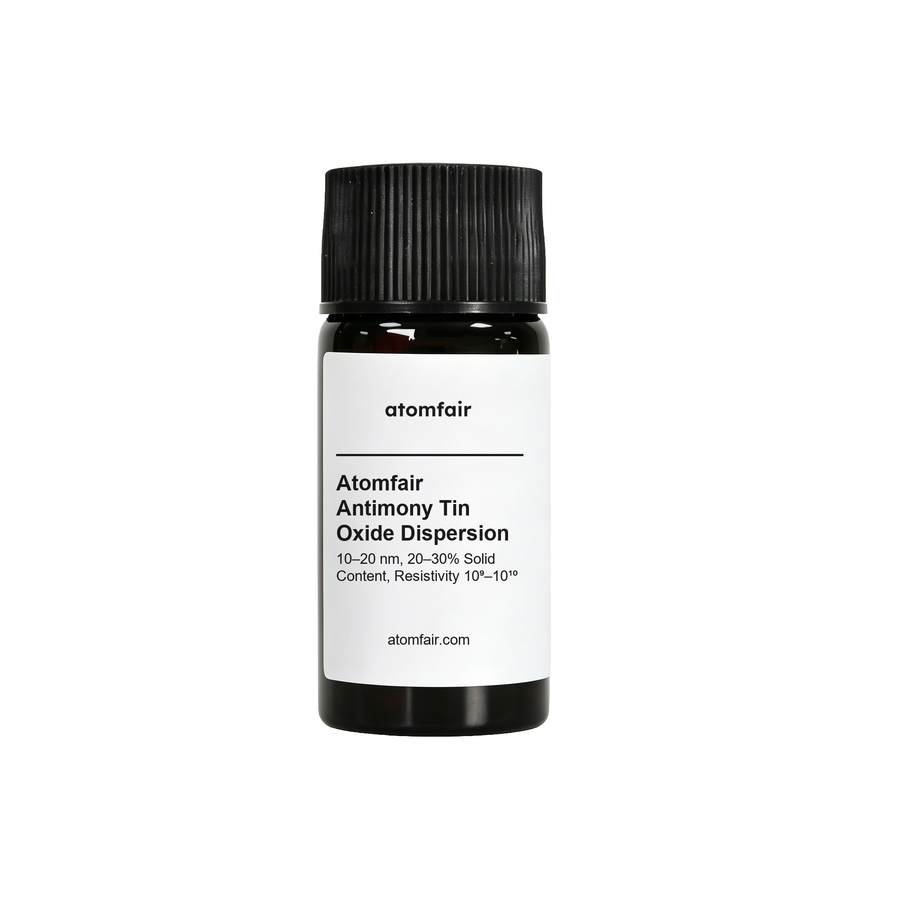
Atomfair Antimony Tin Oxide Dispersion, 10–20 nm, 20–30% Solid Content, Resistivity 10⁹–10¹⁰
Product Description
Atomfair antimony tin oxide dispersion is supplied as blue-black liquid with a particle size of 10–20 nm, 20–30% solid content, resistivity 10⁹–10¹⁰. It is intended for antistatic applications and radiation-shielding materials.
|
Technical Specifications
|
||||||||||||||||
|
Customization & Ordering
Custom specifications, quantities, and packaging may be available upon request. Submit the required specification and delivery timeline through Request a Quote.
Key Features and Advantages
- Resistivity of 10⁹–10¹⁰
- Light-color transparency
- Radiation resistance
APPLICATION SCOPE: antistatic applications, radiation-shielding materials, and thermal-insulation materials.
DOCUMENTATION: COA and SDS can be provided upon request for batch-specific confirmation.
LABORATORY PROCUREMENT SUPPORT
For grade selection, particle-size confirmation, documentation support or custom specification review, contact our technical sales team.
What is the relationship between the particle size (10–20 nm) and the optical transparency of antimony tin oxide coatings?
The small particle size of 10–20 nm is below the visible light wavelength, enabling the dispersion to form transparent coatings. The product is described as having light-color transparency, making it suitable for applications where optical clarity is needed alongside antistatic properties.
Can the alcohol-based ATO dispersion be directly incorporated into UV-curable or heat-curable resin systems?
The dispersion is supplied in alcohol, which may be compatible with alcohol-based resins but may require solvent exchange for other systems. The manufacturer recommends contacting technical sales for grade selection and compatibility testing. The product is intended for antistatic and radiation-shielding materials, implying broad formulation flexibility.
What are the recommended storage conditions to prevent sedimentation or agglomeration of ATO nanoparticles in the dispersion?
The dispersion should be stored in a sealed container at room temperature, away from direct sunlight and extreme temperatures. The product is a stable liquid with a solid content of 20–30%, but periodic agitation may be needed before use. The manufacturer can provide batch-specific stability data via COA.
Atomfair antimony tin oxide dispersion offers 10–20 nm particles with 10⁹–10¹⁰ resistivity in an alcohol carrier, delivering antistatic and radiation-shielding performance with light-color transparency, though solvent flammability and solid-content variability require controlled handling and batch calibration.
Positive
- High resistivity for antistatic use: Resistivity of 10⁹–10¹⁰ Ω·cm provides effective static dissipation for antistatic and radiation-shielding applications.
- Nanoscale particle dispersion: 10–20 nm particles in alcohol solvent yield light-color transparency and uniform film formation for optical coatings.
Trade-offs
- Flammable alcohol solvent: The alcohol-based carrier requires flammability safeguards and proper ventilation during handling and coating processes.
- Solid content variability: 20–30% solid content range demands per-batch viscosity and thickness validation for reproducible coating weights.
Every advanced material, component, equipment, and instrument in our catalog is backed by rigorous testing. We maintain strict internal quality management frameworks and align with CE conformity metrics to deliver transparent, reproducible performance data via our public open-science repository.
To request raw batch performance data, submit formal vendor registration paperwork, or execute a fast-turnaround R&D manufacturing loop, contact us at inquiry@atomfair.com.
Item is dispatched under the Atomfair Shipping & Delivery Framework (Free worldwide shipping on orders over $59 USD excl. heavy equipment). Return is governed by the Atomfair Return & Refund Policy (7-day technical return window).