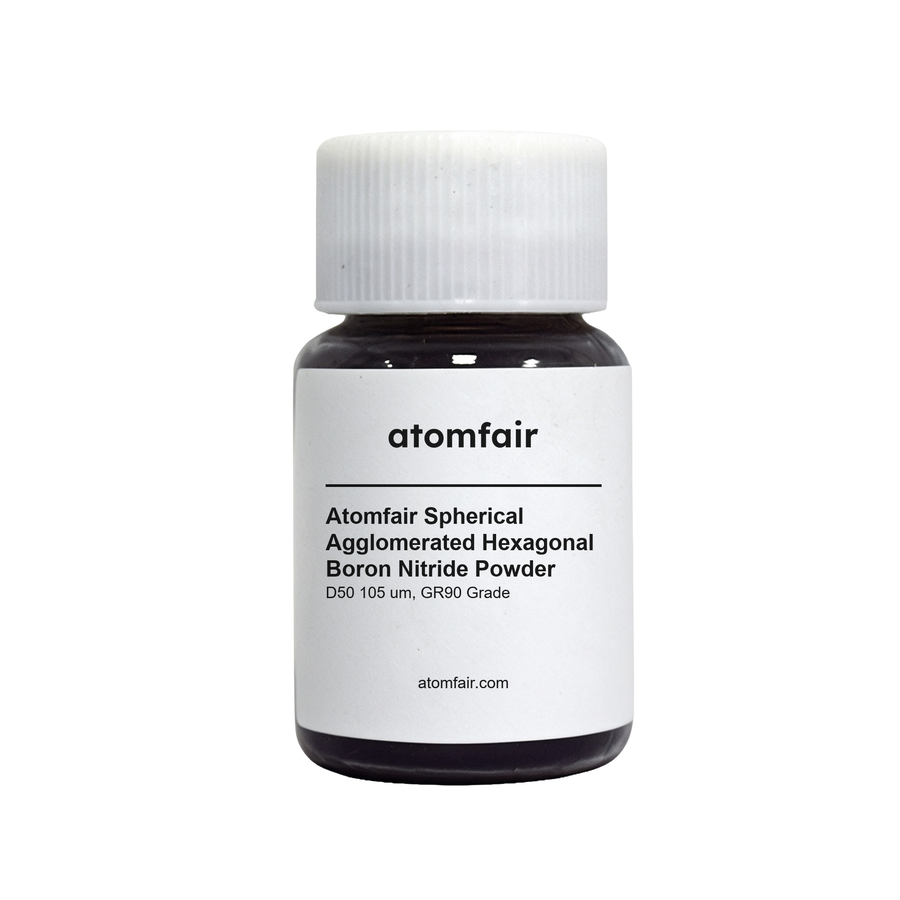
ATOMFAIR® SPHERICAL AGGLOMERATED HEXAGONAL BORON NITRIDE (H-BN) POWDER, D50 105 ΜMRESEARCH GRADE MATERIAL
|
|||||||||||||||||||||||
|
|||||||||||||||||||||||
|
TAILORED SOLUTIONS FOR RESEARCH
Contact our engineering team for technical support or official institutional quotations.
EMAIL: inquiry@atomfair.com
|
|||||||||||||||||||||||
|
Manufacturer: Atomfair LLC
Brand: ATOMFAIR®
|
How does the spherical agglomerated morphology of Atomfair h-BN powder with D50 105 μm influence thermal conductivity in TIM applications compared to non-agglomerated platelets?
The spherical agglomerated morphology, formed from loosely compacted hexagonal boron nitride platelets, enables better packing and reduced interparticle thermal resistance, which can enhance effective thermal conductivity in thermal interface materials. The product is specifically designed for TIM research, with a controlled D50 of 105 μm and tap density of 0.4–0.6 g/cm³ to ensure consistent formulation behavior.
What is the significance of the 0.10% water-soluble boron specification in Atomfair h-BN powder for thermal interface material formulations?
The 0.10% water-soluble boron content indicates a low level of ionic impurities, which is critical for preventing electrical leakage, corrosion, or degradation in sensitive electronic thermal interface materials. This specification is explicitly stated in the product data and is important for maintaining reliability in high-performance TIM applications.
What is the recommended tap density range for this h-BN powder, and how does it affect processing in thermal interface materials?
The tap density is specified as 0.4–0.6 g/cm³, reflecting the bulk density after settling. This range is essential for predicting the powder volume required for a given weight and for understanding its flow and packing behavior during composite mixing or film formation, ensuring consistent filler loading in TIM formulations.
Spherical agglomerated h-BN powder with D50 105 μm and tap density 0.4–0.6 g/cm³, specified for thermal-interface-material research; the loose platelet agglomerates offer controlled packing and flow, while the 0.10% water-soluble boron content imposes a purity consideration for high-reliability applications.
Positive
- Spherical agglomerate morphology: Loosely compacted h-BN platelets form spherical agglomerates that improve flowability and packing uniformity in thermal-interface-material formulations, enabling reproducible filler loading.
- Specified D50 and tap density: The defined D50 of 105 μm and tap density range of 0.4–0.6 g/cm³ provide a consistent particle-size and packing baseline for process design and quality control in research-scale TIM development.
Trade-offs
- Low tap density increases volume: With a tap density of 0.4–0.6 g/cm³, the powder occupies a large volume per unit mass, requiring larger storage and handling volumes and potentially limiting maximum filler loading in composite formulations.
- Water-soluble boron impurity: The 0.10% water-soluble boron content may introduce soluble ionic species that could affect electrical insulation properties or chemical compatibility in sensitive thermal-interface applications, necessitating purity verification for critical use.
Every advanced material, component, equipment, and instrument in our catalog is backed by rigorous testing. We maintain strict internal quality management frameworks and align with CE conformity metrics to deliver transparent, reproducible performance data via our public open-science repository.
To request raw batch performance data, submit formal vendor registration paperwork, or execute a fast-turnaround R&D manufacturing loop, contact us at inquiry@atomfair.com.
Item is dispatched under the Atomfair Shipping & Delivery Framework (Free worldwide shipping on orders over $59 USD excl. heavy equipment). Return is governed by the Atomfair Return & Refund Policy (7-day technical return window).