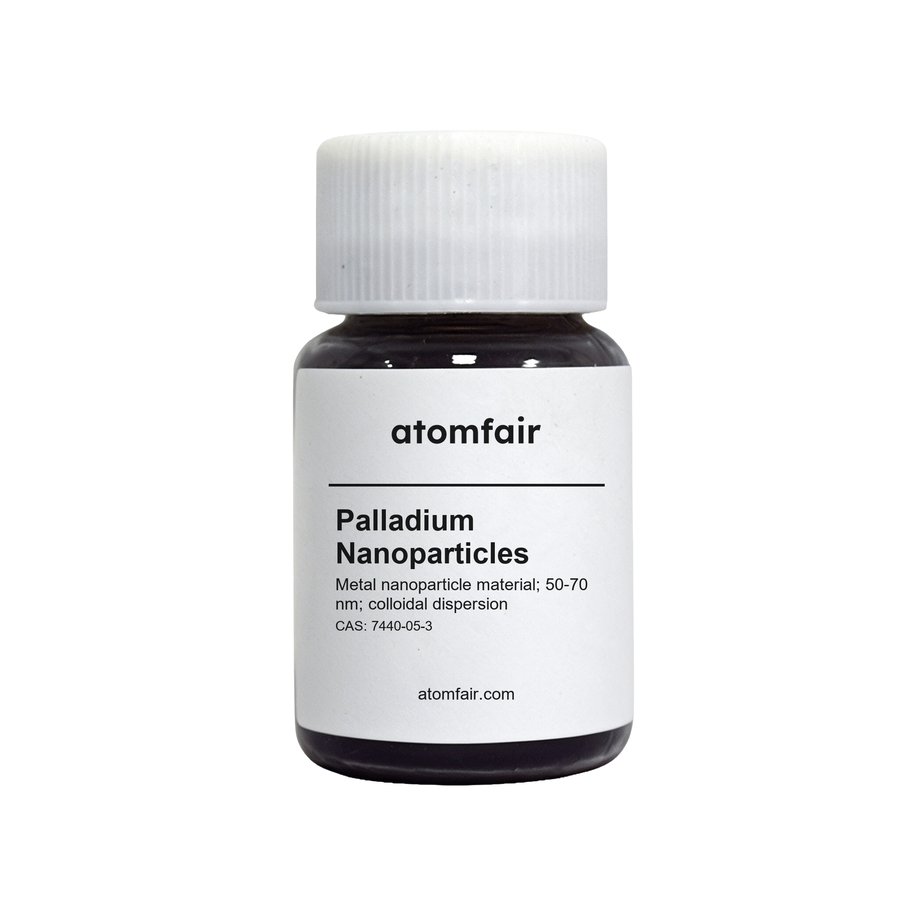
PALLADIUM NANOPARTICLES 50-70 NM 50-70NM RESEARCH GRADE NANOMATERIALRESEARCH GRADE MATERIAL
|
||||||||||||||||||||||||||||||||||||||||
|
Brand: ATOMFAIR®
This colloidal dispersion requires sealed, light-protected storage to prevent photodegradation and contamination. Confirm specific handling conditions and consult the Safety Data Sheet before use.
- Light Protection Requirement: Store the colloidal dispersion in a sealed container protected from light to maintain stability.
What is the dispersion medium concentration and how does it affect catalytic activity of 50-70 nm palladium nanoparticles?
The palladium nanoparticles are supplied as a colloidal dispersion at a concentration of 100 mg/L (100 ppm) in the dispersion medium. This low stabilizer concentration minimizes interference in catalysis and electrocatalysis experiments, allowing the 50-70 nm particle surface to remain accessible for reaction studies without excessive surfactant blocking active sites.
Can these 50-70 nm palladium nanoparticles be used directly in SERS and Raman sensing without additional functionalization?
Yes, the 50-70 nm particle size is suitable for SERS and Raman sensing applications as stated in the product description. However, the colloidal dispersion format with 100 ppm stabilizer may require washing or buffer exchange depending on the target analyte and substrate preparation protocol. Confirm handling conditions before procurement.
What storage and handling conditions are required to maintain colloidal stability of 50-70 nm palladium nanoparticles?
The product must be stored sealed and light-protected to prevent aggregation and photo-degradation of the colloidal dispersion. The 25 mL and 100 mL sealed laboratory packaging formats are designed for short-term research use; avoid freeze-thaw cycles and use appropriate personal protective equipment as specified in the SDS.
This 50-70 nm palladium nanoparticle colloidal dispersion (CAS 7440-05-3) is evaluated for catalysis, coating, electrode, and sensing R&D, with size-defined behavior and a 100 ppm stabilizer for dispersion stability, but requires sealed, light-protected storage and research-grade handling precautions.
Positive
- Controlled 50-70 nm particle size: The nominal 50-70 nm size range enables particle-size-driven screening and formulation optimization for catalysis, SERS, and biomedical studies.
- Colloidal dispersion with stabilizer: Supplied as a colloidal dispersion at 100 mg/L (100 ppm) stabilizer, providing a ready-to-use, uniform dispersion for conductive paste, coating, and electrode development.
Trade-offs
- Sealed, light-protected storage required: The material must be stored sealed and light-protected to prevent degradation, indicating sensitivity to light and atmospheric exposure that limits handling and shelf-life under normal lab conditions.
- Research grade, not clinical or commercial: Intended for laboratory-scale R&D only; users must confirm specifications before procurement and follow SDS safety guidelines, reflecting a lack of regulatory approval for medical or industrial use.
Every advanced material, component, equipment, and instrument in our catalog is backed by rigorous testing. We maintain strict internal quality management frameworks and align with CE conformity metrics to deliver transparent, reproducible performance data via our public open-science repository.
To request raw batch performance data, submit formal vendor registration paperwork, or execute a fast-turnaround R&D manufacturing loop, contact us at inquiry@atomfair.com.
Item is dispatched under the Atomfair Shipping & Delivery Framework (Free worldwide shipping on orders over $59 USD excl. heavy equipment). Return is governed by the Atomfair Return & Refund Policy (7-day technical return window).