|
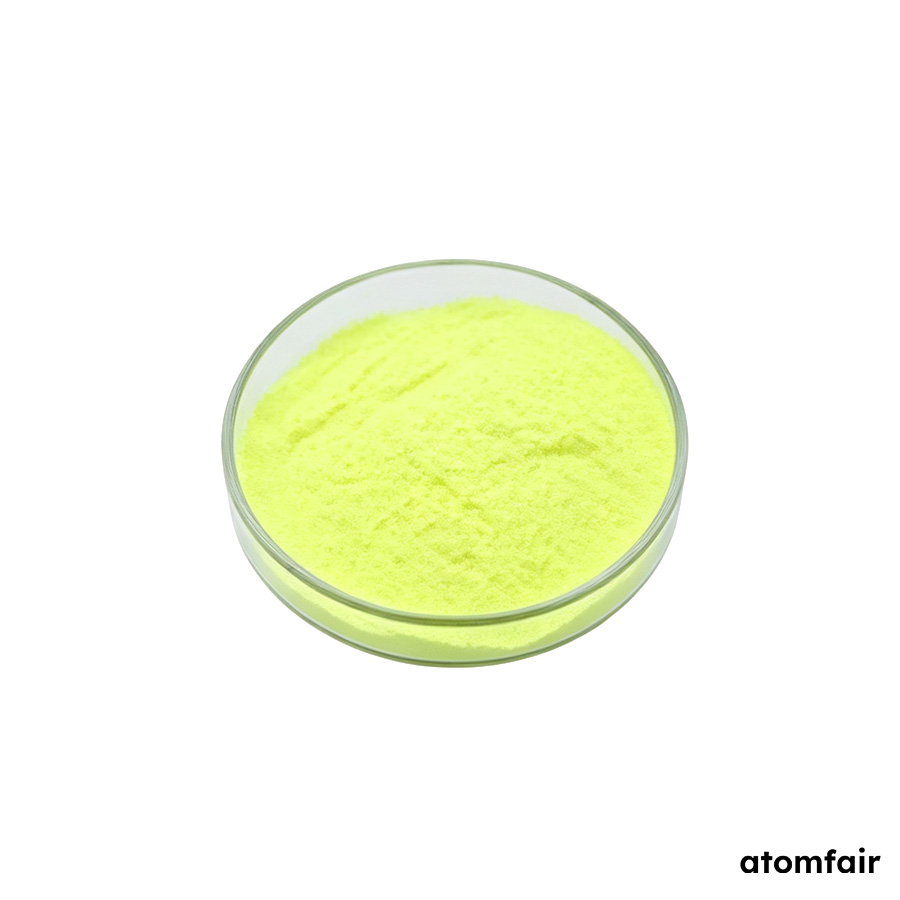
Silicate Yellow-Emitting Phosphor for LED Backlighting D50 17.5 ± 1.5µm
Research-grade luminescent powder
|
|||||||||||||||||||||||||||||
|
|||||||||||||||||||||||||||||
|
PHOSPHOR SELECTION AND QUOTATION SUPPORT
For model selection, particle-size confirmation and quotation support, contact our technical sales team.
E-MAIL: inquiry@atomfair.com
|
|||||||||||||||||||||||||||||
|
Manufacturer: Atomfair LLC
Brand: ATOMFAIR®
|
This phosphor must be kept sealed, dry, and protected from direct light to prevent moisture-induced degradation and photobleaching. Airborne dust during transfer must be minimized to avoid inhalation exposure and cross-contamination.
- Moisture Sensitivity: Sealed, moisture-resistant packaging is required to maintain phosphor stability and prevent hydrolysis of the silicate matrix.
- Light Sensitivity: Direct light exposure must be avoided to preserve the phosphor's quantum efficiency and spectral output characteristics.
- Dust Control: Airborne dust generation during transfer must be minimized using local exhaust ventilation or containment to reduce inhalation risk.
Transfer the phosphor in a low-humidity environment using antistatic tools to prevent segregation and moisture uptake. Store the sealed container in a dark, dry cabinet at controlled room temperature.
Required Equipment: Antistatic spatula or scoop, Sealed, moisture-resistant container
- Prepare transfer environment
Verify that the transfer area has relative humidity below 30% and is free from direct light sources. - Open original container
Open the sealed phosphor container inside a fume hood or glovebox to contain airborne dust. - Transfer phosphor
Transfer the required amount using an antistatic spatula to minimize electrostatic segregation of particles. - Reseal storage container
Immediately reseal the original container with a moisture-proof closure to prevent ambient moisture ingress. - Store container
Store the sealed container in a dark cabinet at 20–25 °C until next use.
How does the 95.3 nm FWHM of this silicate yellow phosphor affect color blending in LED backlighting compared to narrower-band phosphors?
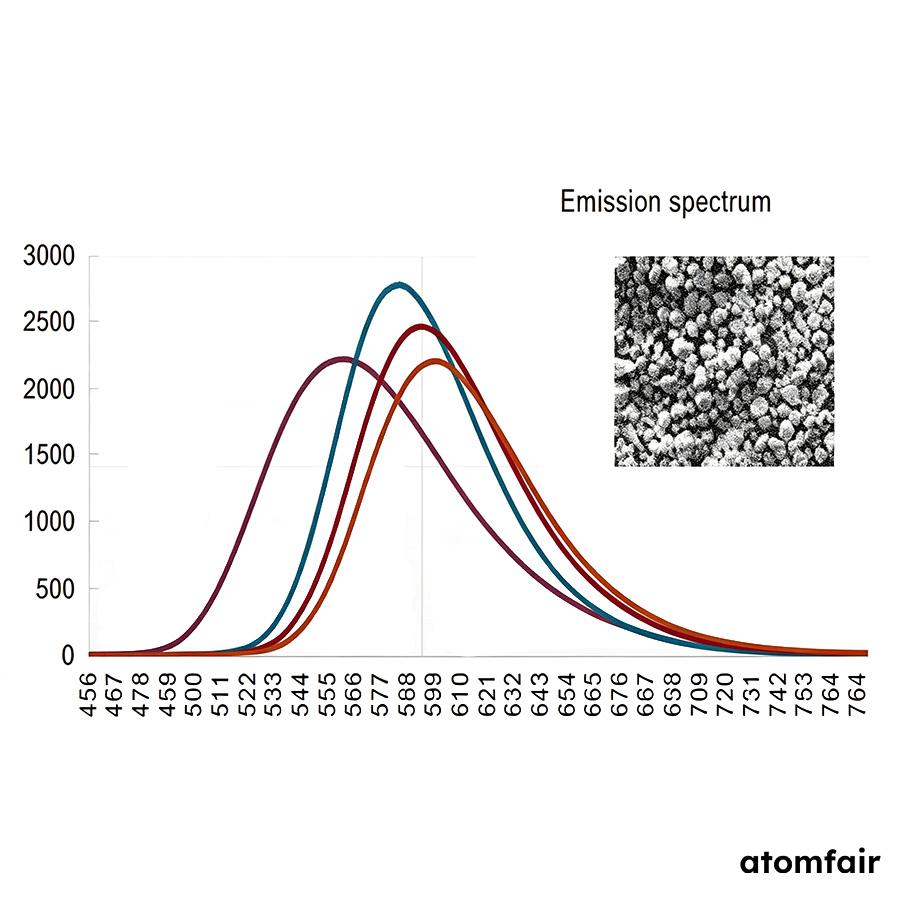
The 95.3 ± 0.5 nm full width at half maximum provides a broad spectral output that supports wide color gamut blending in LED backlighting applications. This broad emission, centered at a peak wavelength of 571.4 ± 0.2 nm with chromaticity coordinates (0.448, 0.535), enables smoother color mixing and more uniform white-point tuning compared to narrower-band phosphors, which may produce sharper spectral lines and require more precise formulation to avoid color non-uniformity.
What are the key compatibility considerations when integrating this silicate phosphor into an existing LED backlight formulation?
The median particle size of D50 17.5 ± 1.5 µm must be matched to the dispensing or coating process to avoid sedimentation or clogging. The silicate system offers resistance to phosphor segregation and stable batch characteristics, which supports consistent dispersion in silicone or epoxy binders. The defined dominant wavelength of 561.8 ± 1.0 nm and chromaticity coordinates (0.448, 0.535) should be verified against the target white-point and color filter transmission to ensure proper color balance.
What handling and storage conditions are required to maintain the quantum efficiency of this silicate yellow phosphor?
The phosphor must be kept sealed, dry, and protected from direct light to prevent moisture-induced degradation and photobleaching that can reduce quantum efficiency. During transfer, airborne dust should be minimized using suitable laboratory protective equipment, and applicable safety documentation must be reviewed before handling. Atomfair can coordinate sealed, moisture-resistant packaging to maintain batch stability during transport and storage.
This silicate yellow-emitting phosphor provides precisely defined spectral output (peak emission 571.4 nm, FWHM 95.3 nm) and controlled particle size (D50 17.5 µm) for LED backlighting, with resistance to segregation and stable batch characteristics, though it requires sealed, dry, light-protected storage and careful dust management during handling.
Positive
- Defined spectral and chromaticity parameters: Peak emission at 571.4 ± 0.2 nm, dominant wavelength 561.8 ± 1.0 nm, FWHM 95.3 ± 0.5 nm, and chromaticity coordinates (0.448, 0.535) enable precise color blending and reproducible backlight formulation.
- Resistance to segregation and batch stability: The silicate phosphor system exhibits resistance to phosphor segregation and stable batch characteristics, supporting consistent manufacturing and formulation in LED backlighting applications.
Trade-offs
- Moisture and light sensitivity during storage: The phosphor must be kept sealed, dry, and protected from direct light to prevent degradation, requiring controlled storage conditions and careful inventory management.
- Dust inhalation hazard during handling: Minimizing airborne dust and using suitable laboratory protective equipment are necessary during transfer, along with review of applicable safety documentation before handling.
Every advanced material, component, equipment, and instrument in our catalog is backed by rigorous testing. We maintain strict internal quality management frameworks and align with CE conformity metrics to deliver transparent, reproducible performance data via our public open-science repository.
To request raw batch performance data, submit formal vendor registration paperwork, or execute a fast-turnaround R&D manufacturing loop, contact us at inquiry@atomfair.com.
Item is dispatched under the Atomfair Shipping & Delivery Framework (Free worldwide shipping on orders over $59 USD excl. heavy equipment). Return is governed by the Atomfair Return & Refund Policy (7-day technical return window).