
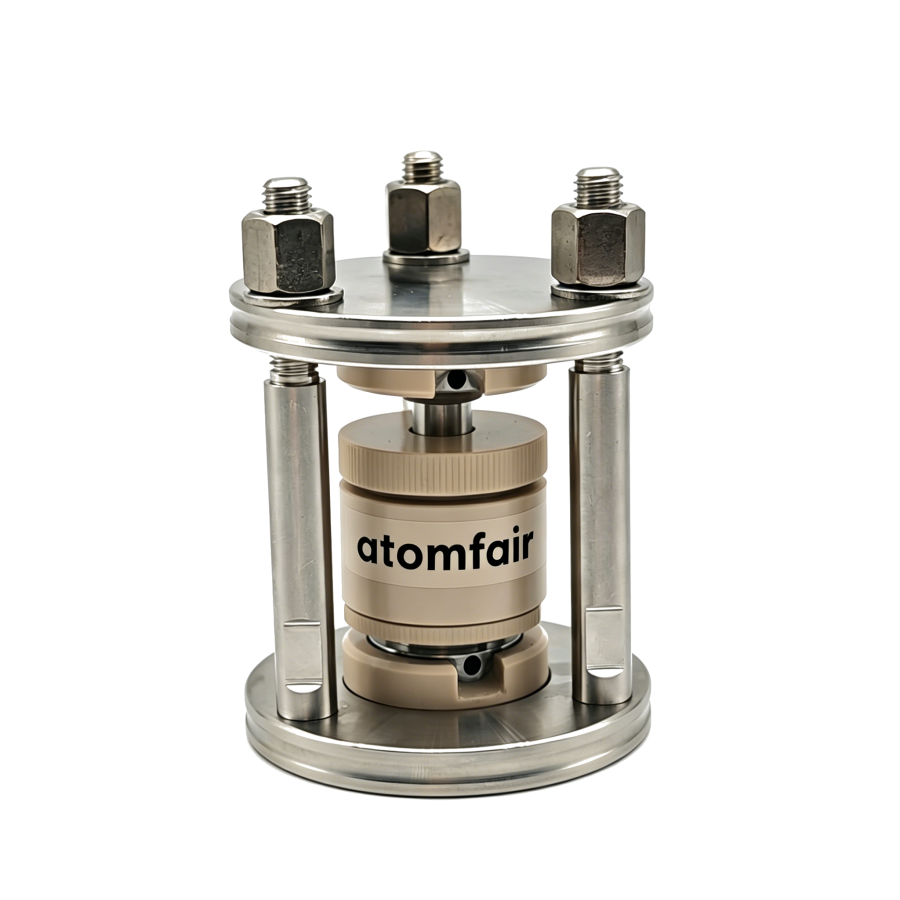
ATOMFAIR® PEEK SOLID-STATE BATTERY MOLDRESEARCH GRADE MATERIAL
|
|||||||||||||||||||||||||||
|
|||||||||||||||||||||||||||
|
TAILORED SOLUTIONS FOR RESEARCH
Contact our engineering team for technical support or official quotations.
EMAIL: inquiry@atomfair.com
|
|||||||||||||||||||||||||||
|
Manufacturer: Atomfair LLC
Brand: ATOMFAIR®
|
This document outlines the critical handling, pressure, temperature, and storage constraints for the Atomfair PEEK solid-state battery mold. Adherence to these limits is mandatory to prevent equipment damage and ensure reliable battery material testing.
- Pressure and Temperature Limits: The mold is rated for a maximum pressure of 6 tons and a maximum operating temperature of 210°C; exceeding these limits may cause permanent deformation or failure.
- Sealing and Atmosphere: The dual sealing structure (thread plus sealing ring) permits testing directly in ambient air without requiring a glovebox environment.
- Surface Preparation: The electrode head features a mirror-polished surface to ensure uniform force distribution; before each use, anti-rust oil must be removed with cleanroom paper to avoid contaminating test samples.
- Post-Use Maintenance: After use, sample residue must be cleaned promptly to prevent corrosion; for long-term storage, clean with anhydrous ethanol, apply anti-rust oil, and store in a dry environment.
This procedure describes the chronological steps to assemble the battery mold, place it in a press, and perform pressure-controlled testing. Proper execution ensures accurate electrochemical measurements and prolongs mold lifespan.
Required Equipment: Mechanical or manual press (e.g., tablet press), Battery analyzer or electrochemical test station
- Prepare the mold surface
Wipe the mold surface with cleanroom paper to remove anti-rust oil before assembly. - Load battery components
Place electrode sheets, separator, and electrolyte directly into the center of the ceramic sleeve. - Position in press
Position the assembled mold at the center of the tablet press, ensuring it is aligned. - Apply pressure
Apply pressure gradually up to the mold's rated maximum of 6 tons for the required test duration. - Connect and measure
Connect the electrode tabs to a battery analyzer and perform electrochemical measurements.
Within what pressure and temperature range can the PEEK solid-state battery mold be operated to avoid structural failure while maintaining reliable performance?
The mold is rated for a withstand pressure of 0–6 tons and a maximum temperature of 210 °C. Operating within this envelope ensures the PEEK outer shell retains its mechanical strength and the ceramic sleeve provides stable, non-stick performance. Exceeding these limits risks damaging the PEEK structure or compromising pellet integrity.
Is a glovebox mandatory for assembling and testing all-solid-state batteries with this mold?
No, this mold is designed with a sealing structure that includes a thread and sealing ring, enabling testing directly in air without glovebox requirements. This is particularly advantageous for handling air-sensitive solid electrolytes and simplifies the electrochemical measurement workflow.
What cleaning and storage procedure is recommended to extend the mold's lifespan after use with metal powders?
After use, promptly remove sample residue to prevent corrosion. For long-term storage, clean the mold with anhydrous ethanol, dry thoroughly, apply anti-rust oil, and store in a dry environment. When working with viscous metal powders such as aluminum, magnesium, or zinc, use a suitable lubricant during compression to reduce friction and wear.
This PEEK solid-state battery mold integrates a ceramic inner sleeve (Ra 0.08) with a mirror-polished die steel electrode head, supporting pressures up to 6 T and temperatures to 210 °C for all-solid-state lithium battery testing. Its sealed design enables direct air operation without a glovebox, though careful cleaning and anti-rust storage are required after use.
Positive
- Ceramic sleeve with low adhesion: The ceramic inner test sleeve (standard 10 mm, customizable 5–20 mm) offers high temperature resistance, no powder adhesion, and inner hole roughness Ra 0.08, ensuring easy cleaning and stable long-term performance.
- Sealed design enables air operation: The dual thread-and-sealing-ring structure allows direct testing in air without requiring a glovebox, simplifying setup and reducing infrastructure demands.
Trade-offs
- Rated pressure limit of 6 T: The mold withstands 0–6 T; exceeding this rating may cause damage. Users must carefully control press pressure within this limit.
- Requires anti-rust maintenance: After each use, the mold must be cleaned with anhydrous ethanol and coated with anti-rust oil for long-term storage to prevent corrosion, adding a recurring maintenance step.
Every advanced material, component, equipment, and instrument in our catalog is backed by rigorous testing. We maintain strict internal quality management frameworks and align with CE conformity metrics to deliver transparent, reproducible performance data via our public open-science repository.
To request raw batch performance data, submit formal vendor registration paperwork, or execute a fast-turnaround R&D manufacturing loop, contact us at inquiry@atomfair.com.
Item is dispatched under the Atomfair Shipping & Delivery Framework (Free worldwide shipping on orders over $59 USD excl. heavy equipment). Return is governed by the Atomfair Return & Refund Policy (7-day technical return window).