1-Butyl-3-methylimidazolium bromide (BMIM Br), 99%, Ionic Liquid
Product Introduction
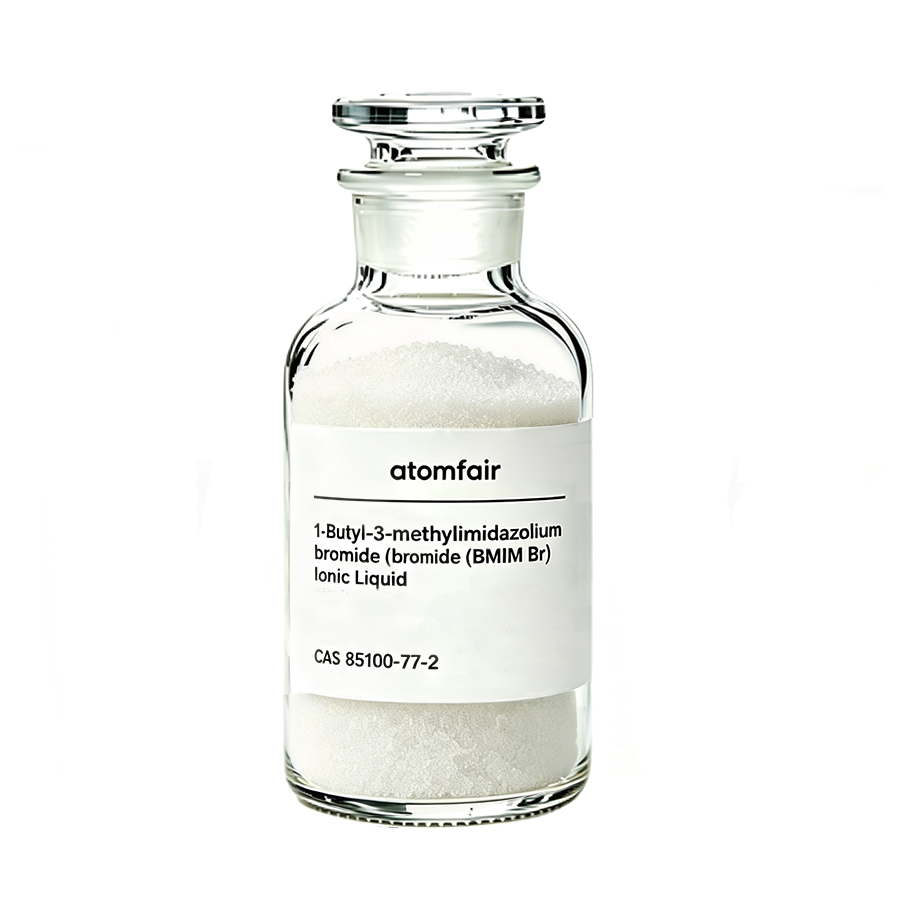
1-Butyl-3-methylimidazolium bromide (BMIM Br), 99%, Ionic Liquid is a research ionic liquid ionic liquid identified in the supplied product record as 1-Butyl-3-methylimidazolium with Bromide (Br). The record lists CAS number 85100-77-2, molecular formula C8H15BrN2, purity 99%, package 100g.
The material is used in laboratory research in organic synthesis, catalysis, electrochemistry, electrodeposition, and molten-salt studies. Use as a reaction medium or electrolyte component. Confirm moisture sensitivity, compatibility, and operating conditions before use.
Key Features
- Defined ionic composition: The listed cation and anion provide a clear basis for electrolyte, solvent, and reaction-medium comparison.
- Declared purity: The supplied record lists 99% purity, supporting controlled material selection for research trials.
- Research package: Supplied in 100g for laboratory-scale evaluation and procurement planning.
- Compatibility and handling reference: The product record notes soluble in water, which helps screen aqueous handling and solvent compatibility. The supplied thermal references include melting point 70 °C.
Technical Specifications
| Parameter | Specification |
|---|---|
| Product Name | 1-Butyl-3-methylimidazolium bromide (BMIM Br), 99%, Ionic Liquid |
| CAS No. | 85100-77-2 |
| Cation | 1-Butyl-3-methylimidazolium |
| Anion | Bromide (Br) |
| Molecular Formula | C8H15BrN2 |
| Molecular Weight | 219.12 g/mol |
| Purity | 99% |
| Grade | Research Ionic Liquid |
| Melting Point | 70 °C |
| Water Solubility | Soluble in water |
| Package | 100g |
Application Areas
- Electrolyte composition and ion-coordination studies
- Electrochemical reaction-media development
- Organic synthesis and catalysis research
- Solvent compatibility and separation-process screening
- Battery and energy-storage formulation research where the listed ionic composition is appropriate
Handling and Procurement
Keep the container tightly closed in a cool, dry, well ventilated area. Protect the material from moisture, water contamination, heat, and direct sunlight, and keep the container closed when not in use. Handle it only in accordance with the SDS and use appropriate protective equipment.
Related Products
| Research Need | Related Product | Best For |
|---|---|---|
| Compare the same cation with a different counterion | 1-Butyl-3-methylimidazolium chloride (BMIM Cl), 99%, Ionic Liquid | Counterion screening and formulation comparison. |
| Compare the same cation with a different counterion | 1-Butyl-3-methylimidazolium dicyanamide (BMIM DCA), Research Grade, 98%, Ionic Liquid | Counterion screening and formulation comparison. |
| Compare the same cation with a different counterion | 1-Butyl-3-methylimidazolium tetrafluoroborate (BMIM BF4), Research Grade, 99%, Ionic Liquid | Counterion screening and formulation comparison. |
| Compare the same cation with a different counterion | 1-Butyl-3-methylimidazolium thiocyanate (BMIM SCN), Ionic Liquid | Counterion screening and formulation comparison. |
This ionic liquid compound is a solid at standard laboratory temperatures and exhibits high water solubility. Proper storage in a sealed, dry environment is essential to prevent moisture absorption and maintain research-grade purity.
- Temperature Stability: Store the compound below its melting point of 70°C to maintain the solid state for handling.
- Moisture Sensitivity: Keep the container tightly sealed when not in use, as the compound's solubility in water indicates potential hygroscopicity.
- Container Material: Use corrosion-resistant containers such as glass or HDPE to avoid contamination.
- Handling Environment: Perform transfers in a low-humidity environment or glovebox to minimize moisture exposure.
- Disposal: Dispose of waste in accordance with local regulations for bromide-containing organic compounds.
This procedure outlines the dissolution of solid [C4MIm]Br in deionized water for solution-based experiments. Ensure all equipment is clean and dry before handling the compound.
Required Equipment: Analytical balance, Glass beaker, Magnetic stirrer, Sealed storage bottle
- Weigh the compound
Transfer the solid [C4MIm]Br using a clean spatula onto a tared weighing boat and record the mass. - Transfer to beaker
Pour the weighed solid into a clean glass beaker containing the desired volume of deionized water. - Stir to dissolve
Agitate the mixture using a magnetic stirrer until the solid is fully dissolved, forming a clear solution. - Store the solution
Transfer the solution to a sealed storage bottle and label with the compound name, concentration, and date.
How does the 70°C melting point of [C4MIm]Br affect its use as a room-temperature electrolyte?
[C4MIm]Br is a solid at standard lab temperatures due to its 70°C melting point. For liquid-phase applications such as electrochemical electrolytes, it must be heated above 70°C, introducing a thermal management requirement that may limit direct room-temperature use. This trade-off is critical for researchers evaluating it against ionic liquids with sub-ambient melting points.
Can [C4MIm]Br be dissolved in common organic solvents for synthesis applications?
The product specifications only confirm solubility in water. No data is provided for organic solvents such as acetonitrile, methanol, or dichloromethane. Researchers should empirically test solubility in their target solvent system before use, as typical imidazolium bromides may show polarity-dependent solubility but this is not guaranteed by the supplier documentation.
What storage and handling conditions are required to preserve the purity of research-grade [C4MIm]Br?
The product ships in climate-controlled protective packaging. As a water-soluble bromide salt, it should be stored in a tightly sealed container in a dry, cool environment to prevent moisture uptake. Standard practice for hygroscopic research-grade solids—such as desiccator or glovebox storage—is recommended to maintain its designated purity. It is sold exclusively for laboratory research and not for commercial or diagnostic use.
This ionic liquid offers high purity and water solubility for reproducible research protocols, but its 70°C melting point necessitates heating for liquid-phase handling.
Positive
- High purity for reproducible research: Premium chemical purity is engineered to ensure consistent, reproducible results in scientific research and analysis.
- Excellent water solubility: The compound is soluble in water, enabling straightforward formulation in diverse solution-based laboratory protocols.
Trade-offs
- High melting point (70°C): A melting point of 70°C means the compound is solid at room temperature, requiring active heating for liquid-phase applications.
- Restricted to research use only: This material is sold exclusively for laboratory research and is prohibited for commercial, diagnostic, or human/animal applications, limiting its deployment scope.
Every advanced material, component, equipment, and instrument in our catalog is backed by rigorous testing. We maintain strict internal quality management frameworks and align with CE conformity metrics to deliver transparent, reproducible performance data via our public open-science repository.
To request raw batch performance data, submit formal vendor registration paperwork, or execute a fast-turnaround R&D manufacturing loop, contact us at inquiry@atomfair.com.
Item is dispatched under the Atomfair Shipping & Delivery Framework (Free worldwide shipping on orders over $59 USD excl. heavy equipment). Return is governed by the Atomfair Return & Refund Policy (7-day technical return window).