|
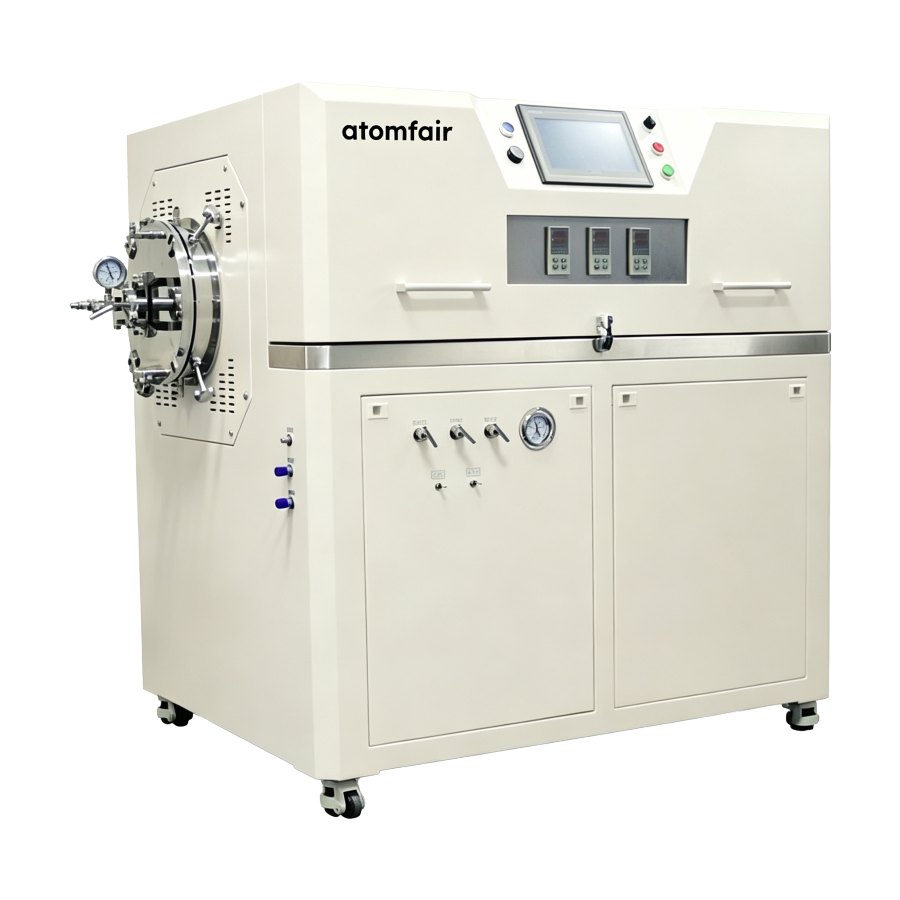
Open Dual-Zone Tube Furnace, 1200 °C
LABORATORY THERMAL PROCESSING EQUIPMENT
|
|||||||||||||||||||
|
|||||||||||||||||||
|
LABORATORY PROCUREMENT SUPPORT
For model selection, configuration matching, power supply confirmation or quotation review, contact our technical sales team.
E-MAIL: inquiry@atomfair.com
|
|||||||||||||||||||
|
Manufacturer: Atomfair LLC
Brand: ATOMFAIR®
|
The furnace requires confirmation of temperature class, process size, gas/vacuum package, and power supply before use. Operate only with appropriate protective equipment and ensure tube material compatibility with process gases.
- Pre-Operation Verification: Confirm temperature class, usable process size, gas/vacuum package, power supply, and accessory configuration before initiating operation.
- Thermal Safety: Maintain a safe distance from the heated chamber and use personal protective equipment due to the 1200 °C operating temperature.
- Atmosphere Control: Ensure the gas/vacuum system is properly connected and leak-tested before introducing process gases.
- Tube Loading: Verify the tube material is compatible with the maximum temperature and process atmosphere to avoid failure.
- Pneumatic Spring Mechanism: The pneumatic spring opening mechanism reduces operator risk but must be inspected regularly for proper function.
This furnace requires step-by-step setup and operation to ensure safe and effective thermal processing. Follow these steps to initialize the furnace and conduct controlled heating under vacuum or gas atmosphere.
Required Equipment: Power supply, Gas/vacuum system, Tube and flanges, Personal protective equipment
- Setup
Set up the furnace on a stable, heat-resistant surface and connect it to the specified power supply. - Install Process Tube
Install the process tube and secure the flanges using the support frame to reduce tube load. - Connect Gas or Vacuum
Connect the gas or vacuum lines to the furnace and perform a leak test before starting. - Set Temperature Controllers
Set the independent temperature controllers for each heating zone to the desired program. - Initiate Heating
Initiate heating and monitor the temperature uniformity across the constant-temperature zone. - Cool Down
After completion, allow the furnace to cool to safe temperatures before opening. - Open Door Safely
Use the pneumatic spring mechanism to open the furnace door safely.
How does individual zone control in the 1200 °C dual-zone tube furnace affect temperature uniformity?
Individual zone control allows each of the two heating zones to be regulated independently, enabling precise thermal profiling along the tube. The chamber is veined with 12 sets of resistance wire, which together with zone control achieves a uniform temperature field and a longer constant-temperature zone, critical for consistent sintering and annealing results.
What gas and vacuum conditions can the 1200 °C dual-zone tube furnace accommodate?
The furnace is designed as a vacuum/atmosphere tube furnace, supporting controlled heating under both vacuum and flowing-gas treatments. It is suitable for inert or reactive gas environments, with a support frame for the flange that reduces load on the tube body during vacuum operation, ensuring structural integrity.
What safety features are included in the 1200 °C dual-zone tube furnace design?
The furnace is equipped with a pneumatic spring for opening, which reduces operator effort and prevents uncontrolled closure, enhancing safety during loading and unloading. Additionally, the reinforced outer packaging and protective inner materials ensure safe handling and storage, while the support frame for the flange minimizes tube stress during operation.
The open dual-zone tube furnace rated for 1200°C enables independent temperature control of two heating zones with individual instruments, features a 12-set resistance wire configuration for uniform temperature fields and extended constant-temperature zones, and includes a pneumatic spring opening mechanism for operator safety. However, the system requires pre-quotation confirmation of temperature class, process size, gas/vacuum package, power supply, and accessories, making it a configurable rather than plug-and-play solution.
Positive
- Independent dual-zone control: Each heating zone is controlled individually by a separate instrument, enabling precise thermal gradients or multi-step profiles for advanced annealing, sintering, and controlled heating processes.
- Uniform temperature with extended zone: The chamber is veined with 12 sets of resistance wire, which promotes a uniform temperature field and a longer constant-temperature zone, critical for reproducible thermal processing.
Trade-offs
- Requires pre-configuration validation: Before deployment, the user must confirm the temperature class, usable process size, gas/vacuum package, power supply, and accessory configuration, adding a consultation step before ordering.
- Dual-zone complexity with two controllers: The need for two separate control instruments increases setup complexity, operator training requirements, and potential for coordination errors between zones.
Every advanced material, component, equipment, and instrument in our catalog is backed by rigorous testing. We maintain strict internal quality management frameworks and align with CE conformity metrics to deliver transparent, reproducible performance data via our public open-science repository.
To request raw batch performance data, submit formal vendor registration paperwork, or execute a fast-turnaround R&D manufacturing loop, contact us at inquiry@atomfair.com.
Item is dispatched under the Atomfair Shipping & Delivery Framework (Free worldwide shipping on orders over $59 USD excl. heavy equipment). Return is governed by the Atomfair Return & Refund Policy (7-day technical return window).