Atomfair FPI-739 Multi-Beam Interference Experimental Instrument
Product Overview
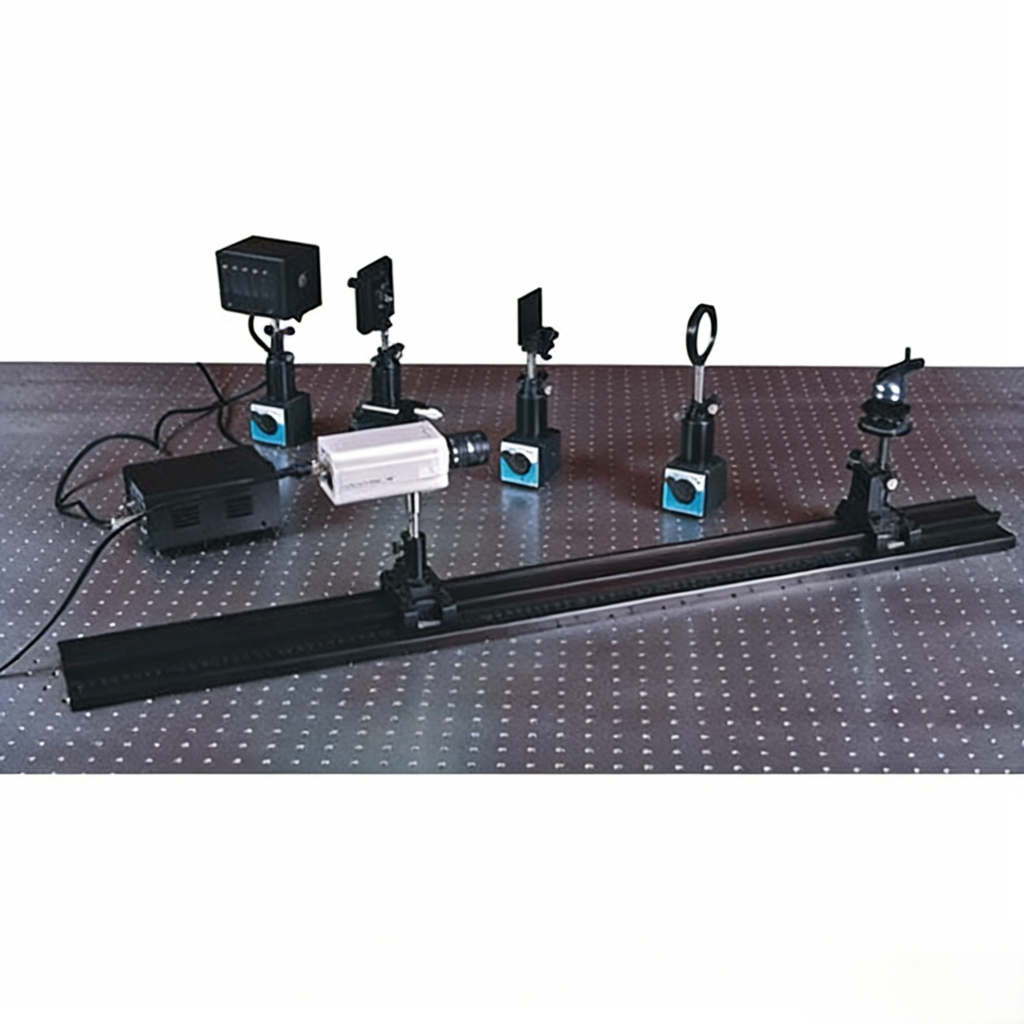
The Atomfair FPI-739 is a high-performance experimental instrument categorized under interference, diffraction, and polarization equipment. It is meticulously engineered to meet international standards, delivering reliable and precise results for academic research, laboratory teaching, and scientific exploration. With its comprehensive configuration and advanced technical parameters, this instrument offers a seamless experimental experience for observing and analyzing multi-beam interference phenomena.
Key Experimental Functions
- Observe multi-beam interference fringes: Intuitively display the physical characteristics of interference phenomena, allowing users to visually perceive the regular patterns and changes of interference fringes, which is essential for understanding the basic principles of optics.
- Accurately measure the wavelength difference of sodium yellow doublet: Provide accurate data support for spectrum analysis-related experiments. It enables precise determination of the wavelength difference between the two spectral lines of sodium yellow light, laying a solid foundation for in-depth research in optical spectroscopy.
- Expand experimental applications: When paired with compatible accessories, the instrument can be used to observe the spectral line shift phenomenon of mercury isotopes and the Zeeman effect of spectral line splitting in a magnetic field. This expandability makes it a versatile tool for exploring various advanced optical phenomena.
Standard Configuration & Technical Parameters
| Item No. | Name | Specification Parameters |
|---|---|---|
| 1 | Instrument Host | Reflector: Diameter 30mm, flatness 1/20λ; Moving mirror preset screw: Minimum division value 0.01mm, stroke 10mm (5–15mm); Measurement accuracy: Minimum reading value 0.0005mm, stroke 1.25mm |
| 2 | Lens | Focal length f’=45mm, equipped with a dedicated lens frame |
| 3 | Ground Glass Screen | Size 55×55mm |
| 4 | Sodium Lamp | Low-voltage design, power 20W |
| 5 | Auxiliary Accessories | Universal base, lens holder, small microscope, and matching microscope frame |
Notes
The configuration and parameters of this product are formulated with reference to international standard specifications, providing customers with a clear understanding of the core performance of the product.
The actual configuration shall be subject to the product packing list. For minor technical adjustments, no separate notice will be given.
If you’re interested, have any questions, or have specific customization requirements, please feel free to contact us at inquiry@atomfair.com.
What is the measurement accuracy of the FPI-739's moving mirror and how does it enable precise determination of the sodium yellow doublet wavelength difference?
The moving mirror assembly provides a minimum reading of 0.0005 mm over a 1.25 mm stroke and a preset screw with a minimum division of 0.01 mm over a 10 mm stroke. This fine adjustment capability allows the optical path difference to be varied with sufficient resolution to resolve the closely spaced 589.0 nm and 589.6 nm lines of the sodium yellow doublet, enabling accurate wavelength difference measurements.
Can the FPI-739 be configured to observe the Zeeman effect or mercury isotope spectral line shifts, and what accessories are needed?
Yes, the instrument can be expanded to observe the spectral line shift of mercury isotopes and the Zeeman effect of spectral line splitting when paired with compatible accessories. The standard configuration includes a lens (f'=45 mm), ground glass screen, low-voltage 20 W sodium lamp, and auxiliary items such as a small microscope and lens holder; specialized accessories for these advanced experiments are not included and must be acquired separately.
What are the handling requirements for the FPI-739's reflector and moving mirror to maintain optical performance?
The reflector has a diameter of 30 mm and a flatness specification of 1/20λ, requiring careful handling to avoid contamination, scratches, or deformation. The moving mirror preset screw allows fine adjustments, but the instrument should be operated on a stable, vibration-free surface. Routine use of the provided ground glass screen and lens ensures proper imaging without direct exposure of optical surfaces to environmental debris.
The Atomfair FPI-739 Multi-Beam Interference Experimental Instrument provides a complete optical bench for observing multi-beam interference and measuring the sodium yellow doublet wavelength difference, with a 30 mm reflector flat to 1/20λ and a 0.0005 mm measurement resolution. Its expandability to mercury isotope and Zeeman effect studies, combined with the included sodium lamp and accessories, makes it a practical choice for advanced optics laboratories.
Positive
- High-precision measurement capability: The moving mirror preset screw offers a minimum division of 0.01 mm over a 10 mm stroke, while the measurement accuracy reaches 0.0005 mm over a 1.25 mm stroke, enabling precise determination of the sodium yellow doublet wavelength difference.
- Expandable for advanced optical studies: With compatible accessories, the instrument supports observation of mercury isotope spectral line shifts and the Zeeman effect in magnetic fields, extending its utility beyond basic interference experiments to advanced spectroscopy research.
Trade-offs
- Requires compatible accessories for expansion: The mercury isotope and Zeeman effect experiments are not possible with the standard configuration; they require additional compatible accessories that must be sourced separately, adding to the total cost and lead time.
- Manual adjustment and alignment sensitivity: The moving mirror preset screw and measurement mechanisms require careful manual adjustment, and the optical alignment is sensitive to environmental vibrations and thermal drift, which can affect measurement repeatability in non-ideal lab conditions.
Every advanced material, component, equipment, and instrument in our catalog is backed by rigorous testing. We maintain strict internal quality management frameworks and align with CE conformity metrics to deliver transparent, reproducible performance data via our public open-science repository.
To request raw batch performance data, submit formal vendor registration paperwork, or execute a fast-turnaround R&D manufacturing loop, contact us at inquiry@atomfair.com.
Item is dispatched under the Atomfair Shipping & Delivery Framework (Free worldwide shipping on orders over $59 USD excl. heavy equipment). Return is governed by the Atomfair Return & Refund Policy (7-day technical return window).