|
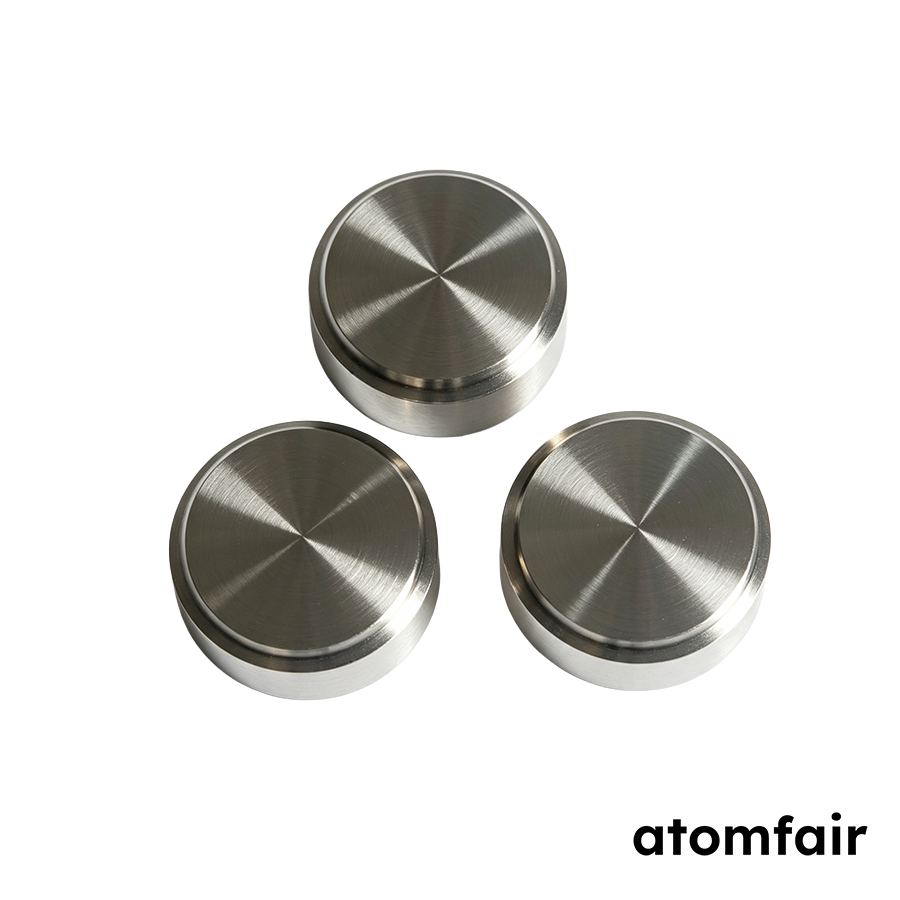
Molybdenum-Tantalum Alloy Sputtering Target (MoTa)
Product Type: Metal alloy sputtering target
Research-grade laboratory product
|
|||||||||||||||||||||||||||||||||||||
|
|||||||||||||||||||||||||||||||||||||
|
LABORATORY PROCUREMENT SUPPORT
INQUIRY: inquiry@atomfair.com
|
|||||||||||||||||||||||||||||||||||||
|
Manufacturer: Atomfair LLC
Brand: ATOMFAIR®
|
The target requires vacuum-based deposition under controlled Ar atmosphere and power density limits to prevent thermal stress or compositional drift. Bonding type and backing plate material must match the sputtering system's cooling and mounting configuration to avoid delamination or poor thermal contact.
- Power density constraint: Operate DC sputtering at 3-15 W/cm² and RF sputtering at 1-5 W/cm² to maintain stable deposition without target cracking or excessive resputtering.
- Atmosphere constraint: Maintain Ar working pressure between 0.5-2.0 Pa to achieve optimal plasma conditions and film stoichiometry within ±2 at% of nominal composition.
- Bonding compatibility constraint: Select indium or elastomer bonding based on the substrate temperature range and cooling capacity of the sputtering cathode to prevent bond failure during extended runs.
- Substrate preparation requirement: Prepare substrates to achieve adhesion strength >15 MPa per ASTM D4541 pull-off test, as deposited film adhesion depends on surface cleanliness and roughness.
This procedure covers mounting, bonding verification, and pre-sputter conditioning of the MoTa alloy target for DC/RF magnetron sputtering. Proper installation prevents arcing, thermal shock, and contamination during initial deposition runs.
Required Equipment: Sputtering system with DC/RF power supply, Argon gas supply with mass flow controller, Vacuum gauge and substrate holder
- Inspect target surface and dimensions
Inspect the target surface for visible defects, verify dimensions against the sputtering cathode pocket, and confirm thickness tolerance within ±0.1 mm. - Mount target with appropriate bonding
Mount the target onto the backing plate using the specified indium or elastomer bonding method, ensuring full thermal contact across the interface. - Install assembly into vacuum chamber
Install the bonded target assembly into the sputtering cathode, tighten all mechanical clamps, and connect cooling water lines to the backing plate. - Evacuate chamber and introduce Ar gas
Evacuate the chamber to base pressure below 1×10⁻⁴ Pa, then backfill with Ar to a working pressure of 0.5-2.0 Pa using the mass flow controller. - Condition target by pre-sputtering
Pre-sputter the target for 10-15 minutes at 50% of maximum rated power density to remove surface oxides and stabilize the plasma. - Set deposition parameters and begin coating
Set the power density to the desired value within 3-15 W/cm² (DC) or 1-5 W/cm² (RF), adjust substrate distance, and begin deposition at a rate of 10-80 nm/min.
How does the MoTa alloy composition affect film stoichiometry and what tolerance can be achieved?
The MoTa sputtering target is supplied with a nominal composition per the chemical formula, enabling stoichiometric transfer to deposited films within ±2 at% under optimized sputtering conditions. This ensures the intended alloy ratio is preserved in the film for applications such as diffusion barriers and gate electrodes.
What are the recommended deposition parameters for achieving uniform MoTa films on 100 mm substrates?
The MoTa target is optimized for DC/RF magnetron sputtering at 3-15 W/cm² (DC) or 1-5 W/cm² (RF) under 0.5-2.0 Pa Ar atmosphere, achieving deposition rates of 10-80 nm/min with ±5% thickness uniformity across a 100 mm substrate. These parameters are specific to the 8 in diameter x 0.25 in target size and should be validated with your deposition system.
What bonding and backing plate options are available for the MoTa sputtering target and how do they impact thermal management?
The MoTa target offers optional indium bonding or elastomer bonding, and backing plate options of oxygen-free copper or CuCrZr. These choices influence thermal conductivity and mechanical stability during sputtering; for instance, indium bonding provides excellent thermal transfer for high-power DC operation, while elastomer bonding may be selected for lower-temperature or specific system compatibility.
Molybdenum-Tantalum alloy sputtering target with 99.95% purity and 8-inch diameter, optimized for DC/RF magnetron sputtering to achieve deposition rates up to 80 nm/min and ±5% thickness uniformity on 100 mm substrates, suitable for diffusion barriers and high-temperature protective coatings.
Positive
- High purity with low impurities: 99.95% (3N5) purity with total metallic impurities <500 ppm and O+N <100 ppm minimizes contamination, improving deposited film resistivity and adhesion.
- Optimized deposition performance: DC/RF magnetron sputtering at 3-15 W/cm² (DC) or 1-5 W/cm² (RF) under 0.5-2.0 Pa Ar achieves deposition rates of 10-80 nm/min with ±5% thickness uniformity across a 100 mm substrate.
Trade-offs
- Requires controlled sputtering conditions: Optimal performance depends on specific DC/RF power density ranges and Ar pressure; deviations may affect deposition rate and film uniformity. Bonding type and backing plate selection also require matching to system thermal management.
- Substrate preparation critical for adhesion: Adhesion strength >15 MPa (ASTM D4541) is achieved only on properly prepared substrates, requiring careful surface cleaning and conditioning prior to deposition.
Every advanced material, component, equipment, and instrument in our catalog is backed by rigorous testing. We maintain strict internal quality management frameworks and align with CE conformity metrics to deliver transparent, reproducible performance data via our public open-science repository.
To request raw batch performance data, submit formal vendor registration paperwork, or execute a fast-turnaround R&D manufacturing loop, contact us at inquiry@atomfair.com.
Item is dispatched under the Atomfair Shipping & Delivery Framework (Free worldwide shipping on orders over $59 USD excl. heavy equipment). Return is governed by the Atomfair Return & Refund Policy (7-day technical return window).