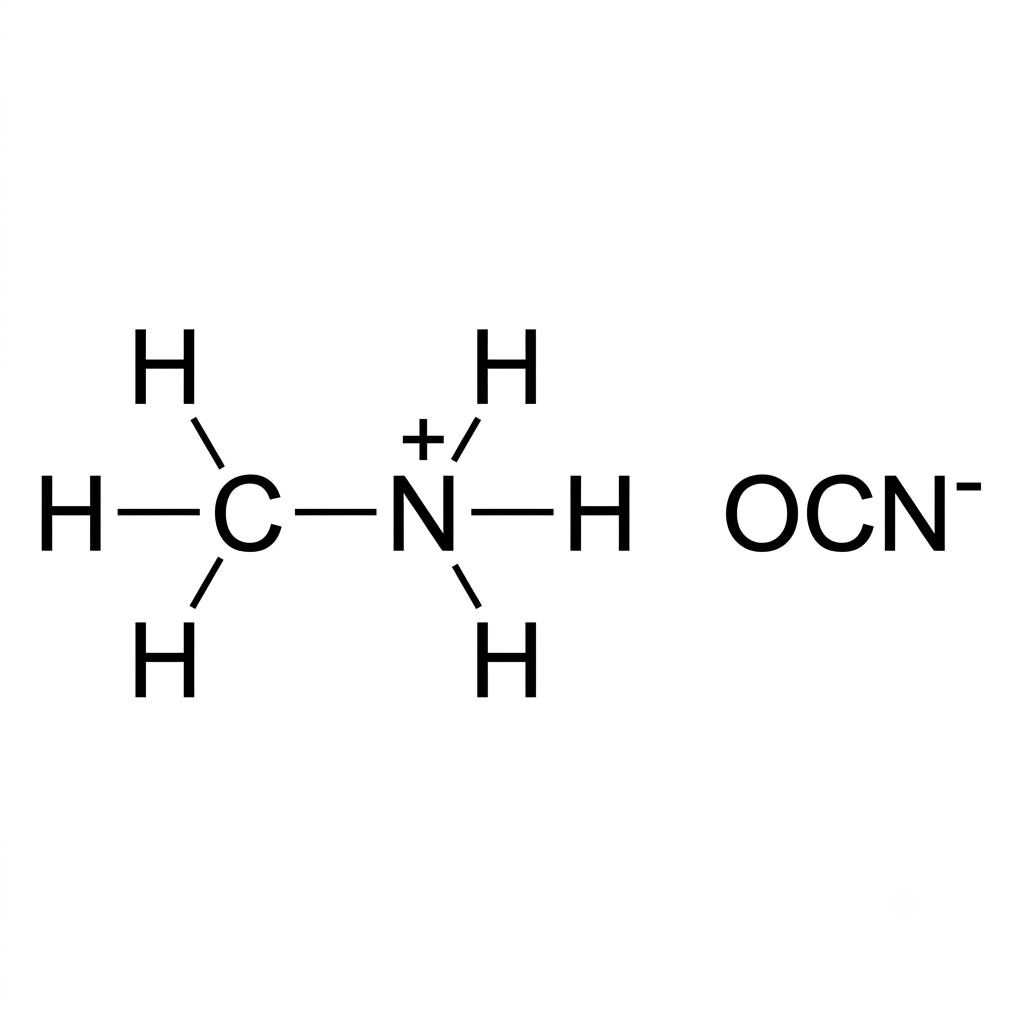
METHYLAMMONIUM CYANATE CH₆N₂O 99% CAS 63405-91-4RESEARCH GRADE MATERIAL
|
|||||||||||||||||||||||||||
|
|||||||||||||||||||||||||||
|
TAILORED SOLUTIONS FOR RESEARCH
Contact our engineering team for technical support or official quotations.
EMAIL: inquiry@atomfair.com
|
|||||||||||||||||||||||||||
|
Manufacturer: Atomfair LLC
Brand: ATOMFAIR®
|
Methylammonium cyanate is hygroscopic and light-sensitive, requiring storage in a light-protected, dry, sealed container at room temperature with long-term storage under nitrogen glovebox conditions. Exposure to atmospheric moisture causes deliquescence and hydrolysis, irreversibly degrading precursor stoichiometry; weighing and solution preparation must be performed in an inert glovebox with H2O and O2 below 1 ppm.
- Moisture Sensitivity: The compound deliquesces and hydrolyzes upon exposure to atmospheric moisture, necessitating immediate transfer to a desiccated, light-protected environment after opening.
- Light Sensitivity: Light-protective packaging must be maintained to prevent photodegradation of the cyanate functional group.
- Inert Atmosphere Requirement: Powder weighing and solution preparation require a nitrogen-filled glovebox with H2O < 1 ppm and O2 < 1 ppm to maintain material integrity.
- Solvent Compatibility: The precursor is soluble in DMF and DMSO and other polar organic solvents, but anhydrous solvents must be used to avoid hydrolysis.
- Chemical Incompatibility: Do not store together with strong acids or strong oxidizing agents due to potential reactivity of the cyanate group.
This procedure describes safe handling and preparation of methylammonium cyanate solutions under inert atmosphere to prevent degradation. All steps must be performed in a nitrogen-filled glovebox with moisture and oxygen levels below 1 ppm.
Required Equipment: Nitrogen-filled glovebox (H2O < 1 ppm, O2 < 1 ppm), Light-protective container or amber vial
- Transfer to Glovebox
Transfer the sealed container of methylammonium cyanate into a nitrogen-filled glovebox before opening to prevent moisture ingress. - Weigh Powder
Weigh the required amount of powder inside the glovebox using a clean spatula and immediately reseal the container. - Prepare Solution
Dissolve the weighed powder in anhydrous DMF or DMSO by stirring until fully dissolved. - Store Solution
Store the prepared solution in a light-protected, sealed vial inside the glovebox until use. - Clean Up
Dispose of any waste materials according to institutional guidelines for cyanate-containing compounds.
How does the cyanate anion in methylammonium cyanate differ from halide-only or thiocyanate-based additives for perovskite crystallization control?
The cyanate anion directly participates in perovskite lattice coordination chemistry, providing a fundamentally different crystallization modulation mechanism compared to halide-only or thiocyanate-based additives. This enables independent control of nucleation density and growth rate while simultaneously passivating grain boundary and surface defects via coordination with under-coordinated metal sites, reducing non-radiative recombination centers for enhanced charge carrier transport.
Which solvent systems and perovskite compositions are compatible with methylammonium cyanate for thin-film fabrication?
Methylammonium cyanate is soluble in DMF, DMSO, and polar organic solvents, making it directly compatible with standard spin-coating and precursor solution blending workflows. It is suitable for doping modification of formamidinium/methylammonium composite perovskite systems, supporting bandgap engineering and stability optimization in mixed-cation device architectures for solar cells and photodetectors.
What are the critical storage and handling requirements to prevent degradation of methylammonium cyanate?
Methylammonium cyanate is hygroscopic and light-sensitive, requiring light-protected, dry, sealed storage at room temperature with immediate transfer to a desiccated environment. For long-term storage, a nitrogen-filled glovebox with H₂O < 1 ppm and O₂ < 1 ppm is recommended; exposure to atmospheric moisture causes deliquescence and hydrolysis, irreversibly degrading precursor stoichiometry. Avoid storage with strong acids or strong oxidizing agents, and always use protective gloves and a mask to prevent skin contact and inhalation.
Methylammonium cyanate (CH₆N₂O) is a perovskite crystallization modulator that uses cyanate anion lattice coordination to independently control nucleation density and growth rate while passivating grain boundary and surface defects, but requires strict inert-atmosphere glovebox storage due to hygroscopic and light-sensitive properties that cause irreversible stoichiometric degradation upon moisture exposure.
Positive
- Cyanate Anion Crystallization Modulation: The cyanate anion directly participates in perovskite lattice coordination, enabling independent control of nucleation density and growth rate, a fundamentally different mechanism compared to halide-only or thiocyanate-based additives.
- Grain Boundary and Surface Passivation: The cyanate group coordinates with under-coordinated metal sites at grain boundaries and film surfaces, passivating deep-level trap states and reducing non-radiative recombination losses for enhanced charge carrier transport.
Trade-offs
- Strict Moisture and Light Sensitivity: The material is hygroscopic and light-sensitive; exposure to atmospheric moisture causes deliquescence and hydrolysis, irreversibly degrading precursor stoichiometry. Long-term storage requires a nitrogen-filled glovebox (H₂O < 1 ppm, O₂ < 1 ppm).
- Handling and Compatibility Hazards: The cyanate group may present irritant properties; gloves and a mask are required to avoid skin contact and dust inhalation. The material must not be stored with strong acids or strong oxidizing agents.
Every advanced material, component, equipment, and instrument in our catalog is backed by rigorous testing. We maintain strict internal quality management frameworks and align with CE conformity metrics to deliver transparent, reproducible performance data via our public open-science repository.
To request raw batch performance data, submit formal vendor registration paperwork, or execute a fast-turnaround R&D manufacturing loop, contact us at inquiry@atomfair.com.
Item is dispatched under the Atomfair Shipping & Delivery Framework (Free worldwide shipping on orders over $59 USD excl. heavy equipment). Return is governed by the Atomfair Return & Refund Policy (7-day technical return window).