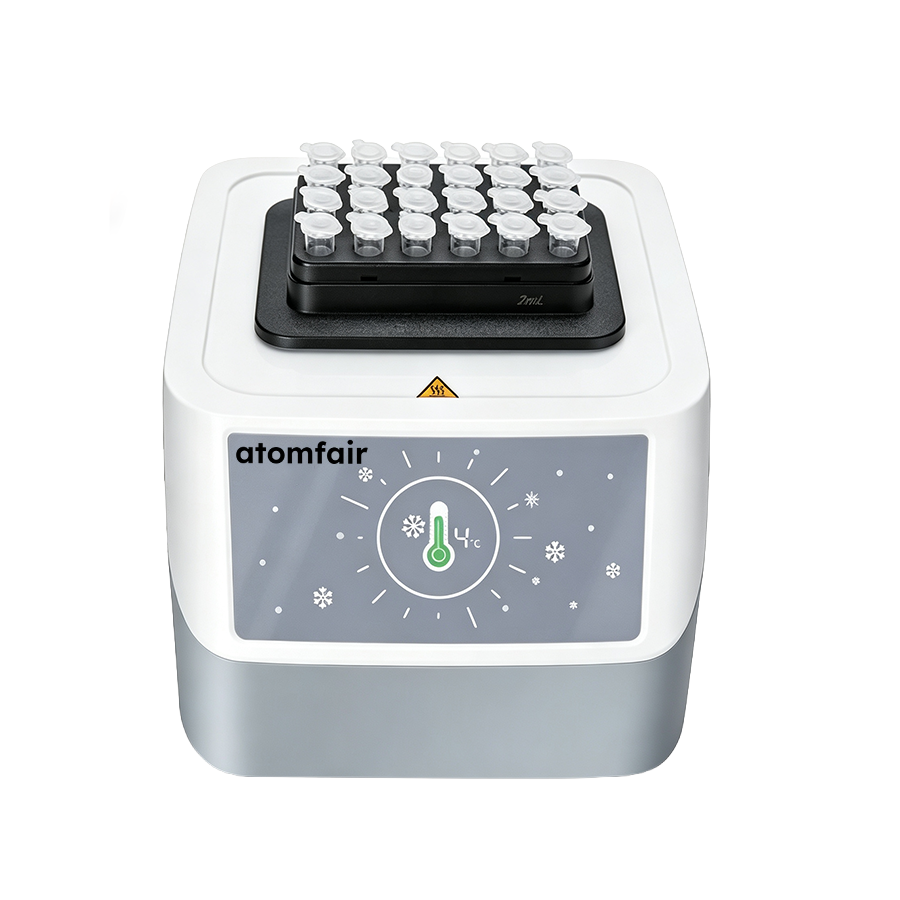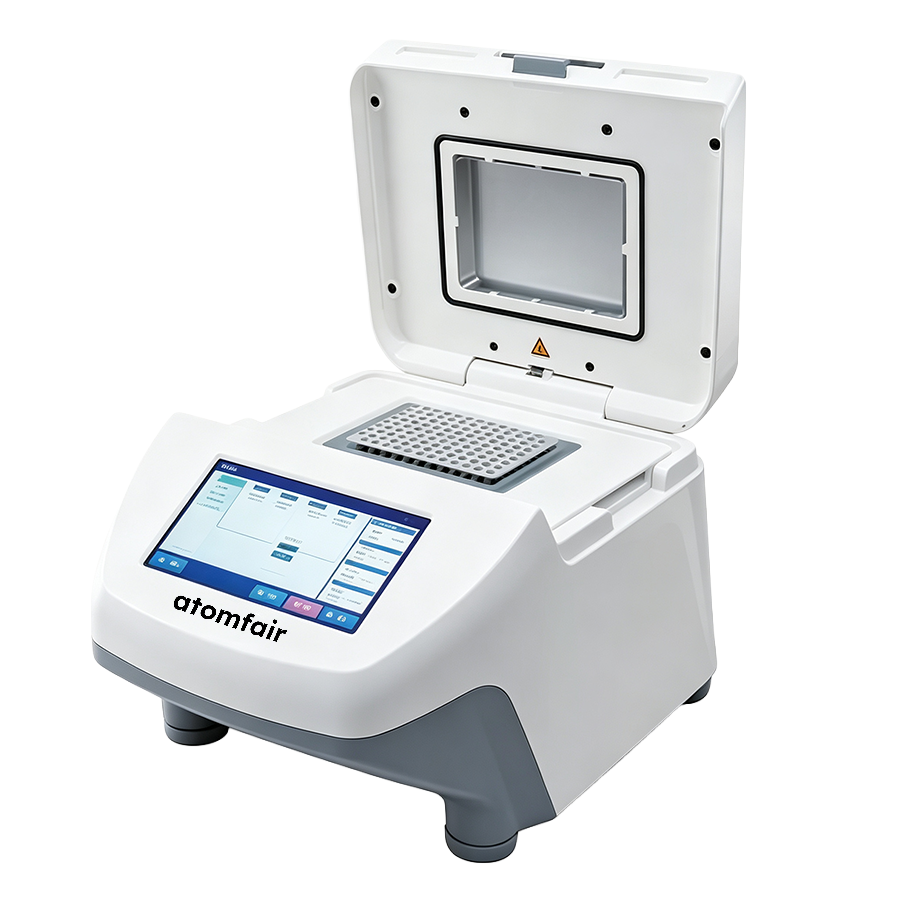
TC1000-S+ Standard Thermal CyclerProduct Type: Temperature control instrument
Research-grade temperature control platform
|
|||||||||||||||||||||||||||||||||||||||||||||||||||||||||
|
|||||||||||||||||||||||||||||||||||||||||||||||||||||||||
|
TAILORED SOLUTIONS FOR RESEARCH
For bulk orders, OEM requirements, accessory matching or configuration confirmation, contact our engineering sales team.
EMAIL: inquiry@atomfair.com
|
|||||||||||||||||||||||||||||||||||||||||||||||||||||||||
|
Supplier: Atomfair
Brand: ATOMFAIR®
|
Operate the instrument within an ambient temperature range of 5 to 40 °C and relative humidity up to 80% RH to ensure proper cooling and electronic stability. The instrument uses a dry-block heating system with a maximum block temperature of 105 °C and a heated lid reaching up to 115 °C, presenting burn and electrical shock hazards requiring standard laboratory safety precautions.
- Electrical Supply Compatibility: Connect only to the specified supply voltage (100-120 V or 200-240 V, 50/60 Hz) at 600 W to prevent damage or fire.
- Sample Vessel Compatibility: Use only compatible thin-walled PCR tubes, strip tubes, or 96-well plates rated for ≤0.2 mL volumes and capable of withstanding 105 °C.
- Heated Lid Safety: Ensure the heated lid is closed securely during operation to avoid exposure to 115 °C surfaces and to maintain uniform thermal contact.
- Ventilation and Clearance: Maintain adequate airflow around the instrument (dimensions 296×370×295 mm) and do not block ventilation slots to prevent overheating.
- Power-Off Protection: The instrument supports power-off protection, but do not rely on sudden power interrupts; always follow safe shutdown procedures.
Begin by verifying all electrical and environmental prerequisites before connecting the instrument. Follow the step-by-step procedure to set the target temperature, load samples, and initiate a programmed run.
Required Equipment: 0.2 mL PCR tubes or 96-well PCR plate, USB flash drive (optional for program transfer), Power cord rated for local mains voltage, Heat-resistant gloves (recommended for handling hot block)
- Verify power and environment
Verify that the power supply matches the instrument rating (100-120 V or 200-240 V, 50/60 Hz) and that the ambient temperature is within 5-40 °C. - Start the instrument
Connect the power cord and turn on the main switch; allow the instrument to power on and display the main menu on the 7-inch touch screen. - Set temperature parameters
Set the heated lid temperature between 30-115 °C and the block temperature between 0-105 °C using the touch screen interface. - Load samples
Load the sample vessels (tubes or plate) into the block and close the heated lid securely. - Program the protocol
Select or program the desired thermal protocol using the on-screen menu, confirming the number of cycles (up to 99) and step parameters. - Run the thermal cycle
Initiate the run and monitor progress via the display; the instrument will automatically control temperature and timing. - Remove samples safely
Upon completion, allow the block to cool below 50 °C before opening the lid and removing samples to avoid burns.
How does the TC1000-S+ achieve ±0.1 °C temperature accuracy without a gradient function, and what are the trade-offs for gradient-dependent PCR optimization?
The TC1000-S+ achieves ±0.1 °C accuracy and ±0.2 °C uniformity at 55 °C via dry-block control with a 0.1 °C display resolution, but it lacks any gradient range or gradient setting capability. This means researchers cannot run a single plate across multiple annealing temperatures simultaneously; instead, they must run sequential optimization runs using the 30-step user-defined program capability. For applications requiring rapid primer annealing temperature screening, a gradient-capable thermal cycler would be necessary.
Can the TC1000-S+ accept standard 0.2 mL 96-well PCR plates, or is it limited to tubes and strips?
Yes, the TC1000-S+ accepts standard 0.2 mL 96-well PCR plates in addition to 96 x 0.2 mL individual PCR tubes and 12 x 0.2 mL 8-strip tubes, as specified in the sample specifications. The single 96-well module bit (1 x 96) means only one block format is supported at a time, so users must confirm block or module compatibility before ordering to ensure their specific plate or tube format is physically accommodated.
What are the power supply and environmental constraints for installing the TC1000-S+ in a shared laboratory?
The TC1000-S+ requires a 600 W power supply and accepts dual voltage ranges (100–120 V or 200–240 V, 50/60 Hz), so it can operate on standard lab circuits but may need a dedicated outlet if other high-draw instruments share the same line. The operating environment must be 5 to 40 °C with up to 80% relative humidity, and the instrument footprint is 296 x 370 x 295 mm weighing 9.5 kg, which fits on a standard benchtop but requires adequate clearance for the heated lid and USB/WiFi connections.
The TC1000-S+ Standard Thermal Cycler is a dry-block temperature control instrument offering a 0–105 °C sample module range, ±0.1 °C accuracy, and a 5 °C/sec ramp rate, suitable for PCR and enzyme incubation workflows. Its 7-inch touchscreen and USB/WiFi connectivity support program storage of over 20,000 protocols, but the absence of gradient functionality limits optimization for annealing temperature screening.
Positive
- High temperature accuracy and uniformity: Temperature accuracy of ±0.1 °C and uniformity of ±0.2 °C at 55 °C ensure reproducible incubation conditions for sensitive enzymatic reactions and nucleic acid workflows.
- Extensive program storage and connectivity: Storage capacity for over 20,000 user-defined programs with USB and WiFi communication enables convenient protocol transfer and long-term method archiving without external memory constraints.
Trade-offs
- No gradient functionality: The instrument lacks gradient temperature control, preventing simultaneous optimization of annealing temperatures across a block, which is a standard requirement for PCR assay development.
- No shaking module: Absence of an integrated shaking module limits the instrument's utility for workflows requiring agitation during incubation, such as certain enzymatic digestions or mixing steps.
Every advanced material, component, equipment, and instrument in our catalog is backed by rigorous testing. We maintain strict internal quality management frameworks and align with CE conformity metrics to deliver transparent, reproducible performance data via our public open-science repository.
To request raw batch performance data, submit formal vendor registration paperwork, or execute a fast-turnaround R&D manufacturing loop, contact us at inquiry@atomfair.com.
Item is dispatched under the Atomfair Shipping & Delivery Framework (Free worldwide shipping on orders over $59 USD excl. heavy equipment). Return is governed by the Atomfair Return & Refund Policy (7-day technical return window).