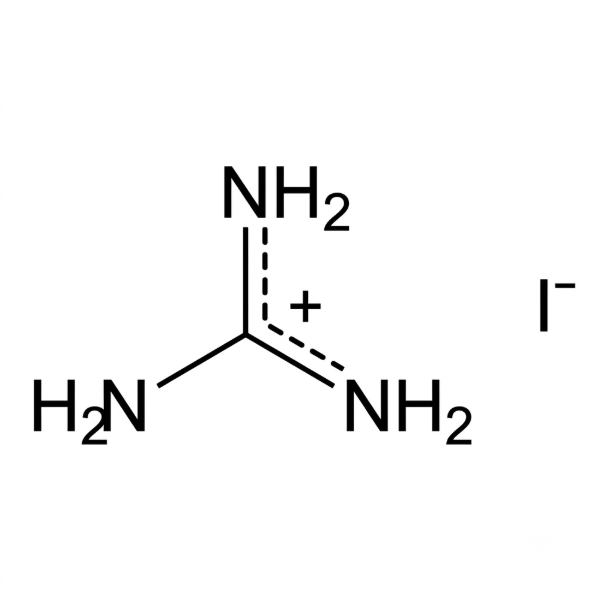
GUANIDINIUM IODIDE CH₆IN₃ 99.5% CAS 19227-70-4RESEARCH GRADE MATERIAL
|
|||||||||||||||||||||||||
|
|||||||||||||||||||||||||
|
TAILORED SOLUTIONS FOR RESEARCH
Contact our engineering team for technical support or official quotations.
EMAIL: inquiry@atomfair.com
|
|||||||||||||||||||||||||
|
Manufacturer: Atomfair LLC
Brand: ATOMFAIR®
|
Guanidinium iodide is strongly hygroscopic and light-sensitive, requiring strict environmental controls to prevent degradation. Exposure to atmospheric moisture causes deliquescence and hydrolysis, while light exposure can induce photodegradation, compromising precursor stoichiometry and device performance.
- Moisture Sensitivity: The material must be handled exclusively in an inert-atmosphere glovebox with H2O < 1 ppm to prevent moisture absorption.
- Light Sensitivity: Storage requires light-protective packaging and a dark environment to avoid photodegradation.
- Storage Compatibility: Do not store together with strong oxidizing agents or acidic reagents to avoid hazardous reactions.
- Container Integrity: The container cap must be tightened immediately after each use to maintain a dry environment.
- Temperature Control: Store at room temperature in a sealed, desiccated environment; avoid temperature fluctuations.
Guanidinium iodide requires careful handling under inert and light-protected conditions to maintain its purity and functionality. The following steps outline the proper receipt, storage, and preparation procedures for this hygroscopic and light-sensitive material.
Required Equipment: Inert-atmosphere glovebox, Protective gloves
- Inspect packaging
Inspect the packaging upon receipt and transfer immediately to a desiccated, light-protected storage environment. - Secure container
Tighten the container cap immediately after each use to prevent moisture ingress. - Don personal protective equipment
Wear protective gloves throughout all experimental procedures to avoid direct skin contact. - Prepare solutions in glovebox
When preparing precursor solutions, handle the white solid within an inert-atmosphere glovebox with H2O < 1 ppm and O2 < 1 ppm. - Store appropriately
Store the material in a light-protected, moisture-free environment, away from strong oxidizing agents and acidic reagents.
How does guanidinium iodide's multi-amino hydrogen-bonding network improve defect passivation compared to single-ammonium cations?
The guanidinium cation contains three amino groups that form extensive hydrogen-bonding networks within the perovskite lattice, providing superior internal defect passivation relative to single-ammonium cations. This reduces non-radiative recombination centers, enhances charge carrier mobility, and significantly improves device thermal stability by stabilizing the crystal structure against thermal degradation.
What are the critical handling and storage requirements for guanidinium iodide to prevent degradation?
Guanidinium iodide is strongly hygroscopic and light-sensitive. It must be stored in a light-protected, dry, sealed container at room temperature. The container cap must be tightened immediately after each use to prevent moisture ingress. For solution preparation, the white solid should be handled inside an inert-atmosphere glovebox with H₂O < 1 ppm and O₂ < 1 ppm to avoid deliquescence and hydrolysis, which irreversibly degrade precursor stoichiometry.
What infrastructure is required for processing guanidinium iodide in perovskite device fabrication?
Processing requires an inert-atmosphere glovebox with H₂O < 1 ppm and O₂ < 1 ppm for handling the solid and preparing precursor solutions. Protective gloves must be worn to avoid direct skin contact. The material must not be stored with strong oxidizing agents or acidic reagents. Exposure to atmospheric moisture causes deliquescence and hydrolysis, making strict environmental control essential for maintaining material integrity.
Guanidinium Iodide (CH₆IN₃, 99.5% purity) is a perovskite defect passivation additive that leverages a multi-amino hydrogen-bonding network to reduce non-radiative recombination and enhance thermal stability. Its strong hygroscopicity and light sensitivity mandate inert-atmosphere handling and strict moisture-free storage to prevent irreversible degradation.
Positive
- Multi-amino hydrogen-bonding defect passivation: The guanidinium cation's three amino groups form extensive hydrogen-bonding networks within the perovskite lattice, providing superior internal defect passivation compared to single-ammonium cations and significantly reducing non-radiative recombination centers.
- Enhanced thermal stability via structural stabilization: Strong hydrogen-bonding interactions between guanidinium ions and the inorganic perovskite framework stabilize the crystal structure against thermal degradation, enabling improved device operational stability at elevated temperatures.
Trade-offs
- Strongly hygroscopic and light-sensitive: The material is strongly hygroscopic and light-sensitive; exposure to atmospheric moisture causes deliquescence and hydrolysis, irreversibly degrading precursor stoichiometry. Handling must be performed in an inert-atmosphere glovebox (H₂O < 1 ppm, O₂ < 1 ppm).
- Requires immediate protective storage upon receipt: Each package must be transferred immediately to a desiccated, light-protected environment upon receipt. The container must be tightly sealed after each use to prevent moisture ingress from ambient air.
Every advanced material, component, equipment, and instrument in our catalog is backed by rigorous testing. We maintain strict internal quality management frameworks and align with CE conformity metrics to deliver transparent, reproducible performance data via our public open-science repository.
To request raw batch performance data, submit formal vendor registration paperwork, or execute a fast-turnaround R&D manufacturing loop, contact us at inquiry@atomfair.com.
Item is dispatched under the Atomfair Shipping & Delivery Framework (Free worldwide shipping on orders over $59 USD excl. heavy equipment). Return is governed by the Atomfair Return & Refund Policy (7-day technical return window).