Description
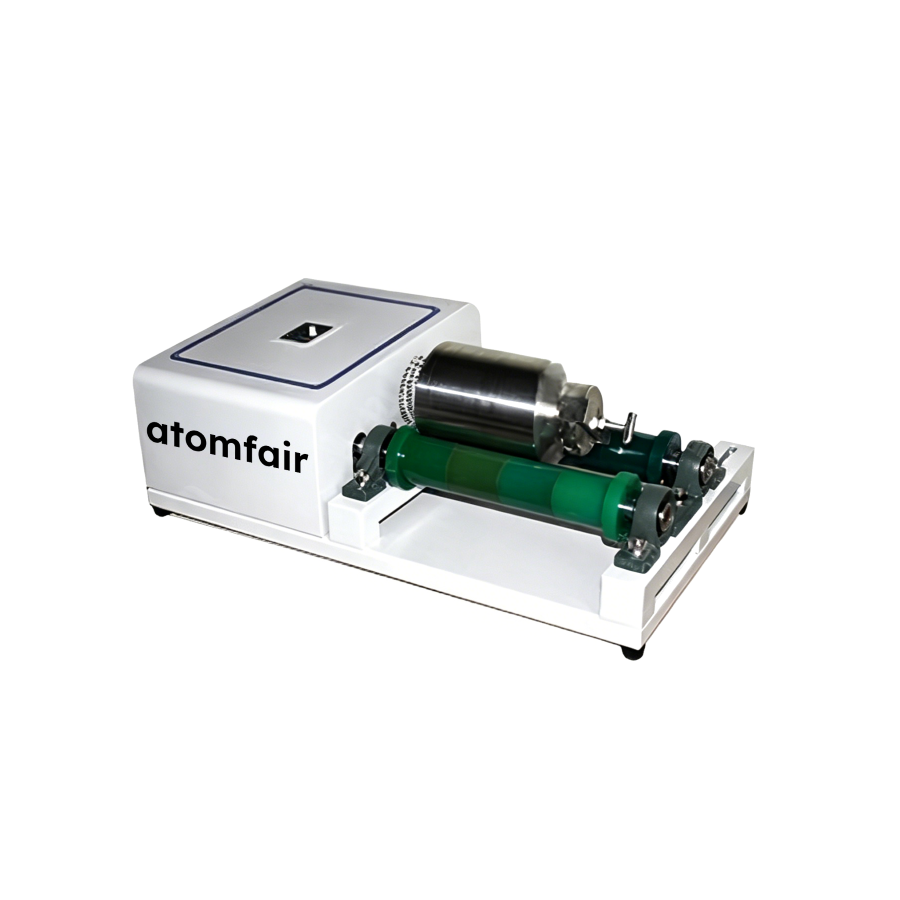
ATOMFAIR® ROLLER BALL MILL / MODEL ATOMFAIR-RBM-927RESEARCH GRADE MATERIAL
|
|||||||||||||||||||||||||
|
|||||||||||||||||||||||||
|
TAILORED SOLUTIONS FOR RESEARCH
Contact our engineering team for technical support or official quotations.
EMAIL: inquiry@atomfair.com
|
|||||||||||||||||||||||||
|
Manufacturer: Atomfair LLC
Brand: ATOMFAIR®
|
This roller ball mill requires connection to a grounded AC220V electrical outlet. Rotating rollers and processed materials demand proper sealing and operator attention.
- Electrical Grounding: Connect the mill to a properly grounded AC220V outlet to reduce the risk of electrical shock.
- Jar Sealing: Always seal grinding jars tightly before operation to prevent leakage of wet or dry materials.
- Stable Placement: Position the mill on a stable, level surface to avoid tipping or excessive vibration.
- Ambient Conditions: Operate the mill in a clean, dry environment within standard laboratory temperature ranges to protect electronic components.
This procedure describes the safe operation of the roller ball mill for dry or wet grinding. Follow each step to ensure uniform results and prevent accidents.
Required Equipment: Grinding jars (appropriate for material and method)
- Inspect equipment
Inspect the mill and all grinding jars for cracks, damage, or debris before use. - Load grinding jars
Place the filled and securely sealed grinding jars evenly onto the rollers. - Set rotation speed
Set the desired rotation speed using the digital control knob. - Set running time
Adjust the running time for the required duration using the digital timer. - Start grinding cycle
Press the start button to begin the grinding cycle, which will alternate direction automatically. - Monitor operation
Monitor the mill periodically for unusual noise, vibration, or material leakage. - Stop and unload
After the cycle ends, press stop, wait for rollers to cease completely, then carefully remove the jars.
What is the optimal speed range for achieving uniform grinding fineness with soft versus hard materials on the Atomfair-RBM-927 roller ball mill?
The Atomfair-RBM-927's stepless speed range of 60-600 rpm allows precise optimization for material hardness: lower speeds (60-200 rpm) are typically selected for soft materials to minimize heat generation, while harder materials benefit from higher speeds (300-600 rpm) to achieve the uniform grinding fineness the mill is designed to deliver. The digital display and program control ensure accurate speed selection, but the optimal setting depends on the specific material properties and is determined through empirical testing.
Can the Atomfair-RBM-927 roller ball mill accommodate both dry and wet grinding jars of varying capacities, and are there any constraints on jar dimensions?
Yes, the Atomfair-RBM-927 supports both dry and wet grinding with convenient jar replacement, but jar dimensions are constrained by the mill's compact footprint (610 mm L x 435 mm W x 360 mm H). The maximum jar diameter and length are limited to fit within the roller spacing and overall clearance, though specific capacity values are not published. Users should verify jar compatibility with the manufacturer before use.
What are the electrical and physical infrastructure requirements for installing the Atomfair-RBM-927 roller ball mill in a standard laboratory?
The Atomfair-RBM-927 requires a single-phase AC220V, 400W power supply, and a bench or table area measuring at least 610 mm × 435 mm to accommodate its base dimensions, with additional clearance for jar loading and ventilation. The digital display and program control system require no special grounding beyond standard laboratory electrical safety practices.
The Atomfair-RBM-927 Roller Ball Mill delivers uniform grinding fineness via a stepless 60-600 rpm speed range, accommodating both dry and wet milling. Its compact footprint and digital control simplify operation, though the 220V single-phase power requirement and 9999-minute maximum runtime present installation and process duration constraints.
Positive
- Uniform grinding fineness: Consistent particle size distribution is achieved, ensuring reproducible results crucial for research and production applications.
- Stepless speed adjustment: The 60-600 rpm stepless control allows precise optimization of milling intensity for varying material hardness and desired fineness.
Trade-offs
- 220V single-phase power dependency: Requires a dedicated 220V AC supply, which may necessitate a voltage transformer or infrastructure modification in 110V laboratory environments.
- Maximum runtime limitation: The programmable run time is capped at 9999 minutes (~6.9 days), potentially insufficient for extended continuous milling protocols.
Every advanced material, component, equipment, and instrument in our catalog is backed by rigorous testing. We maintain strict internal quality management frameworks and align with CE conformity metrics to deliver transparent, reproducible performance data via our public open-science repository.
To request raw batch performance data, submit formal vendor registration paperwork, or execute a fast-turnaround R&D manufacturing loop, contact us at inquiry@atomfair.com.
Item is dispatched under the Atomfair Shipping & Delivery Framework (Free worldwide shipping on orders over $59 USD). Return is governed by the Atomfair Return & Refund Policy (7-day technical return window).