Description
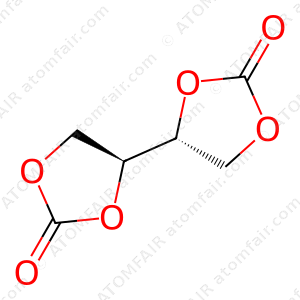
Erythritol 1,2:3,4-dicarbonate (CAS No. 24690-44-6) is a high-purity cyclic carbonate derivative of erythritol, with the molecular formula C6H6O6. This specialized organic compound is synthesized for advanced research and industrial applications, offering exceptional stability and reactivity due to its unique dicarbonate structure. Ideal for use in polymer chemistry, pharmaceuticals, and material science, it serves as a versatile building block for crosslinking agents, biodegradable polymers, and drug delivery systems. With a well-defined molecular weight of 174.11 g/mol, this compound is characterized by its high solubility in polar organic solvents and its role in facilitating controlled-release formulations. Each batch undergoes rigorous QC testing to ensure ≥98% purity (HPLC), making it a reliable choice for demanding scientific applications.
Properties
- CAS Number: 24690-44-6
- Complexity: 200
- IUPAC Name: (4R)-4-[(4S)-2-oxo-1,3-dioxolan-4-yl]-1,3-dioxolan-2-one
- InChI: InChI=1S/C6H6O6/c7-5-9-1-3(11-5)4-2-10-6(8)12-4/h3-4H,1-2H2/t3-,4+
- InChI Key: ZWGIZHOZSXFSNW-ZXZARUISSA-N
- Exact Mass: 174.01643791
- Molecular Formula: C6H6O6
- Molecular Weight: 174.11
- SMILES: C1[C@@H](OC(=O)O1)[C@@H]2COC(=O)O2
- Topological: 71.1
- Monoisotopic Mass: 174.01643791
- Synonyms: Erythritol 1,2:3,4-dicarbonate, ERYTHRITOL 1,2, 24690-44-6, (4R)-4-[(4S)-2-OXO-1,3-DIOXOLAN-4-YL]-1,3-DIOXOLAN-2-ONE, DTXSID701244769, rel-(4R,4a(2)S)-[4,4a(2)-Bi-1,3-dioxolane]-2,2a(2)-dione
Erythritol 1,2:3,4-dicarbonate is primarily used as a reactive intermediate in the synthesis of biodegradable polymers and specialty resins. Its cyclic carbonate groups enable efficient crosslinking in polyurethane and epoxy systems, enhancing thermal stability and mechanical properties. Researchers also employ it as a protected form of erythritol in pharmaceutical synthesis, particularly for prodrug development. In material science, it contributes to the creation of CO2-based polycarbonates with tunable degradation profiles.
Safety and Hazards
GHS Hazard Statements
- H301 (95.1%): Toxic if swallowed [Danger Acute toxicity, oral]
- H311 (95.1%): Toxic in contact with skin [Danger Acute toxicity, dermal]
- H315 (95.1%): Causes skin irritation [Warning Skin corrosion/irritation]
- H318 (95.1%): Causes serious eye damage [Danger Serious eye damage/eye irritation]
- H330 (95.1%): Fatal if inhaled [Danger Acute toxicity, inhalation]
- H335 (95.1%): May cause respiratory irritation [Warning Specific target organ toxicity, single exposure; Respiratory tract irritation]
- H350 (95.1%): May cause cancer [Danger Carcinogenicity]
Precautionary Statements
- P203, P260, P261, P262, P264, P264+P265, P270, P271, P280, P284, P301+P316, P302+P352, P304+P340, P305+P354+P338, P316, P317, P318, P319, P320, P321, P330, P332+P317, P361+P364, P362+P364, P403+P233, P405, and P501
Hazard Classes and Categories
- Acute Tox. 3 (95.1%)
- Skin Irrit. 2 (95.1%)
- Eye Dam. 1 (95.1%)
- Acute Tox. 2 (95.1%)
- STOT SE 3 (95.1%)
- Carc. 1B (95.1%)
If you are interested or have any questions, please contact us at support@atomfair.com
Disclaimer: Sold exclusively for laboratory research. Prohibited for commercial use, diagnostics, or human/animal applications. Buyers assume all compliance liability.


Reviews
There are no reviews yet.