
Battery Electrolytes, Salts & Additives
Battery Electrolytes, Salts & Additives covers electrolyte components and ready-to-use electrolyte systems for battery research and development. The category brings together electrolyte salts, carbonate solvents, ether and fluorinated solvents, LHCE diluents, ionic liquids, functional additives, and pre-mixed electrolyte formulations.
Researchers can use this category to compare individual electrolyte building blocks with formulated systems. Single salts, solvents, and additives support custom electrolyte development, while ready-to-use electrolytes help shorten screening work when a defined formulation is preferred.
Because electrolyte performance is highly chemistry-dependent, selection should consider salt identity, solvent family, additive role, concentration, moisture sensitivity, voltage window, electrode compatibility, and intended cell format.
Show More: How to Choose Battery Electrolyte Materials
Browse by Electrolyte Role
| Subcategory | Main Scope | Typical Use |
|---|---|---|
| Battery Electrolyte Salts | Lithium, sodium, potassium, and other conductive salts | Custom electrolyte preparation and ion-transport studies |
| Carbonate Electrolyte Solvents | EC, DMC, DEC, EMC, PC, and related carbonate solvents | Conventional lithium-ion electrolyte systems |
| Ether, Fluorinated Solvents & LHCE Diluents | Ether solvents, fluorinated solvents, and LHCE diluents | Lithium metal, low-temperature, high-voltage, and LHCE research |
| Electrolyte Additives | Film-forming, safety, high-voltage, and interfacial additives | SEI/CEI control, cycle-life improvement, gas suppression, and stability tuning |
| Ionic Liquids for Batteries | Imidazolium, pyrrolidinium, ammonium, phosphonium, and related ionic liquids | Low-volatility electrolyte systems, additives, or ion-conducting media |
| Ready-to-Use Battery Electrolytes | Pre-mixed electrolyte formulations | Coin cell, pouch cell, and screening experiments using defined formulations |
| Gel Polymer Electrolyte Materials | Polymer hosts, gel electrolyte components, and quasi-solid-state materials | Flexible, safer, or semi-solid electrolyte development |
Key Selection Considerations
Electrolyte salt choice affects ionic conductivity, interfacial chemistry, corrosion behavior, and compatibility with electrodes. Lithium salts such as LiPF6, LiTFSI, LiFSI, and related systems are commonly evaluated for lithium-ion and lithium metal cells, while sodium and potassium salts support post-lithium battery research.
Solvent selection should match the target electrochemical window and electrode chemistry. Carbonate solvents are widely used for conventional lithium-ion systems, while ether and fluorinated solvents are often explored for lithium metal, sulfur, sodium, and localized high-concentration electrolyte designs.
Additives are typically used at lower concentrations than main solvents or salts. Their role may include SEI formation, CEI stabilization, high-voltage protection, gas reduction, flame-retardant behavior, or improved low-temperature operation. Additive performance is formulation-dependent and should be screened with the full electrolyte system.
Application Paths
For standard lithium-ion research, start with carbonate solvents, lithium electrolyte salts, and selected film-forming additives. For lithium metal and high-energy research, compare ether-based systems, fluorinated solvents, LHCE diluents, and ionic-liquid options. For safer or semi-solid formats, explore gel polymer electrolyte materials together with compatible salts, plasticizers, and liquid electrolyte components.
Ready-to-use electrolyte formulations are suitable when consistency and speed are more important than building every formulation from individual raw materials. Individual salts, solvents, and additives are better suited for mechanism studies, custom concentration screening, and formulation optimization.
FAQ
What is the difference between electrolyte salts and additives?
Electrolyte salts provide the main mobile ions in the electrolyte. Additives are usually used in smaller amounts to tune interface formation, stability, gas behavior, safety, or cycle performance.
Are carbonate solvents and ether solvents interchangeable?
Not directly. Carbonates are common in conventional lithium-ion cells, while ether systems are often studied for lithium metal, sodium, sulfur, and other chemistries. Compatibility depends on the electrode materials, salt, voltage range, and cell design.
Where should fluorinated solvents be classified?
Fluorinated solvents can belong in the ether/fluorinated solvents and LHCE diluents group when used as main solvents or diluents. If used only at low concentration for interfacial modification, they may fit better under electrolyte additives.
What belongs in Ready-to-Use Battery Electrolytes?
This subcategory should contain pre-mixed electrolyte formulations with defined salt, solvent, and sometimes additive compositions. Single salts, single solvents, and single additives should remain in their respective component categories.
Showing 145–145 of 145 results
-
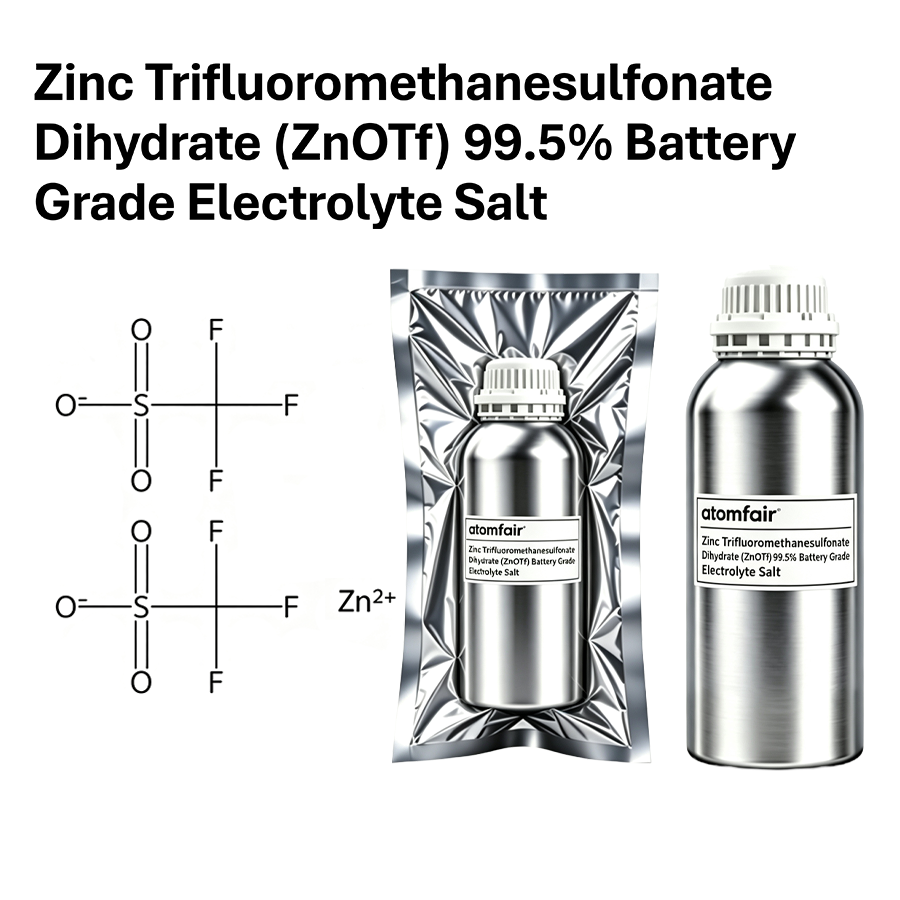
Zinc Trifluoromethanesulfonate Dihydrate (ZnOTf) 99.5% Battery Grade Electrolyte Salt
Price range: $311.00 through $427.00