
Battery Electrolyte Salts
Battery electrolyte salts define the ionic framework of many battery electrolyte systems and strongly influence transport behavior, solvation structure, interphase chemistry, oxidation stability, and low-temperature performance.
For research-oriented selection, salt choice is rarely reduced to nominal purity alone. It is usually evaluated against the target electrode chemistry, solvent window, moisture tolerance, free-acid level, trace-metal profile, and the intended electrochemical operating window.
This category is organized around salt chemistry and the parameters that matter most in battery development: composition, purity, moisture control, stability, solubility, and compatibility with the intended cell design.
Show More
Salt Families and Research Focus
| Salt family | Typical research focus |
|---|---|
| LiPF6 | Baseline lithium-ion systems; moisture stability, HF-related side reactions, and aluminum current collector compatibility are often reviewed closely. |
| LiFSI | High-rate, low-temperature, and advanced electrolyte designs; transport behavior, interphase formation, and aluminum stability are commonly evaluated. |
| LiTFSI | High-concentration and lithium-metal-oriented systems; solvation structure, viscosity, and current collector compatibility are often key variables. |
| LiBF4 | Specialized lithium-ion formulations; solubility limits and overall electrolyte compatibility are typically assessed. |
| LiBOB | Film-forming and stabilization-focused systems; SEI and CEI composition, first-cycle efficiency, and impedance evolution are important. |
| LiDFOB | Interphase optimization and high-stability designs; formation efficiency, solubility, and high-voltage behavior are often compared. |
| NaFSI / NaTFSI / NaBF4 / NaDFOB | Sodium-ion development; dissolution behavior, ionic transport, negative-electrode compatibility, and long-term stability are commonly screened. |
Key Selection Parameters
| Parameter | Why it matters |
|---|---|
| Moisture content | Directly affects decomposition pathways, HF formation, interfacial parasitics, and reproducibility. |
| Free acid | Can accelerate degradation and alter storage stability, especially in sensitive cell chemistries. |
| Trace metals | May shift impedance growth, side reactions, and cycle-to-cycle variability. |
| Solubility | Determines practical concentration limits, formulation feasibility, and viscosity behavior. |
| Ionic association | Affects effective transport, desolvation behavior, and rate capability. |
| Thermal stability | Important for storage, handling, processing, and elevated-temperature testing. |
| Morphology and particle form | Can affect dissolution behavior, handling consistency, and batch-to-batch processability. |
How Researchers Typically Compare Salts
For conventional lithium-ion work, LiPF6 remains the familiar starting point. In higher-stress designs, LiFSI and LiTFSI are often evaluated earlier because they can shift solvation structure, transport, and interfacial behavior in ways that become important at low temperature, high rate, or high concentration.
When the objective is interface control, LiBOB and LiDFOB are common candidates because they are frequently examined for their impact on SEI and CEI formation, first-cycle efficiency, and impedance evolution.
In sodium-ion development, NaFSI, NaTFSI, NaBF4, and NaDFOB are typically assessed against the target solvent system and electrode pairing rather than by nominal salt class alone.
FAQ
What should be checked first when selecting a battery electrolyte salt?
Moisture content, free acid, trace metals, and compatibility with the intended solvent system are usually the first technical filters.
Why is LiPF6 still used as a baseline reference?
It remains the most familiar benchmark for many conventional lithium-ion electrolyte studies, which makes it useful as a reference point for comparison.
Why do LiFSI and LiTFSI attract so much research attention?
They are often evaluated in advanced electrolyte designs because they can strongly influence transport, solvation, and interfacial behavior under demanding conditions.
What is the practical role of LiBOB and LiDFOB?
They are commonly examined for their ability to shape film formation, stabilize interfaces, and improve early-cycle electrochemical behavior.
How should sodium-ion salts be compared?
They should be compared by solubility, ionic transport, electrode compatibility, and stability in the selected solvent environment.
Why does the same salt perform differently across batches?
Small differences in moisture, acid residue, trace impurities, and particle morphology can create measurable changes in impedance and cycle behavior.
Which technical data are most valuable at quotation stage?
Specification sheet values for moisture, purity, acid residue, impurity profile, packaging size, and storage recommendations are usually the most decision-critical.
Is mixed-salt screening relevant in this category?
Yes, but the evaluation should still begin from well-defined single-salt baselines so that the effect of each component can be interpreted cleanly.
Showing 33–33 of 33 results
-
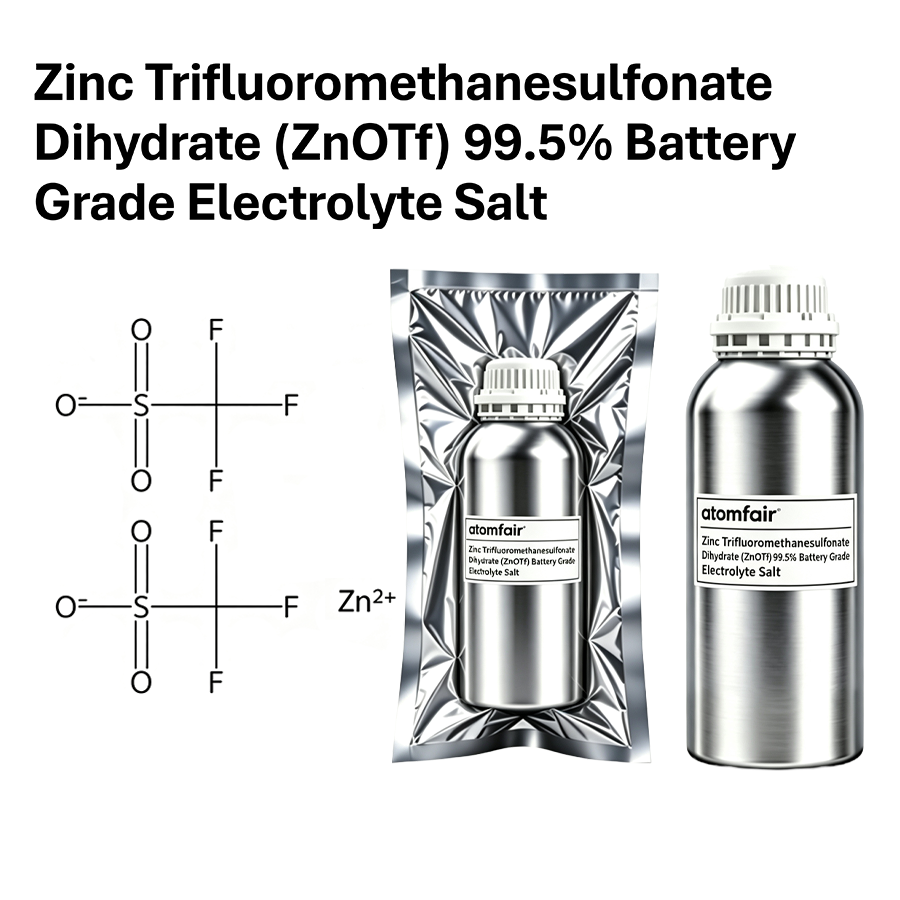
Zinc Trifluoromethanesulfonate Dihydrate (ZnOTf) 99.5% Battery Grade Electrolyte Salt
Price range: $311.00 through $427.00