
Mesoporous Carbon
Mesoporous carbon is a class of porous carbon materials with mesopores typically ranging from approximately 2 to 50 nm. Compared with dense carbon materials, mesoporous carbon provides accessible internal channels, high contact surface area and improved mass transport, while retaining the chemical stability and electrical conductivity associated with carbon materials.
These materials can be selected by pore size, pore architecture, particle morphology, surface chemistry, specific surface area and pore volume. Ordered mesoporous carbon, disordered mesoporous carbon, mesoporous carbon spheres, hollow carbon spheres, doped carbon and cage-like carbon structures each offer different advantages for adsorption, catalysis, energy storage, sensing and nanocomposite design.
When selecting a material, compare the pore-size distribution and pore volume together with BET surface area. Particle size, morphology, surface functionalization, dopant content, purity and packaging can also affect dispersion, loading capacity, ion transport, interfacial reactions and processing performance.
Show More
Mesoporous Carbon Material Types
Ordered Mesoporous Carbon
Ordered mesoporous carbon has relatively regular and interconnected pore channels. It is commonly selected for catalyst supports, molecular adsorption, templated synthesis, mass-transfer studies and electrochemical interface research where structural consistency is important.
Disordered Mesoporous Carbon
Disordered mesoporous carbon has a broader and less uniform pore distribution. It can provide a useful balance of pore volume, surface accessibility and structural tolerance for adsorption, catalyst loading, electrode composites and porous-carbon research.
Mesoporous Carbon Spheres and Hollow Carbon Spheres
Mesoporous carbon spheres provide a defined particle morphology and can be useful in dispersion, interface and nanoscale transport studies. Hollow mesoporous carbon spheres combine an internal cavity with a porous shell, making them suitable for encapsulation, confined reactions and energy-storage research.
Doped and Functionalized Mesoporous Carbon
Nitrogen, sulfur, phosphorus or boron doping, as well as surface oxidation and other functionalization methods, can modify polarity, wettability, electronic structure and active sites. These materials are useful when surface compatibility, catalytic activity or electrochemical interface behavior requires additional control.
Nanocage and Hierarchical Porous Carbon Structures
Some mesoporous carbon materials feature cage-like, hollow or multi-scale pore structures. These architectures can combine different transport lengths and provide space for active materials, ions, molecules or catalyst phases.
Key Specifications to Compare
| Selection Parameter | Why It Matters |
|---|---|
| Pore diameter and distribution | Affects molecular access, ion transport, adsorption selectivity and active-material loading. |
| BET surface area | Indicates the accessible surface available for adsorption and interfacial reactions. |
| Pore volume | Influences adsorption capacity, filling capability and the amount of active material that can be accommodated. |
| Particle size and morphology | Affects dispersion, mixing, coating, film formation and composite processing. |
| Surface chemistry | Controls wettability, interface bonding, adsorption behavior and catalytic interactions. |
| Dopant type and content | Can influence polarity, conductivity, active sites and electrochemical behavior. |
| Purity and characterization | Supports reproducibility and helps match the material to analytical, catalytic or electrochemical requirements. |
| Package size | Should match initial screening, formulation development, validation testing or larger-scale research. |
Typical Applications
Catalyst Supports
Mesoporous carbon can help disperse metals, metal oxides and other active phases. Selection should consider whether the pores can accommodate the active component and whether the surface chemistry supports stable attachment.
Adsorption and Separation
Mesoporous carbon is used in the study of gases, dyes, organic molecules and other target species. For larger molecules or faster mass transfer, suitable pore dimensions and pore volume are often more important than maximum surface area alone.
Battery and Supercapacitor Electrodes
Mesoporous carbon can function as a conductive framework, active-material host or component of a composite electrode. Important comparison points include pore volume, electrical conductivity, pore distribution, surface chemistry and electrolyte compatibility.
Lithium-Sulfur Battery Materials
Mesoporous carbon can provide space for sulfur and its reaction intermediates while supporting electron transport and helping reduce active-material migration. Materials should be compared by pore volume, conductivity, structural stability and sulfur-loading compatibility.
Sensors and Interface Materials
The high accessible surface and adjustable surface chemistry of mesoporous carbon can improve contact with target molecules and support gas sensors, electrochemical sensors, biological interfaces and detection materials.
Nanocomposites
Mesoporous carbon can be combined with metals, oxides, polymers, sulfur and other nanomaterials to improve conductivity, mechanical stability, dispersion and interfacial performance.
How to Select Mesoporous Carbon
- Choose ordered mesoporous carbon when regular pore channels and structural repeatability are important.
- Consider disordered mesoporous carbon when broader pore distribution or higher pore-volume flexibility is required.
- Select mesoporous carbon spheres when particle morphology and dispersion are important.
- Choose hollow spheres or cage-like structures when internal space or encapsulation is required.
- Consider doped or functionalized grades when surface polarity, wettability or catalytic activity needs to be adjusted.
- For sulfur, catalyst or other active-material loading, compare pore volume and pore accessibility rather than BET surface area alone.
- For electrochemical or catalytic work, confirm purity, ash content, surface chemistry and characterization data.
Frequently Asked Questions
What is mesoporous carbon?
Mesoporous carbon is a porous carbon material with mesopores, generally around 2–50 nm in diameter. It combines carbon stability and conductivity with accessible internal surfaces and transport channels.
What is the difference between mesoporous carbon and activated carbon?
Activated carbon often contains a complex mixture of micropores, mesopores and larger pores. Mesoporous carbon places greater emphasis on mesopore structure and controllable pore architecture. The best choice depends on the target molecule, transport requirement and application.
Is a higher BET surface area always better?
No. Surface area should be considered together with pore size, pore volume, pore connectivity, particle size and surface chemistry. A material with a more suitable pore structure can perform better than one with a higher total BET value.
Which mesoporous carbon is suitable for ordered pore studies?
Ordered mesoporous carbon is generally the preferred starting point when regular pore channels and good structural repeatability are required. The final choice should be based on the required pore range, surface area and application.
What is the purpose of nitrogen doping?
Nitrogen doping can modify surface polarity, wettability, electronic structure and active sites. Its effect depends on the nitrogen content, bonding configuration, pore structure and processing conditions.
Can mesoporous carbon be used in lithium-sulfur batteries?
Yes. Mesoporous carbon can serve as a conductive framework and sulfur host, helping support electron transport and active-material confinement. Performance depends on pore volume, sulfur loading, electrolyte, binder and electrode-processing conditions.
What forms of mesoporous carbon are available?
Powders are the most common form, with options that may include ordered carbon, disordered carbon, spheres, hollow spheres, nanocages and doped or functionalized structures. Particle size and morphology should be matched to the intended processing method.
Which specifications should be checked before purchase?
Check pore diameter and distribution, BET surface area, pore volume, particle size, morphology, carbon purity, ash content, dopant or functional-group information, package size and available characterization data such as BET, SEM, TEM, Raman or XPS results.
Showing 17–32 of 44 results
-
Hydroxylated SWCNT Powder >95wt%, 0.7-2.5 nm, 1 g ATOMFAIR®
$391.00 -
Mesoporous Carbon Spheres 200 nm, 500 mg Pack ATOMFAIR®
$336.00 -
Mesoporous Carbon Spheres 200 nm, BET 400 ATOMFAIR®
$222.00 -
Mesoporous Carbon Spheres 50-150 nm 500 mg ATOMFAIR®
$336.00 -
Mesoporous Carbon Spheres 50–150 nm, 250 mg ATOMFAIR®
$222.00 -
Mesoporous N-Doped Carbon 1 g, BET 350 m2/g ATOMFAIR®
$355.00 -
Mesoporous N-Doped Carbon 500 mg BET 350 m2/g ATOMFAIR®
$222.00 -
Microporous Activated Carbon 10 g SSA 2600–3000 ATOMFAIR®
$182.00 -
Microporous Activated Carbon 2600–3000 m2/g 50 g ATOMFAIR®
$669.00 -
Microporous Activated Carbon 5g, SSA 2600–3000 ATOMFAIR®
$122.00 -
MWCNT Powder >95wt%, 5–15 nm, 10 g Research Grade ATOMFAIR®
$364.00 -
N-Doped CMK-3 Mesoporous Carbon 1 g SSA>500 m2/g ATOMFAIR®
$291.00 -
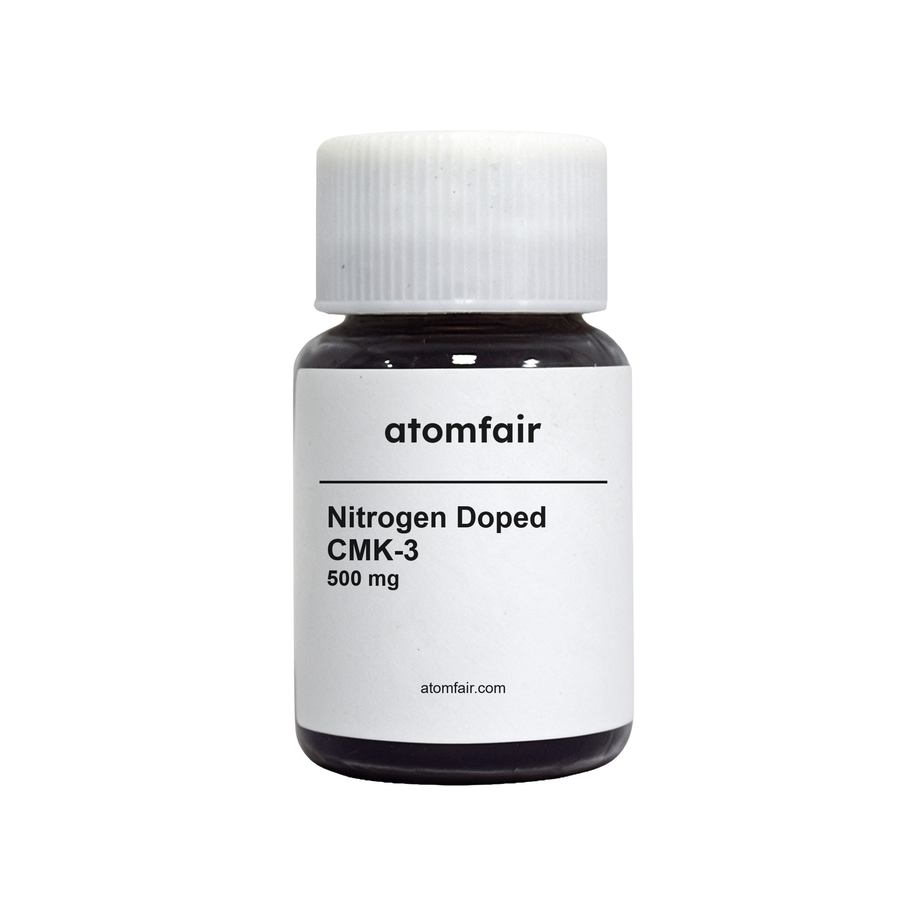
N-Doped CMK-3 Mesoporous Carbon SSA>500m2/g 500 mg ATOMFAIR®
$182.00 -
N-Doped Mesoporous Carbon Spheres 130-170 nm ATOMFAIR®
$403.00 -
N-Doped Mesoporous Carbon Spheres 130–170 nm ATOMFAIR®
$253.00 -
N-Doped Mesoporous Carbon Spheres 200-400 nm ATOMFAIR®
$253.00