
Inorganic Nanomaterials
Inorganic nanomaterials are essential materials for advanced research and development in functional coatings, catalysis, energy, electronics, optics, environmental technologies, and biomedical applications. At the nanoscale, inorganic materials can provide higher surface area, enhanced surface activity, and distinctive optical, electrical, magnetic, thermal, and catalytic properties compared with their bulk counterparts.
This category covers a broad range of inorganic nanoscale systems, including metal and metal oxide nanomaterials, non-metal oxides, sulfides, selenides, nitrides, carbides, phosphides, hydroxides, phosphates, and other functional inorganic nanostructures. Materials can be selected according to chemical composition, morphology, particle size, purity, crystal structure, surface chemistry, and supply form.
Whether you are developing a catalyst, coating, composite, sensor, energy material, optical component, or functional formulation, compare the material parameters with your intended process and application requirements. Powder, dispersion, doped, coated, and composite forms may offer different advantages during processing and final use.
Show More: Inorganic Nanomaterial Selection Guide
Material Families
Metal and Metal Oxide Nanomaterials
Metal and metal oxide nanomaterials offer diverse surface chemistry and tunable physical properties. They are widely used for conductivity, catalysis, photocatalysis, antimicrobial functions, ultraviolet absorption, magnetic response, gas sensing, and surface modification.
- Metal nanoparticles and nanostructures
- Metal oxide nanopowders
- Magnetic metal oxide nanomaterials
- Semiconductor oxide nanomaterials
- Doped, coated, and composite oxide nanomaterials
- Nanoparticles, nanorods, nanowires, and nanosheets
Sulfide, Selenide, and Other Chalcogenide Nanomaterials
Sulfide and selenide nanomaterials are valued for their layered structures, electronic properties, optical responses, carrier behavior, and surface reactivity. They are commonly considered for energy materials, catalysis, optoelectronics, sensing, and functional composites.
Nitride, Carbide, and High-Stability Nanomaterials
Nitride and carbide nanomaterials can provide high hardness, thermal stability, electrical conductivity, wear resistance, or chemical stability. They are suitable for thermal-management materials, conductive coatings, electrocatalysis, high-temperature systems, and structural composites.
Phosphide, Hydroxide, Phosphate, and Other Inorganic Nanomaterials
This group includes phosphides, hydroxides, phosphates, halides, silicates, and other inorganic nanoscale materials with specialized chemical or structural properties. They may be used in energy storage, electrocatalysis, adsorption, separation, environmental treatment, optical materials, sensors, and surface engineering.
Choose by Nanomaterial Morphology
| Morphology | Key characteristics | Typical application directions |
|---|---|---|
| Nanoparticles | Flexible for dispersion, formulation, and composite processing | Catalysis, coatings, fillers, and sensors |
| Nanopowders | Convenient for storage, weighing, and downstream processing | Ceramics, energy materials, and composites |
| Nanorods and nanowires | Directional structure and extended transport pathways | Electronics, optoelectronics, sensing, and catalysis |
| Nanosheets and layered materials | Large planar surfaces and distinctive interfacial behavior | Coatings, shielding, energy, and electronic materials |
| Porous nanostructures | High porosity and accessible surface area | Adsorption, catalysis, separation, and sensing |
| Core-shell and composite structures | Combines complementary functions in one material system | Optical, catalytic, magnetic, and interface engineering |
Specifications to Compare
| Specification | Why it matters |
|---|---|
| Chemical composition | Determines the fundamental chemical, electronic, optical, and catalytic behavior. |
| Particle size and distribution | Influences surface area, reactivity, packing, optical response, and dispersion. |
| Morphology | Nanoparticles, rods, wires, sheets, and porous structures can behave differently in the same formulation. |
| Purity | Trace impurities can affect sensitive electronic, optical, catalytic, and energy applications. |
| Crystal structure | Different phases may provide different conductivity, activity, stability, or optical properties. |
| Surface treatment | Surface modification affects wetting, dispersion, compatibility, and interfacial bonding. |
| Supply form | Dry powder and liquid dispersion forms support different processing workflows. |
Application Areas
- Catalysts, photocatalysts, and electrocatalysts
- Batteries, supercapacitors, and other energy materials
- Conductive, thermally conductive, dielectric, and insulating composites
- Functional, protective, wear-resistant, and barrier coatings
- Optical, optoelectronic, and luminescent materials
- Gas, chemical, and biosensors
- Magnetic materials and magnetically responsive composites
- Adsorption, separation, and environmental treatment
- Ceramic, polymer, and metal matrix nanocomposites
- Nanostructured surfaces and advanced functional devices
Frequently Asked Questions
What types of materials are included in inorganic nanomaterials?
This category includes metal and metal oxide nanomaterials, non-metal oxides, sulfides, selenides, nitrides, carbides, phosphides, hydroxides, phosphates, and other inorganic materials with nanoscale structures.
How do I choose the right inorganic nanomaterial?
Start with the required function, such as conductivity, thermal performance, catalysis, magnetism, optical response, wear resistance, or adsorption. Then compare composition, particle size, morphology, purity, crystal phase, surface treatment, and supply form.
Does a smaller particle size always provide better performance?
Not necessarily. Smaller particles may offer higher surface area and activity, but they can also be more difficult to disperse and more prone to agglomeration. The best particle size depends on the application and processing method.
Can inorganic nanomaterials be added directly to coatings or polymers?
Some materials can be used directly, while others may require pre-dispersion, surface treatment, or a suitable dispersant. Compatibility with the resin, solvent, and other formulation components should be confirmed before use.
Should I choose a powder or a dispersion?
Powders provide greater flexibility when adjusting the solvent, formulation, or solids loading. Dispersions can simplify processing and reduce the risk of agglomeration. The best choice depends on the intended workflow and target concentration.
How can I evaluate agglomeration and dispersion behavior?
Review the particle-size distribution, surface treatment, specific surface area, dispersion medium, and storage conditions. For coatings, slurries, and composites, practical dispersion testing in the final formulation is recommended.
Can inorganic nanomaterials be customized?
Some materials may be available with customized composition, particle size, morphology, doping, surface modification, dispersion medium, or packaging format. Requirements can be evaluated according to the intended application and quantity.
What information should I provide before purchasing?
Provide the target material or chemical composition, intended application, particle-size or morphology requirements, purity level, powder or dispersion preference, solvent or matrix, estimated quantity, and any surface-treatment requirements.
Showing 81–96 of 181 results
-
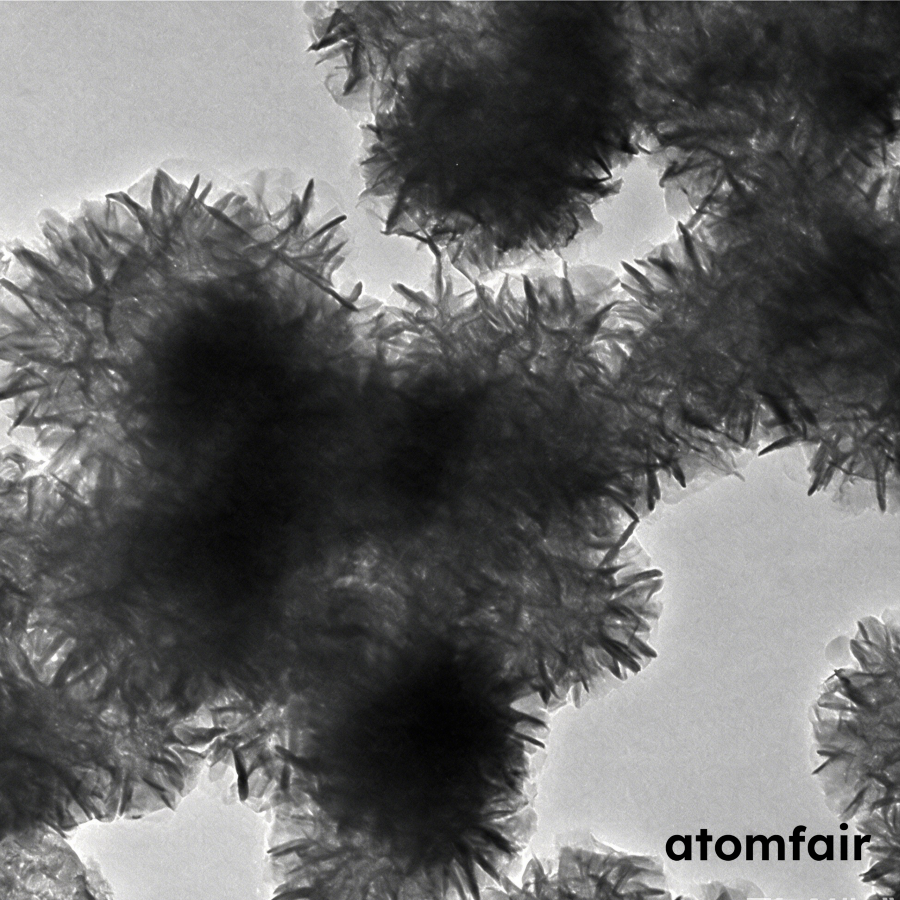
Flower-Like δ-MnO2 Water Dispersion 200-600nm ATOMFAIR®
$160.00 -
g-C3N4 Carbon Nitride Powder 1-10μm >99wt% 30 g ATOMFAIR®
$774.00 -
g-C3N4 Powder 1-10 μm >99 wt% Carbon Material 5 g ATOMFAIR®
$269.00 -
g-C3N4 Powder 1-10μm >99wt% 50g Research Grade ATOMFAIR®
$1,028.00 -
g-C3N4 Powder 1–10 μm >99 wt% 1 g Research Grade ATOMFAIR®
$75.00 -
g-C3N4 Powder 1–10μm >99wt% Research Grade ATOMFAIR®
$400.00 -
g-C3N4 Research Powder 1–10 μm >99 wt% 500 mg ATOMFAIR®
$50.00 -
Gallium Nitride Nanoparticles 0.5–3μm 92wt% ATOMFAIR®
$209.00 -
Graphite Paper Research-Grade ~50μm A4 >99% Pure ATOMFAIR®
$50.00 -
h-BN Nanoplates 1–5μm, <5nm Thick, 90at% ATOMFAIR®
$50.00 -
Halloysite Nanotubes 50–300nm, 1–10μm, >95% ATOMFAIR®
$306.00 -
Halloysite Nanotubes Powder 50–300nm >95%, 50 g ATOMFAIR®
$190.00 -
High-Purity TiO2 Nanopowder 1.0±0.3μm ≥99.9% 1kg ATOMFAIR®
$12.00 -
High-Purity TiO2 Powder ≥99.9% 1.0±0.3μm 25 kg ATOMFAIR®
$355.00 -
Hollow Mesoporous Ceria Nanoparticles 1 mg/mL ATOMFAIR®
$517.00 -
Hollow Mesoporous Ceria Nanoparticles 1mg/mL 5mL ATOMFAIR®
$776.00