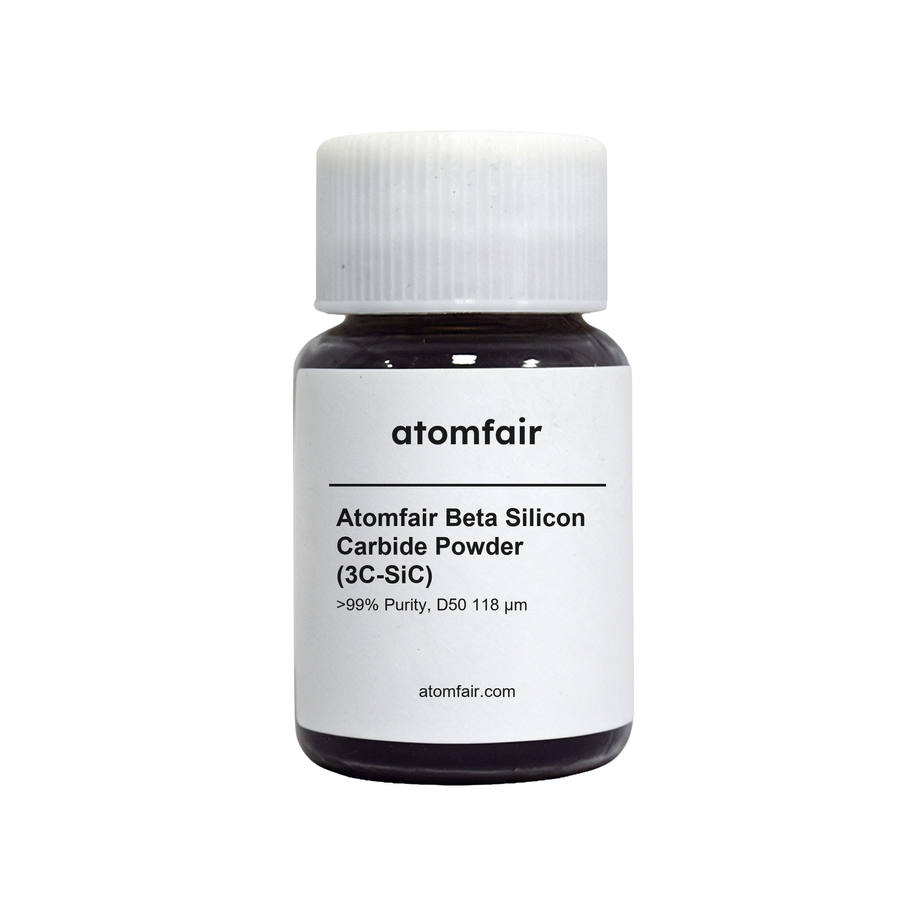
Atomfair Beta Silicon Carbide Powder (3C-SiC), >99% Purity, D50 118 μm – Thermal Conductivity and Microwave Absorption
Product Description
Atomfair beta Silicon Carbide Powder (3C-SiC) is supplied with >99% purity, D50 118 μm particle size, and a cubic beta-SiC (3C-SiC) crystal structure. It is intended for thermal-conductive fillers, microwave-absorbing materials, and dielectric or insulation materials research.
|
Technical Specifications
|
||||||||||||||||||||||||
|
Customization & Ordering
Custom particle-size and purity requirements may be evaluated for selected
grades upon request. Alternative package sizes may also be available.
Minimum order quantities, pricing, and lead times vary by specification and
will be confirmed during technical review and quotation.
Key Features and Advantages
- Defined >99% purity grade with D50 118 μm particle size.
- Complete-crystal, low-defect cubic beta-SiC powder format with high density.
- Low oil-absorption behavior with tunable dielectric performance for functional filler evaluation.
APPLICATION SCOPE: thermal-conductive fillers, microwave-absorbing materials, and dielectric or insulation materials research
DOCUMENTATION: COA and SDS can be provided upon request for batch-specific confirmation. Additional documentation requirements may be discussed before order confirmation.
LABORATORY PROCUREMENT SUPPORT
For grade selection, particle-size confirmation, documentation support or custom specification review, contact our technical sales team.
How does the D50 of 118 μm and tap density of 1.95 g/cm³ affect thermal conductivity performance in beta-SiC filler applications?
The 118 μm median particle size and 1.95 g/cm³ tap density provide a high packing density and reduced interfacial thermal resistance, which are critical for maximizing thermal conductivity in composite fillers. The coarse, cubic beta-SiC (3C-SiC) structure with >99% purity and low impurity levels (Fe₂O₃<0.08%, SiO₂<0.1%) minimizes phonon scattering, supporting efficient heat transfer in thermal management applications.
Can this beta-SiC powder be integrated into microwave-absorbing composites without additional surface treatment?
Yes, the powder's low oil-absorption behavior and tunable dielectric performance allow direct incorporation into polymer or ceramic matrices for microwave absorption evaluation. The cubic 3C-SiC phase with >99% purity and defined particle size distribution (D10 76.5 μm, D90 18 μm) provides consistent dielectric properties, though custom surface functionalization may be discussed with the technical team for specific absorption bandwidth requirements.
What storage and handling precautions are required for this beta-SiC powder to maintain its low-defect crystal structure?
Store in a dry, sealed container to prevent moisture absorption and oxidation, which could degrade the low-defect cubic beta-SiC structure. The powder's fine particle size (D97 ≤198 μm) and high tap density require careful handling to avoid airborne dust; use local exhaust ventilation and personal protective equipment as recommended in the SDS. Batch-specific COA and SDS are available upon request for detailed safety and stability data.
This 3C-SiC powder, with >99% purity and a D50 of 118 μm, is engineered for thermal-conductive filler and microwave-absorbing applications, offering a defined cubic crystal phase and low impurity profile. Its coarse particle size and high tap density present specific trade-offs in dispersion and sintering that must be managed during formulation.
Positive
- High-purity cubic beta-SiC phase: The >99% purity and cubic 3C-SiC crystal structure with low defect density provide a consistent dielectric and thermal baseline for functional filler research, with Fe2O3 below 0.08% and SiO2 below 0.1%.
- Low oil absorption for filler loading: The powder's low oil-absorption behavior supports higher filler loadings in composite matrices, which is advantageous for achieving target thermal conductivity or microwave absorption without excessive viscosity increase.
Trade-offs
- Coarse particle size limits dispersion: With a D50 of 118 μm and D90 of 18 μm (likely a typo for 180 μm), the large particle size may cause settling and poor dispersion in low-viscosity matrices, requiring additional milling or surface treatment for uniform distribution.
- High tap density affects processing: A tap density of 1.95 g/cm³ indicates significant packing, which can complicate dry handling and require specialized equipment for consistent dosing or compaction in manufacturing processes.
Every advanced material, component, equipment, and instrument in our catalog is backed by rigorous testing. We maintain strict internal quality management frameworks and align with CE conformity metrics to deliver transparent, reproducible performance data via our public open-science repository.
To request raw batch performance data, submit formal vendor registration paperwork, or execute a fast-turnaround R&D manufacturing loop, contact us at inquiry@atomfair.com.
Item is dispatched under the Atomfair Shipping & Delivery Framework (Free worldwide shipping on orders over $59 USD excl. heavy equipment). Return is governed by the Atomfair Return & Refund Policy (7-day technical return window).