SKU: AFCM718367758
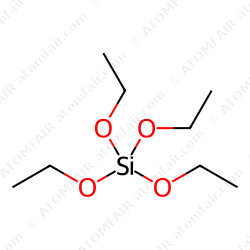
CAS Number: 78-10-4
Molecular Formula: C8H20O4Si
Alias: Tetraethyl orthosilicate; Tetraethoxysilane; Tetraethyl silicate; ETHYL SILICATE; Silicon ethoxide; Dynasil A; Silicon tetraethoxide; Tetraethoxysilicon; Silikan L; Ethyl orthosilicate; Etylu krzemian; Tetraethylsilikat; Silane; tetraethoxy-; Tetraethylorthosilicate; Silicic acid; tetraethyl ester; Silicate d’ethyle; Silicate tetraethylique; Silicic acid (H4SiO4); ES 28 (ester); ((EtO)4Si); Tetraethyl-O-silicate; Etylu krzemian [Polish]; Tetraethylsilikat [Czech]; ES 28; Silicate d’ethyle [French]; NSC 4790; ES 100; HSDB 534; Silicate tetraethylique [French]; Orthosilicic acid; EINECS 201-083-8; UN1292; BRN 1422225; CCRIS 8482; DTXSID6026450; Tetraethoxysilicon(IV); AI3-15098; (H4SiO4); NSC-4790; 42064KRE49; ETHYL SILICATE [MI]; DTXCID906450; BOTDANWDWHJENH-UHFFFAOYSA-; EC 201-083-8; TETRAETHYL SILICATE [HSDB]; Etylu krzemian (Polish); Tetraethylsilikat (Czech); Silicate d’ethyle (French); Silicate tetraethylique (French); Silibone; TetraethylOsilicate; tetraethoxy; SILIBOND; CONSERVARE OH; STEINFESTIGER OH; ETHYL SILICATE 28; ETHYL SILICATE 40; Silicic acid tetraethyl ester; ES 100 (SILICATE); Ethyl silicate (ACGIH:OSHA); KBE 04; TES 28; SI 42; ETHYL SILICATE ((ETO)4SI); TSL 8124; SILICON ETHOXIDE (SI(OET)4); LS 2430; TETRAETHYL ORTHOSILICATE [INCI]; SILICON TETRAETHOXIDE (SI(OET)4); 201-083-8; inchi=1/c8h20o4si/c1-5-9-13(10-6-2; 11-7-3)12-8-4/h5-8h2; 1-4h3; TEOS; TEOS (VAN); MFCD00009062; Orthosilicic acid tetraethyl ester; TEOS [VAN]; UNII-42064KRE49; tetraethoxy silane; R-(E; E)]-7-[4-(Dimethylamino)phenyl]-N-hydroxy-4; 6-dimethyl-7-oxo-2; 4-heptadienamide;; tetra(ethoxy)silane; ES 28 ester; tetrakis(ethoxy)silane; tetraethylortho silicate; Si(OEt)4; ethyl ester; tetraethyl-ortho-silicate; Tetraethyl orthosilicateTEOS; SCHEMBL17680; (C2H5O)4Si; Si(OC2H5)4; CHEMBL3187981; SCHEMBL11752468; SCHEMBL11752473; NSC4790; DTXSID301304393; STR05461; WLN: 2O-SI-O2&O2&O2; Tox21_200426; AKOS000269012; TETRA-ETHYL ESTER; UN 1292; CAS-78-10-4; s15425; NCGC00248607-01; NCGC00257980-01; ETHYL; 1-[(TRIETHOXYSILYL)OXY]-; >=99.0% (GC); NS00041218; T0100; EN300-19960; reagent grade; 98%; Q421458; Tetraethyl silicate [UN1292] [Flammable liquid]; 99.999% trace metals basis; SAJ first grade; >=95.0%; F0001-2050; packaged for use in deposition systems; 76063-52-0
If you are interested or have any questions, please contact us at inquiry@atomfair.com
Disclaimer: Sold exclusively for laboratory research. Prohibited for commercial use, diagnostics, or human/animal applications. Buyers assume all compliance liability.
Every advanced material, component, equipment, and instrument in our catalog is backed by rigorous testing. We maintain strict internal quality management frameworks and align with CE conformity metrics to deliver transparent, reproducible performance data via our public open-science repository.
To request raw batch performance data, submit formal vendor registration paperwork, or execute a fast-turnaround R&D manufacturing loop, contact us at inquiry@atomfair.com.
Item is dispatched under the Atomfair Shipping & Delivery Framework (Free worldwide shipping on orders over $59 USD excl. heavy equipment). Return is governed by the Atomfair Return & Refund Policy (7-day technical return window).