Description
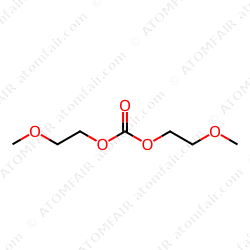
Bis(2-methoxyethyl) carbonate (CAS: 626-84-6) is a high-purity organic carbonate ester with the molecular formula C7H14O5. This compound is widely utilized in advanced electrochemical applications, including as a solvent or additive in lithium-ion battery electrolytes due to its favorable dielectric properties and stability. It is also employed as a chemical intermediate in organic synthesis, particularly in the production of polycarbonates and other specialty polymers. With a molecular weight of 178.18 g/mol, this clear, colorless liquid exhibits excellent solubility in common organic solvents, making it a versatile reagent for research and industrial processes. Available in various packaging options, our product meets stringent quality standards, ensuring reproducibility and performance for demanding scientific applications.
Properties
- CAS Number: 626-84-6
- Complexity: 102
- IUPAC Name: bis(2-methoxyethyl) carbonate
- InChI: InChI=1S/C7H14O5/c1-9-3-5-11-7(8)12-6-4-10-2/h3-6H2,1-2H3
- InChI Key: STLGQBDVSTWGIP-UHFFFAOYSA-N
- Exact Mass: 178.08412354
- Molecular Formula: C7H14O5
- Molecular Weight: 178.18
- SMILES: COCCOC(=O)OCCOC
- Topological: 54
- Monoisotopic Mass: 178.08412354
- Synonyms: Bis(2-methoxyethyl) carbonate, Ethanol, 2-methoxy-, carbonate (2:1), Ethanol, 2-methoxy-, carbonate, DTXSID80978172, NSC 7314, DTXCID501405496, Ethanol, 2-methoxy-, carbonate (2:1) (9CI), 633-105-0, stlgqbdvstwgip-uhfffaoysa-n, 626-84-6, bis(2-methoxyethyl)carbonate, Carbonic acid bis(2-methoxyethyl) ester, SCHEMBL302273, NSC7314, AAA62684, NSC-7314, MFCD33022136, carbonic acid bis-(2-methoxy-ethyl ester), G71952
Bis(2-methoxyethyl) carbonate is primarily used as a solvent or co-solvent in lithium-ion battery electrolytes, where its high dielectric constant enhances ionic conductivity. It also serves as a key intermediate in the synthesis of polycarbonates and other polymeric materials. Additionally, this compound finds utility in organic synthesis for the preparation of carbonates and urethanes. Its stability and solvation properties make it suitable for specialized electrochemical and material science research.
Safety and Hazards
GHS Hazard Statements
- H315 (100%): Causes skin irritation [Warning Skin corrosion/irritation]
- H319 (100%): Causes serious eye irritation [Warning Serious eye damage/eye irritation]
- H335 (100%): May cause respiratory irritation [Warning Specific target organ toxicity, single exposure; Respiratory tract irritation]
- H360 (100%): May damage fertility or the unborn child [Danger Reproductive toxicity]
Precautionary Statements
- P203, P261, P264, P264+P265, P271, P280, P302+P352, P304+P340, P305+P351+P338, P318, P319, P321, P332+P317, P337+P317, P362+P364, P403+P233, P405, and P501
Hazard Classes and Categories
- Skin Irrit. 2 (100%)
- Eye Irrit. 2 (100%)
- STOT SE 3 (100%)
- Repr. 1B (100%)
If you are interested or have any questions, please contact us at support@atomfair.com
Disclaimer: Sold exclusively for laboratory research. Prohibited for commercial use, diagnostics, or human/animal applications. Buyers assume all compliance liability.


Reviews
There are no reviews yet.