Description
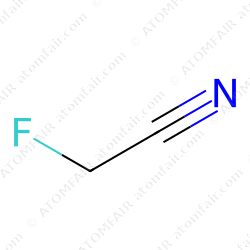
Acetonitrile, fluoro- (CAS No. 503-20-8) is a high-purity fluorinated nitrile compound with the molecular formula C2H2FN. Also known as 2-fluoroacetonitrile, this specialty chemical is widely utilized in advanced electrochemical applications due to its unique properties. The compound features a fluorine substituent on the acetonitrile backbone, enhancing its reactivity and solvation capabilities. Our product is rigorously tested to ensure superior quality, with stringent controls for moisture, impurities, and stability. Ideal for researchers and scientists working on next-generation battery technologies, this reagent is supplied in sealed containers under inert conditions to maintain integrity. Available in various quantities to suit lab-scale and industrial needs.
Properties
- CAS Number: 503-20-8
- Complexity: 41.2
- IUPAC Name: 2-fluoroacetonitrile
- InChI: InChI=1S/C2H2FN/c3-1-2-4/h1H2
- InChI Key: GNFVFPBRMLIKIM-UHFFFAOYSA-N
- Exact Mass: 59.017127230
- Molecular Formula: C2H2FN
- Molecular Weight: 59.04
- SMILES: C(C#N)F
- Topological: 23.8
- Monoisotopic Mass: 59.017127230
- Synonyms: Fluoroacetonitrile, 503-20-8, ACETONITRILE, FLUORO-, Fluoromethyl cyanide, Monofluoroacetonitrile, BRN 1697891, DTXSID10198301, DTXCID00120792, 610-523-1, 2-fluoroacetonitrile, C2H2FN, fluoro-acetonitrile, MFCD00009969, 2-fluoro-acetonitrile, FCH2CN, Fluoroacetonitrile, 98%, SCHEMBL575089, SCHEMBL869056, AKOS005258231, InChI=1/C2H2FN/c3-1-2-4/h1H, DB-007519, F0665, NS00121657, A20122, P18220
Application
Acetonitrile, fluoro- is a key component in fast-charging electrolytes and low-temperature electrolyte formulations for advanced lithium-ion batteries. Its fluorinated structure improves ionic conductivity and electrochemical stability, enabling high-performance energy storage systems. Researchers also explore its potential as a precursor in organic synthesis and specialty material production.
Safety and Hazards
GHS Hazard Statements
- H225 (100%): Highly Flammable liquid and vapor [Danger Flammable liquids]
- H301 (100%): Toxic if swallowed [Danger Acute toxicity, oral]
- H311 (100%): Toxic in contact with skin [Danger Acute toxicity, dermal]
- H315 (97.6%): Causes skin irritation [Warning Skin corrosion/irritation]
- H319 (97.6%): Causes serious eye irritation [Warning Serious eye damage/eye irritation]
- H331 (97.6%): Toxic if inhaled [Danger Acute toxicity, inhalation]
- H335 (95.1%): May cause respiratory irritation [Warning Specific target organ toxicity, single exposure; Respiratory tract irritation]
Precautionary Statements
- P210, P233, P240, P241, P242, P243, P261, P262, P264, P264+P265, P270, P271, P280, P301+P316, P302+P352, P303+P361+P353, P304+P340, P305+P351+P338, P316, P319, P321, P330, P332+P317, P337+P317, P361+P364, P362+P364, P370+P378, P403+P233, P403+P235, P405, and P501
Hazard Classes and Categories
- Flam. Liq. 2 (100%)
- Acute Tox. 3 (100%)
- Skin Irrit. 2 (97.6%)
- Eye Irrit. 2 (97.6%)
- Acute Tox. 3 (97.6%)
- STOT SE 3 (95.1%)
If you are interested or have any questions, please contact us at support@atomfair.com
Disclaimer: Sold exclusively for laboratory research. Prohibited for commercial use, diagnostics, or human/animal applications. Buyers assume all compliance liability.


Reviews
There are no reviews yet.