Description
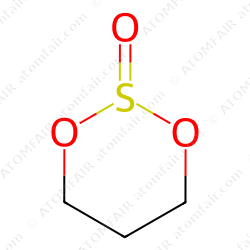
1,3,2-Dioxathiane 2-oxide (CAS No. 4176-55-0) is a specialized heterocyclic organic compound with the molecular formula C3H6O3S. This high-purity chemical is characterized by its unique six-membered ring structure containing sulfur and oxygen, making it a valuable intermediate in organic synthesis and material science applications. Our product is rigorously tested to ensure ≥98% purity (GC) and is supplied as a clear to pale yellow liquid with excellent batch-to-batch consistency. Ideal for research and development purposes, this compound is packaged under inert atmosphere to ensure stability and long shelf life. Available in quantities ranging from 100mg to 1kg, with custom synthesis options available for bulk orders.
Key Specifications:
– CAS: 4176-55-0
– Molecular Weight: 122.14 g/mol
– Purity: ≥98% (GC)
– Appearance: Clear to pale yellow liquid
– Storage: Store under inert atmosphere at 2-8°C
Properties
- CAS Number: 4176-55-0
- Complexity: 74.2
- IUPAC Name: 1,3,2-dioxathiane 2-oxide
- InChI: InChI=1S/C3H6O3S/c4-7-5-2-1-3-6-7/h1-3H2
- InChI Key: LOURZMYQPMDBSR-UHFFFAOYSA-N
- Exact Mass: 122.00376522
- Molecular Formula: C3H6O3S
- Molecular Weight: 122.15
- SMILES: C1COS(=O)OC1
- Topological: 54.7
- Monoisotopic Mass: 122.00376522
- Synonyms: 1,3,2-Dioxathiane 2-oxide, 4176-55-0, 1,3,2-dioxathiane, 2-oxide, EINECS 224-044-7, DTXSID10194585, NSC 78687, DTXCID50117076, 224-044-7, inchi=1/c3h6o3s/c4-7-5-2-1-3-6-7/h1-3h, Trimethylene sulfite, 1,3,2-Dioxathian-2-one, 1,3-Propylene sulfite, 1,3-Propanediol cyclic sulfite, NSC-78687, MFCD01682880, 1,2-Dioxathiane, 2-oxide, 4AT4ZWH29Y, 2-Oxo-1,3,2-dioxathiane, SCHEMBL186292, 1,3-Propylene sulfite, 99%, LOURZMYQPMDBSR-UHFFFAOYSA-N, NSC78687, AKOS006277349, CS-W013557, DS-11427, D4426, NS00031052, D90284
Application
1,3,2-Dioxathiane 2-oxide serves as a versatile building block in organic synthesis, particularly in the development of sulfur-containing heterocycles. Researchers utilize this compound as a precursor for the synthesis of novel ligands in coordination chemistry and as a key intermediate in pharmaceutical research. Its unique structure makes it valuable for studying ring-opening polymerization reactions and developing new polymeric materials with tailored properties.
Safety and Hazards
GHS Hazard Statements
- H315 (100%): Causes skin irritation [Warning Skin corrosion/irritation]
- H317 (100%): May cause an allergic skin reaction [Warning Sensitization, Skin]
- H318 (100%): Causes serious eye damage [Danger Serious eye damage/eye irritation]
- H335 (97.5%): May cause respiratory irritation [Warning Specific target organ toxicity, single exposure; Respiratory tract irritation]
Precautionary Statements
- P261, P264, P264+P265, P271, P272, P280, P302+P352, P304+P340, P305+P354+P338, P317, P319, P321, P332+P317, P333+P317, P362+P364, P403+P233, P405, and P501
Hazard Classes and Categories
- Skin Irrit. 2 (100%)
- Skin Sens. 1 (100%)
- Eye Dam. 1 (100%)
- STOT SE 3 (97.5%)
If you are interested or have any questions, please contact us at support@atomfair.com
Disclaimer: Sold exclusively for laboratory research. Prohibited for commercial use, diagnostics, or human/animal applications. Buyers assume all compliance liability.


Reviews
There are no reviews yet.