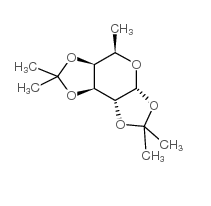
1,2,3,4-Di-O-isopropylidene-alpha-D-fucopyranose (CAS No. 4026-27-1) is a highly specialized carbohydrate derivative with the molecular formula C12H20O5. This compound, also known by its IUPAC name (1S,2R,6R,8R,9S)-4,4,8,11,11-pentamethyl-3,5,7,10,12-pentaoxatricyclo[7.3.0.02,6]dodecane, is a protected form of fucose, featuring isopropylidene groups that enhance its stability and reactivity in synthetic applications. It is widely utilized in organic synthesis, glycochemistry, and as a chiral building block for complex molecular architectures. The compound is supplied as a high-purity solid, ensuring optimal performance in sensitive reactions. Its unique stereochemistry makes it invaluable for researchers developing glycosides, glycoconjugates, and other bioactive molecules.
Properties
-
- CAS Number: 4026-27-1
- Complexity: 327
- IUPAC Name: (1S,2R,6R,8R,9S)-4,4,8,11,11-pentamethyl-3,5,7,10,12-pentaoxatricyclo[7.3.0.02,6]dodecane
- InChI: InChI=1S/C12H20O5/c1-6-7-8(15-11(2,3)14-7)9-10(13-6)17-12(4,5)16-9/h6-10H,1-5H3/t6-,7+,8+,9-,10-/m1/s1
- InChI Key: FBWQLTARTKWGMT-SOYHJAILSA-N
- Exact Mass: 244.13107373
- Molecular Formula: C12H20O5
- Molecular Weight: 244.28
- SMILES: C[C@@H]1[C@H]2[C@@H]([C@@H]3[C@H](O1)OC(O3)(C)C)OC(O2)(C)C
- Topological: 46.2
- Monoisotopic Mass: 244.13107373
- Synonyms: 4026-27-1, 1,2,3,4-Di-O-isopropylidene-alpha-D-fucopyranose, 1,2:3,4-di-O-Isopropylidene-D-fucopyranose, 6-Deoxy-1,2:3,4-di-O-isopropylidene-alpha-D-galactopyranose, (1S,2R,6R,8R,9S)-4,4,8,11,11-pentamethyl-3,5,7,10,12-pentaoxatricyclo[7.3.0.02,6]dodecane, 1,2,3,4-Di-O-isopropylidene-a-D-fucopyranose, MFCD00190867, SCHEMBL3330131, SCHEMBL13328902, MD05797, CS-0452273, 1,2:3,4-Di-O-isopropylidene-a-D-fucopyranose, G84278, (1S,2R,6R,8R,9S)-4,4,8,11,11-pentamethyl-3,5,7,10,12-pentaoxatricyclo[7.3.0.0,dodecane, (3AR,5R,5aS,8aS,8bR)-2,2,5,7,7-pentamethyltetrahydro-5H-bis([1,3]dioxolo)[4,5-b:4′,5′-d]pyran, 6-DEOXY-1:2,3:4-DI-O-ISOPROPYLIDENE-ALPHA-D-GALACTOPYRANOSE, 1:2,3:4-DI-O-ISOPROPYLIDENE-ALPHA-D-FUCOSE
Application
1,2,3,4-Di-O-isopropylidene-alpha-D-fucopyranose is primarily used as a protected intermediate in the synthesis of fucose-containing glycoconjugates and oligosaccharides. It serves as a key precursor in carbohydrate chemistry for the preparation of glycosyl donors and acceptors. Researchers employ this compound in the study of glycosylation reactions and enzymatic processes involving fucose. Its stability under various conditions makes it suitable for multi-step synthetic routes in medicinal chemistry and glycobiology.
If you are interested or have any questions, please contact us at inquiry@atomfair.com.
Disclaimer: Sold exclusively for laboratory research. Prohibited for commercial use, diagnostics, or human/animal applications. Buyers assume all compliance liability.
This compound is a protected carbohydrate derivative that requires anhydrous storage to prevent hydrolysis of the isopropylidene acetal groups. Exposure to moisture or protic acids will lead to deprotection and degradation.
- Moisture Sensitivity: Store under inert gas in a tightly sealed container away from atmospheric moisture to maintain the integrity of the acetal protecting groups.
- Acid Sensitivity: Avoid contact with strong acids, which catalyze the removal of isopropylidene groups and cause decomposition.
- Temperature Stability: Maintain storage temperatures within the range recommended by the supplier to prevent thermal degradation or unwanted intramolecular reactions.
This procedure outlines the safe receipt, storage, and handling of this moisture-sensitive carbohydrate derivative. Proper technique prevents degradation and ensures reproducible results in synthetic applications.
Required Equipment: Inert atmosphere glovebox or Schlenk line, Anhydrous solvent (e.g., dry dichloromethane or tetrahydrofuran), Oven-dried glassware and syringes
- Equilibrate to room temperature
Allow the sealed container to warm to ambient temperature in a desiccator over phosphorus pentoxide to prevent moisture condensation on the solid. - Open under inert atmosphere
Open the vial inside a glovebox or under a positive flow of dry nitrogen or argon to avoid exposure to atmospheric moisture. - Transfer with anhydrous solvent
Dissolve the solid in an anhydrous solvent and transfer using a gas-tight syringe to a reaction vessel maintained under inert gas. - Reseal and store
After use, reseal the container under inert gas and store in a cool, dry place away from light and acids.
What is the role of the isopropylidene groups in 1,2,3,4-Di-O-isopropylidene-alpha-D-fucopyranose for glycosylation reactions?
The isopropylidene groups protect the hydroxyl groups at positions 1,2 and 3,4, preventing unwanted side reactions and enhancing the compound's stability and reactivity in multi-step synthetic routes. This protection is crucial for selective glycosylation, enabling the controlled formation of glycosidic bonds when the compound is used as a precursor for glycosyl donors or acceptors. The protected form allows for the introduction of fucose moieties into complex glycoconjugates and oligosaccharides under conditions that would otherwise degrade unprotected sugars.
This protected fucose derivative, with its isopropylidene acetal groups, provides a stable, high-purity intermediate for stereoselective glycosylation and glycoconjugate synthesis, though its acid-labile protecting groups and research-only classification impose handling and application constraints.
Positive
- Protected fucose building block: The isopropylidene groups protect the 1,2- and 3,4-diols, enabling selective functionalization at the anomeric center and other positions, which is critical for synthesizing fucosylated glycoconjugates and oligosaccharides.
- High-purity solid form: Supplied as a high-purity solid, this compound ensures consistent stoichiometry and reduces moisture sensitivity, facilitating accurate weighing and handling in multi-step synthetic routes.
Trade-offs
- Acid-labile protecting groups: The isopropylidene acetals are susceptible to hydrolysis under acidic conditions, requiring careful pH control during deprotection and subsequent reaction steps to prevent undesired cleavage.
- Research-use-only restriction: This compound is restricted to laboratory research and prohibited for commercial, diagnostic, or human/animal applications, limiting its use to non-clinical R&D settings.
Every advanced material, component, equipment, and instrument in our catalog is backed by rigorous testing. We maintain strict internal quality management frameworks and align with CE conformity metrics to deliver transparent, reproducible performance data via our public open-science repository.
To request raw batch performance data, submit formal vendor registration paperwork, or execute a fast-turnaround R&D manufacturing loop, contact us at inquiry@atomfair.com.
Item is dispatched under the Atomfair Shipping & Delivery Framework (Free worldwide shipping on orders over $59 USD excl. heavy equipment). Return is governed by the Atomfair Return & Refund Policy (7-day technical return window).