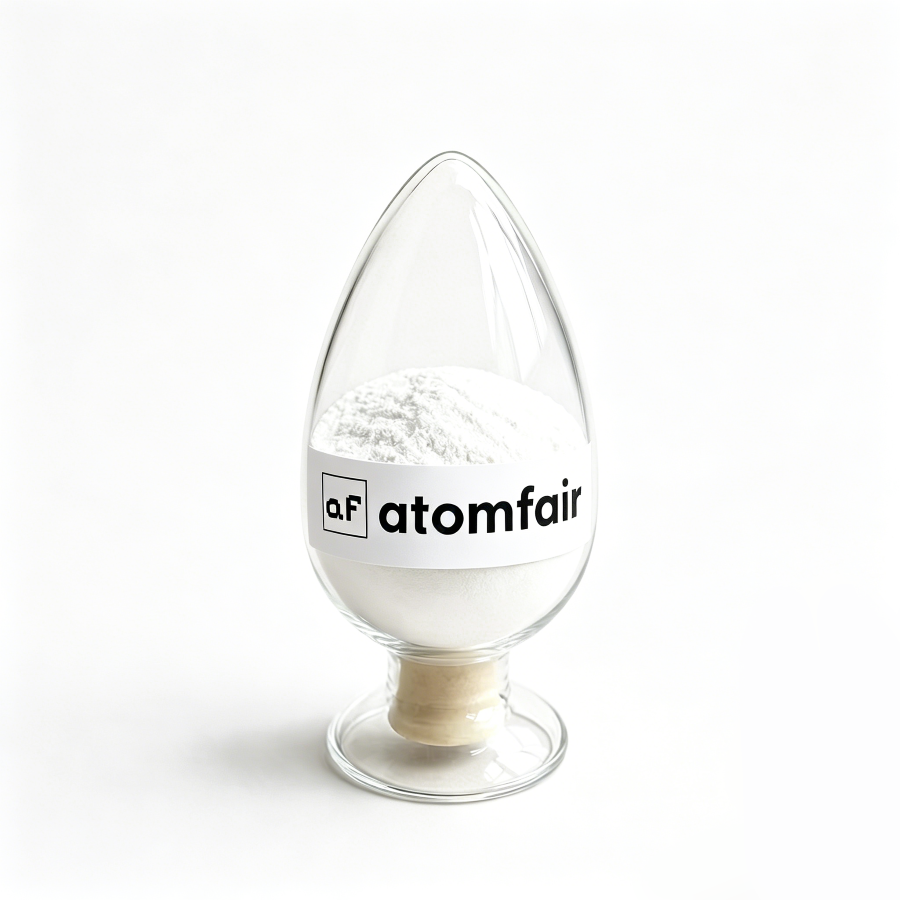
ATOMFAIR LNMO (25:75) High Voltage Spinel PrecursorRESEARCH GRADE MATERIAL
|
|||||||||||||||||||||||||||||||||||||||||||||
|
|||||||||||||||||||||||||||||||||||||||||||||
This nickel manganese hydroxide precursor powder is highly prone to moisture absorption from ambient air, requiring storage in sealed containers under dry inert atmosphere to maintain water content below 0.50 wt%. Particle morphology and surface area must be preserved to ensure consistent electrochemical performance in downstream high-voltage spinel synthesis.
- Moisture Sensitivity: Absorbed moisture above 0.50 wt% degrades precursor quality and may affect final cathode stoichiometry.
- Contamination Sensitivity: Exposure to carbon dioxide or airborne particulates introduces impurities that alter the intended Ni:Mn ratio and crystalline phase.
- Handling Requirements: Use powder handling procedures in a dry glovebox or controlled low-humidity environment to prevent aggregation and moisture uptake.
What is the trade-off between specific surface area (25.5 m²/g) and tap density (1.47 g/cm³) in this LNMO precursor for optimizing rate capability and volumetric energy density?
The specific surface area of 25.5 m²/g (within the standard window of 25.00 ± 5.00 m²/g) provides sufficient electrode–electrolyte contact for high rate capability, while the tap density of 1.47 g/cm³ maintains practical volumetric energy density. This balance is supported by the narrow particle size span of 0.75 and a D50 of 4.52 μm, enabling uniform coating and minimizing performance trade-offs across consumer digital electronics, EV, and grid storage applications.
What application-specific constraints must be considered when integrating this Ni25:Mn75 hydroxide precursor into new energy vehicle pouch cells versus power tool cylindrical cells?
For automotive pouch cells, the narrow D50 of 4.52 μm and span of 0.75 allow high-loading electrode coatings with consistent porosity, while for power tool cylindrical cells, the specific surface area of 25.5 m²/g supports high-rate discharge without excessive electrolyte decomposition. The low water content of 0.44 wt% (below the 0.50 wt% requirement) minimizes HF formation regardless of binder system, and the trace sodium (34 ppm) and sulfur (714 ppm) levels remain well within their respective limits of 300 ppm and 2000 ppm to avoid contamination in any cell format.
What storage conditions are required to maintain the water content below 0.50 wt% and prevent trace sodium contamination in this LNMO precursor?
The precursor powder must be stored in an inert, dry atmosphere with relative humidity below 2% to preserve the 0.44 wt% water content. Sodium contamination (currently 34 ppm) is kept below the 300 ppm boundary by using HDPE containers and avoiding sodium-based lubricant exposure. Room-temperature storage in sealed vessels with desiccant is required to protect the spherical morphology and particle size distribution (D50 4.52 μm, span 0.75) for downstream calcination into high-voltage spinel.
This LNMO 25:75 high-voltage spinel precursor powder delivers a tightly controlled particle size distribution (D50 4.52 μm, span 0.75) and low impurity levels, making it well-suited for consistent cathode prototyping, though its strict water content requirement (<0.50 wt%) and narrow compositional tolerances demand careful environmental and quality control during handling and synthesis.
Positive
- Uniform morphology and narrow PSD: The precursor exhibits an ultra-uniform morphology with a highly concentrated particle size distribution (D50 4.52 μm, span 0.75), which reduces variability in electrode fabrication and supports consistent electrochemical rate capability and energy density.
- Low impurity and water content: Trace contaminants are well below specified limits (Na 34 ppm, S 714 ppm) and water content is controlled at 0.44 wt% (below 0.50 wt% requirement), minimizing parasitic side reactions during high-voltage cycling.
Trade-offs
- Moisture-sensitive handling required: With a maximum allowable water content of just 0.50 wt%, the powder must be stored and handled in dry conditions (e.g., argon or dry room) to prevent moisture uptake that could degrade precursor performance and final cathode quality.
- Tight composition control needed: The Ni and Mn mole fractions are specified to within ±0.30 mol% of target (Ni 25.10, Mn 74.90 mol%), meaning any deviation outside this narrow window during synthesis or blending may compromise the high-voltage spinel phase purity and electrochemical properties.
Every advanced material, component, equipment, and instrument in our catalog is backed by rigorous testing. We maintain strict internal quality management frameworks and align with CE conformity metrics to deliver transparent, reproducible performance data via our public open-science repository.
To request raw batch performance data, submit formal vendor registration paperwork, or execute a fast-turnaround R&D manufacturing loop, contact us at inquiry@atomfair.com.
Item is dispatched under the Atomfair Shipping & Delivery Framework (Free worldwide shipping on orders over $59 USD excl. heavy equipment). Return is governed by the Atomfair Return & Refund Policy (7-day technical return window).