Description
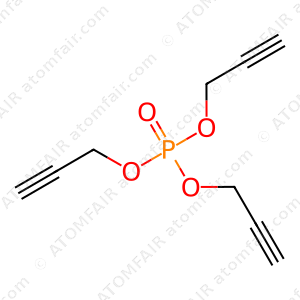
Tri-2-propyn-1-yl phosphate (CAS No. 1779-34-6), also known as tris(prop-2-ynyl) phosphate, is a highly specialized organophosphorus compound with the molecular formula C9H9O4P. This compound features three propargyl (prop-2-ynyl) groups bonded to a phosphate core, making it a versatile intermediate in synthetic chemistry and material science applications. Its high reactivity due to the presence of terminal alkynes allows for selective modifications, including click chemistry reactions. Tri-2-propyn-1-yl phosphate is supplied as a high-purity liquid, rigorously tested for quality and consistency, making it ideal for researchers requiring precise and reliable reagents. Suitable for use in controlled environments, this compound is packaged under inert conditions to ensure stability and longevity.
Properties
- CAS Number: 1779-34-6
- Complexity: 301
- IUPAC Name: tris(prop-2-ynyl) phosphate
- InChI: InChI=1S/C9H9O4P/c1-4-7-11-14(10,12-8-5-2)13-9-6-3/h1-3H,7-9H2
- InChI Key: FCTINJHSYHFASK-UHFFFAOYSA-N
- Exact Mass: 212.02384576
- Molecular Formula: C9H9O4P
- Molecular Weight: 212.14
- SMILES: C#CCOP(=O)(OCC#C)OCC#C
- Topological: 44.8
- Monoisotopic Mass: 212.02384576
- Synonyms: 1779-34-6, Tri-2-propyn-1-yl phosphate, 853-966-8, tripropargyl phosphate, tris(prop-2-ynyl) phosphate, Tripropargyl Phosphate, 98%, SCHEMBL6424273, MFCD34561840, DB-405808, T3987, F88862
Application
Tri-2-propyn-1-yl phosphate is primarily used as a reactive intermediate in organic synthesis, particularly in the development of flame retardants and cross-linking agents due to its propargyl functional groups. It serves as a key precursor in click chemistry applications, enabling the formation of triazole derivatives via copper-catalyzed azide-alkyne cycloaddition (CuAAC). Researchers also utilize this compound in polymer chemistry to modify material properties such as thermal stability and adhesion. Its unique structure makes it valuable for designing advanced coatings and adhesives with tailored performance characteristics.
Safety and Hazards
GHS Hazard Statements
- H302 (100%): Harmful if swallowed [Warning Acute toxicity, oral]
- H312 (25%): Harmful in contact with skin [Warning Acute toxicity, dermal]
- H317 (75%): May cause an allergic skin reaction [Warning Sensitization, Skin]
- H331 (25%): Toxic if inhaled [Danger Acute toxicity, inhalation]
- H412 (75%): Harmful to aquatic life with long lasting effects [Hazardous to the aquatic environment, long-term hazard]
Precautionary Statements
- P261, P264, P270, P271, P272, P273, P280, P301+P317, P302+P352, P304+P340, P316, P317, P321, P330, P333+P317, P362+P364, P403+P233, P405, and P501
Hazard Classes and Categories
- Acute Tox. 4 (100%)
- Skin Sens. 1 (75%)
- Aquatic Chronic 3 (75%)
If you are interested or have any questions, please contact us at support@atomfair.com
Disclaimer: Sold exclusively for laboratory research. Prohibited for commercial use, diagnostics, or human/animal applications. Buyers assume all compliance liability.


Reviews
There are no reviews yet.