ATOMFAIR® ATOMFAIR-COA-443 PILOT COATING MACHINERESEARCH GRADE MATERIAL
|
|||||||||||||||||||||||||||||||||||||||
|
|||||||||||||||||||||||||||||||||||||||
High-voltage (380V, 30 kW) machinery requires proper grounding and lockout/tagout procedures during maintenance. Solvent-based coatings mandate integrated explosion-proof ventilation and solvent recovery systems to prevent atmospheric accumulation.
- Electrical Safety Limits: Do not operate without verifying that the machine is connected to a grounded power supply and that all safety interlocks are functional.
- Compressed Air Safety: Use compressed air only within the specified 0.5–0.7 MPa range and secure all fittings against accidental disconnection.
- Chemical Fume Management: Operate the solvent recovery system continuously when coating with volatile organic solvents to maintain air quality below exposure limits.
- Thermal Hazard Prevention: Keep the drying oven area free of flammable materials and monitor temperature to prevent overheating beyond the 120°C set point.
- Web Handling Constraints: Maintain proper web tension and align rollers to avoid substrate tearing or wrinkling during intermittent coating cycles.
Follow this step-by-step sequence to initialize and operate the pilot coating machine safely and accurately. The procedure covers electrical verification, parameter setup, and post-operation shutdown.
Required Equipment: Personal protective equipment (safety glasses, insulated gloves, lab coat), Solvent recovery system (for volatile coatings), Touch screen controller with PLC interface, Compressed air supply (0.5–0.7 MPa regulated)
- Pre-operation inspection
Inspect all electrical connections, compressed air lines, and solvent recovery ducts for visible damage or loose fittings before powering the machine. - System grounding verification
Verify that the ground cable is securely attached and that the residual current device is functioning before turning on the main power supply. - Parameter programming
Set coating thickness, intermittent pattern, web speed, and oven temperature on the touch screen controller according to the electrode specifications. - Substrate loading
Load the substrate roll onto the unwind shaft, thread it through the tension rollers and coating head, and secure it to the rewind shaft. - Coating initiation
Start the coating process by enabling the drive system and gradually increasing web speed to the programmed value while monitoring coating uniformity. - Oven drying monitoring
Observe the drying oven temperature and airflow across all three sections to ensure consistent solvent evaporation without skinning or blistering. - Post-coating shutdown
Stop the drive system, shut off the oven and solvent recovery unit, and perform a lockout/tagout before cleaning the rollers or inspecting the coating head.
How does the ±3 μm coating accuracy translate to electrode uniformity at the minimum and maximum thickness settings?
At the minimum thickness of 40 μm, ±3 μm represents a 7.5% variation; at the maximum 200 μm, it is only 1.5%. The comma blade and three-roll transfer coating mechanism maintain this accuracy across the full 300 mm coating width, with edge effects limited to ±5 μm.
How does the intermittent coating mode work for patterned electrode coatings?
The intermittent coating mode uses PLC-controlled start/stop of the slurry supply to create coated and uncoated sections. The comma blade precision and web tension control ensure clean edges with minimal overspray. The maximum mechanical speed of 5 m/min and coating accuracy of ±3 μm apply to both intermittent and continuous modes.
What are the compressed air and power requirements for installing this machine?
The machine requires a 380V 3-phase 50Hz power supply with a maximum power draw of 30 kW. Compressed air supply must be 0.5–0.7 MPa. The oven and optional solvent recovery system may require additional ventilation or exhaust connections. Ensure the facility can support the ~2 T weight and 6600 mm length.
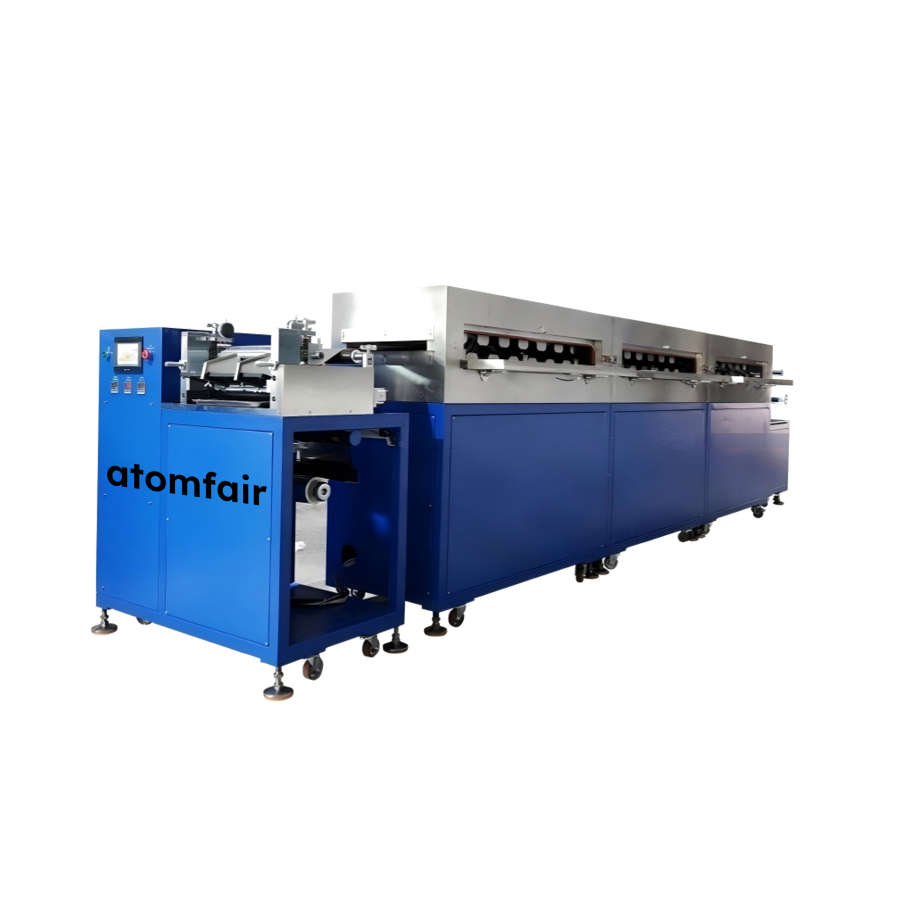
This intermittent pilot coating machine delivers ±3 μm transfer coating precision for lithium-ion battery electrodes, with a 300 mm max coating width and 5 m/min mechanical speed that constrain pilot-scale throughput but enable reproducible R&D trials.
Positive
- High coating accuracy ±3 μm: Coating precision of ±3 μm (edge ±5 μm) ensures uniform electrode layer thickness, critical for consistent electrochemical performance in lithium-ion battery R&D and pilot production.
- Intermittent and continuous coating modes: Supports both intermittent and continuous coating, allowing flexible deposition patterns for patterned electrode designs or full-area coatings within a single machine.
Trade-offs
- Limited coating width 300 mm: Maximum coating width of 300 mm constrains the electrode substrate size, making the machine suitable only for small-area R&D and pilot batches rather than production-scale widths.
- Low mechanical speed up to 5 m/min: Maximum line speed of 5 m/min limits throughput, requiring extended processing times for pilot runs and precluding high-speed coating for production development.
Every advanced material, component, equipment, and instrument in our catalog is backed by rigorous testing. We maintain strict internal quality management frameworks and align with CE conformity metrics to deliver transparent, reproducible performance data via our public open-science repository.
To request raw batch performance data, submit formal vendor registration paperwork, or execute a fast-turnaround R&D manufacturing loop, contact us at inquiry@atomfair.com.
Item is dispatched under the Atomfair Shipping & Delivery Framework (Free worldwide shipping on orders over $59 USD excl. heavy equipment). Return is governed by the Atomfair Return & Refund Policy (7-day technical return window).