Description
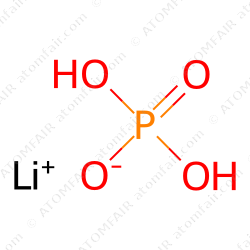
Phosphoric acid, lithium salt (1:1), also known as Lithium dihydrogen phosphate (LiH2PO4), is a high-purity inorganic compound widely utilized in advanced electrochemical applications, particularly in the development of lithium-ion battery electrolytes. This white crystalline powder exhibits excellent solubility in water and delivers superior ionic conductivity, making it an essential component for energy storage solutions. With a molecular formula of H2LiO4P and CAS number 13453-80-0, it is manufactured under strict quality control to ensure minimal impurities, optimal thermal stability, and consistent performance. Ideal for researchers and engineers, this product is packaged in moisture-resistant containers to maintain integrity and shelf life. Its role in enhancing battery efficiency and cycle life makes it indispensable for next-generation energy technologies.
Properties
- CAS Number: 13453-80-0
- Complexity: 61.9
- IUPAC Name: lithium;dihydrogen phosphate
- InChI: InChI=1S/Li.H3O4P/c;1-5(2,3)4/h;(H3,1,2,3,4)/q+1;/p-1
- InChI Key: SNKMVYBWZDHJHE-UHFFFAOYSA-M
- Exact Mass: 103.98507397
- Molecular Formula: H2LiO4P
- Molecular Weight: 104.0
- SMILES: [Li+].OP(=O)(O)[O-]
- Topological: 80.6
- Monoisotopic Mass: 103.98507397
- Synonyms: Lithium dihydrogen phosphate, 13453-80-0, Lithium dihydrophosphate, Lithium dihydrogen orthophosphate, Phosphoric acid, monolithium salt, Lithium dihydrogenorthophosphate, EINECS 236-633-6, Phosphoric acid, lithium salt (1:1), Lithium phosphate (LiH2PO4), DTXSID40884609, DTXCID701024040, Lithium phosphate (LiH2PO4) (7CI), 236-633-6, Lithium phosphate monobasic, Lithium dihydrogenphosphate, lithium;dihydrogen phosphate, Monolithium phosphate, Lithiumdihydrogenphosphate, MFCD00016188, H2LiO4P, SCHEMBL94160, Li H2 P O4, SNKMVYBWZDHJHE-UHFFFAOYSA-M, AKOS015904095, AKOS030228263, DB-297712, Q2683107
Lithium dihydrogen phosphate is primarily used as a precursor in the synthesis of lithium-ion battery electrolytes, where it contributes to improved ionic conductivity and electrode stability. It serves as a key additive in solid-state electrolytes for advanced energy storage systems, enhancing thermal and electrochemical performance. Researchers also employ it in the development of phosphate-based cathode materials for high-energy-density batteries. Additionally, it finds applications in specialty ceramics and as a buffering agent in analytical chemistry.
Safety and Hazards
GHS Hazard Statements
- H302 (100%): Harmful if swallowed [Warning Acute toxicity, oral]
- H315 (100%): Causes skin irritation [Warning Skin corrosion/irritation]
- H319 (100%): Causes serious eye irritation [Warning Serious eye damage/eye irritation]
- H335 (100%): May cause respiratory irritation [Warning Specific target organ toxicity, single exposure; Respiratory tract irritation]
Precautionary Statements
- P261, P264, P264+P265, P270, P271, P280, P301+P317, P302+P352, P304+P340, P305+P351+P338, P319, P321, P330, P332+P317, P337+P317, P362+P364, P403+P233, P405, and P501
Hazard Classes and Categories
- Acute Tox. 4 (100%)
- Skin Irrit. 2 (100%)
- Eye Irrit. 2 (100%)
- STOT SE 3 (100%)
If you are interested or have any questions, please contact us at support@atomfair.com
Disclaimer: Sold exclusively for laboratory research. Prohibited for commercial use, diagnostics, or human/animal applications. Buyers assume all compliance liability.


Reviews
There are no reviews yet.