Introduction
Specifications
How does the cell size (PPI) range from 5 to 1300 affect the trade-off between filtration efficiency and pressure drop in this open-cell nickel foam?
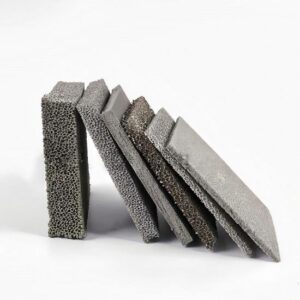
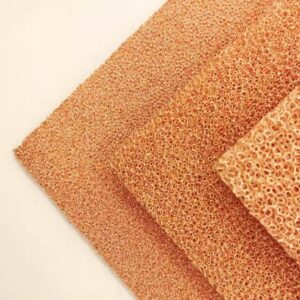
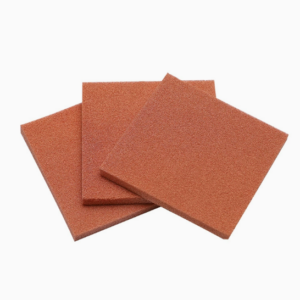
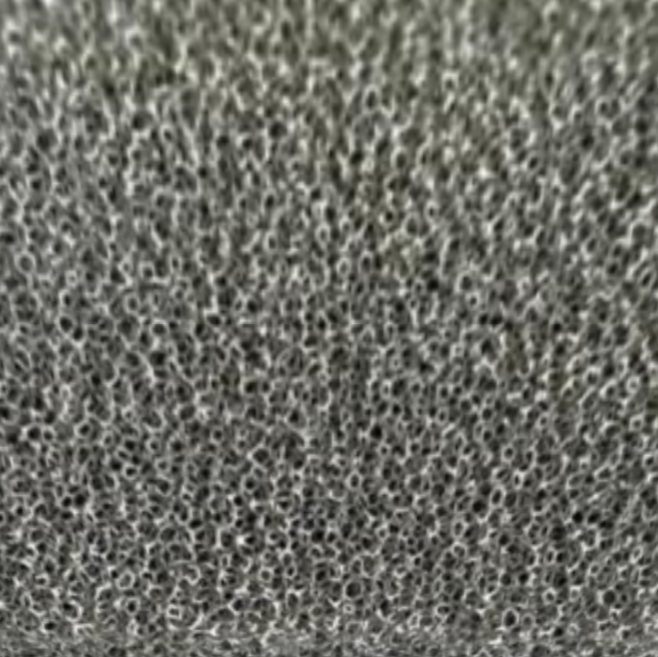
The nickel foam has a porosity of 95-98% and open cell rate ≥98%, ensuring low flow resistance. As PPI increases, the average pore size decreases, which raises pressure drop but improves filtration of particles smaller than 15μm. The standard foam effectively filters particles of 15μm diameter; for finer filtration, higher PPI (up to 1300) is required, with a corresponding increase in flow resistance.
Can this nickel foam be used as a photocatalytic support medium given its ultraviolet light absorption capacity?
Yes. The product description states that compared to traditional aluminum-based honeycomb networks, this nickel foam offers significantly increased effective contact area and enhanced ultraviolet light absorption capacity. Combined with high porosity (95-98%) and open cell structure, it is well-suited for photocatalytic oxidation applications in air purifiers and hospital environments. The foam's chemical purity (Ni ≥99.5%) minimizes catalytic interference.
What mechanical handling precautions are required for this nickel foam given its tensile strength and elongation properties?
The nickel foam has vertical tensile strength ≥30 N/20mm and horizontal ≥25 N/20mm, allowing moderate tension handling. However, elongation rates are low: vertical ≥5% and horizontal ≥10%, meaning limited stretchability. Avoid excessive pulling or bending during installation. The foam is flexible (flexibility vertical ≥5, horizontal ≥15) but can be cut to shape using sharp tools; support large sheets to prevent sagging or tearing due to its open-cell structure.
This nickel foam substrate offers high porosity (95-98%) and open cell structure, making it suitable for catalyst support and filtration applications requiring low flow resistance and high surface area. However, mechanical strength and temperature resistance are theoretical or conditional, necessitating validation for demanding structural or thermal environments.
Positive
- High porosity and specific surface area: Porosity of 95-98% and open cell rate ≥98% provide excellent air permeability and large effective contact area, enhancing catalytic efficiency and filtration performance.
- Broad cell size range and customizability: Cell size from 5-1300 PPI and thickness from 0.08-30 mm allow tailoring for specific application requirements, from high-efficiency filtration to catalyst support.
Trade-offs
- Theoretical mechanical strength data: Mechanical strength values are theoretical (2-7 MPa) and may vary with actual porosity and cell size; reliance on these values for structural design requires verification.
- Temperature resistance conditionally specified: Maximum service temperature of ≥500°C is listed 'as per request', indicating that standard product may not achieve this without customization; buyer must confirm thermal limits for intended high-temperature use.
Every advanced material, component, equipment, and instrument in our catalog is backed by rigorous testing. We maintain strict internal quality management frameworks and align with CE conformity metrics to deliver transparent, reproducible performance data via our public open-science repository.
To request raw batch performance data, submit formal vendor registration paperwork, or execute a fast-turnaround R&D manufacturing loop, contact us at inquiry@atomfair.com.
Item is dispatched under the Atomfair Shipping & Delivery Framework (Free worldwide shipping on orders over $59 USD excl. heavy equipment). Return is governed by the Atomfair Return & Refund Policy (7-day technical return window).