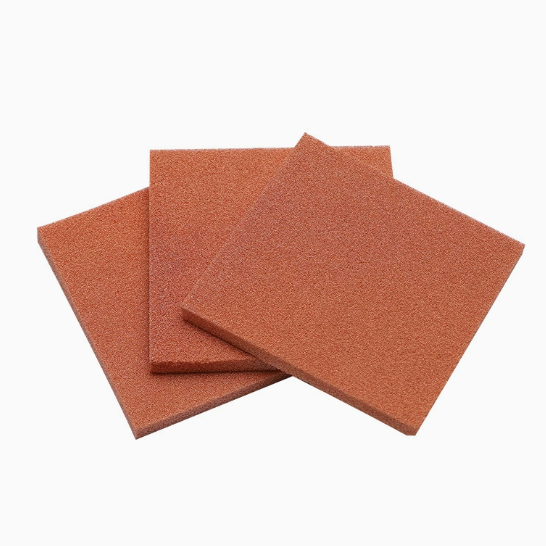
COPPER FOAM 0.1-10MM PORE ≥98% THROUGH POROSITY THERMAL EMIADVANCED POROUS METAL MATERIAL
|
|||||||||||||||||||||||||||||||||
|
|||||||||||||||||||||||||||||||||
|
TAILORED SOLUTIONS FOR RESEARCH
Contact our engineering team for technical support or official quotations.
EMAIL: inquiry@atomfair.com
|
|||||||||||||||||||||||||||||||||
|
Manufacturer: Atomfair LLC
Brand: ATOMFAIR®
|
How does the pore size range of 0.1-10mm in Atomfair copper foam affect its suitability for battery electrode versus EMI shielding applications?
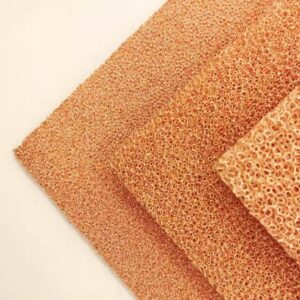
Pore size directly influences application performance. For battery electrodes, smaller pores (0.1-1mm) provide higher surface area for active material loading and ion transport, while larger pores (5-10mm) are better for EMI shielding due to lower electrical resistance and higher conductivity. The foam's porosity of 60-80% and through-hole rate ≥98% remain consistent across pore sizes, but mechanical strength varies from 2-5 MPa, with smaller pores offering higher strength.
What are the critical compatibility factors for using Atomfair copper foam as a catalyst carrier in high-temperature organic reactions?
As a catalyst carrier, copper foam's high specific surface area and temperature resistance ≥900°C make it suitable for organic reactions. The through-hole porosity ≥98% ensures uniform reactant flow, while the pore size (0.1-10mm) can be selected to match catalyst particle size. However, the copper surface may catalyze unwanted side reactions in certain chemistries, so compatibility testing is recommended. The foam's tensile strength of 5-18 KPa provides sufficient mechanical integrity for fixed-bed reactors.
What handling precautions are necessary to preserve the through-hole structure of Atomfair copper foam during installation in thermal management systems?
Atomfair copper foam has a through-hole rate ≥98% and compressive strength ≥250 KPa, indicating it can withstand moderate pressure but may be damaged by sharp bending or compression. During installation, avoid excessive force that could collapse the porous structure. The material is non-hazardous and environmentally friendly, but sharp edges from cutting may require protective gloves. For thermal applications, the heat transfer coefficient >6 W/(m²·K) is maintained only if the foam is not compressed beyond its elastic limit.
This copper foam product offers high through-hole porosity (≥98%) and temperature resistance (≥900°C), making it suitable for battery electrodes, heat dissipation, filtration, and catalysis. However, its low mechanical strength (2–5 MPa) and wide pore size range (0.1–10 mm) require careful application-specific selection and handling.
Positive
- High through-hole porosity: With a through-hole rate ≥98%, the foam ensures excellent fluid permeability and filtration efficiency, critical for electrode and catalyst applications.
- High temperature resistance: Rated for ≥900°C, the material maintains structural integrity in high-temperature environments such as catalytic reactors and thermal management systems.
Trade-offs
- Low mechanical strength: Tensile strength (5–18 KPa) and compressive strength (≥250 KPa) are low, requiring careful handling and limiting use in load-bearing or vibration-prone setups.
- Wide pore size distribution: Pore size ranges from 0.1 mm to 10 mm, which may necessitate specific size selection to ensure uniformity in filtration, fluid flow, or electrode performance.
Every advanced material, component, equipment, and instrument in our catalog is backed by rigorous testing. We maintain strict internal quality management frameworks and align with CE conformity metrics to deliver transparent, reproducible performance data via our public open-science repository.
To request raw batch performance data, submit formal vendor registration paperwork, or execute a fast-turnaround R&D manufacturing loop, contact us at inquiry@atomfair.com.
Item is dispatched under the Atomfair Shipping & Delivery Framework (Free worldwide shipping on orders over $59 USD excl. heavy equipment). Return is governed by the Atomfair Return & Refund Policy (7-day technical return window).